Category Archives: Consultation Response

Objection to redevelopment of Boroughmuir High School – excessive car parking

Living Streets Edinburgh has submitted an official objection to the redevelopment of Boroughmuir High School due to the planned excessive car parking (planning ref 16/04581/FUL).

The full plans can be viewed here – https://goo.gl/IJsiFB

boroughmuir-high-school-planWe object to the application on the grounds of excessive parking provision. The Transport Statement makes great play about how the proposed development supports the Council’s sustainable transport policies; however, we do not consider a development with 95 parking spaces to be consistent with the council’s transport and environmental objectives. The case made in the application comparing existing and projected traffic flows is spurious; obviously traffic generation will be totally different as it is no longer going to be a 1000+ pupil school. The application notes that it aims to achieve 68% of the permitted maximum; we propose on the contrary, that the development should be have the minimum permitted number of residents’ parking spaces (zero – i.e. a car-free development). Limited car parking for disabled people and visitors would be acceptable.

As the application notes, the site is extremely well-sited for travel by bus (eight frequent, regular services within three minutes’ walk), bicycle and on foot. The sustainability of the local Bruntsfield area will be enhanced by a car-free development which is actively aimed at people attracted to a car-free lifestyle. We strongly oppose the suggestion that there should be 16 new on-street parking spaces on Viewforth in addition, for the same reason. An option could be to site a car-club facility on or near the site.

The application incorrectly claims that the footways on Viewforth are at least 2m wide; in fact they are typically 1.8m on both sides (only wider at the Bruntsfield Place end and at one or two specific spots). The Council’s Street Design Guidance specifies the width for this kind of street as an “absolute minimum of 2m (only allowed in short sections), desirable minimum 2.5m or wider.” If the application were to be granted, the opportunity should therefore be taken to meet these standards in the vicinity of the development. Continuous pavements giving clear pedestrian priority (rather than dropped kerbs) should be provided on the Viewforth access points. The application also claims that there “no evidence of parked vehicles obstructing footway” (p8). This is patently not so and pavement parking is endemic at weekends and evenings owing to lack of TRO prohibitions. Again, if the application were to be granted, conditions should be attached to remedy this shortcoming.
Walking Campaigners Welcome Change To Roseburn Cycle Plan Design

A proposed change to the design of the planned Roseburn-Leith Walk segregated cycling route has been welcomed by the local walking campaign, Living Streets Edinburgh [1]. The City Council’s amended plan published on 21st June suggested two options to change the route design at Roseburn Terrace, both of which removed the controversial ‘floating bus stop’ on the north side of Roseburn Terrace. The Convenor of Living Streets Edinburgh, David Spaven, said:

“We’re pleased that the Council have taken note of our biggest concern about the Roseburn design – a floating bus stop at this busy location would have created unwelcome conflicts between pedestrians and cyclists at a busy location.”

However, the group are continuing to strongly oppose the Council’s plan to drive the cycle route along the centre of the busy east end of Princes Street pavement, arguing that “this would take space from pedestrians and would create unmanageable conflicts between cyclists and pedestrians, in which the most vulnerable street users would inevitably come off worst.”

Living Streets says it is “surprised and disappointed” that the Council has not specifically addressed 16 other detailed concerns [2] it raised in the consultation, including the narrow footway on Roseburn Terrace towards the junction with Roseburn Street, and the proposed elimination of the eastbound bus lane from Roseburn to Coates Gardens.

In its submission  the group indicates that it will continue to work with the Council on the details of this scheme, and to scrutinise the emerging design iterations to ensure that they (i) prioritise the needs of pedestrians, (ii) are in line with Council’s own Street Design Guidance, and (iii) comply with Equality Impacts Assessment requirements.

The full response can be found here

Response to Roseburn-Leith Walk cycle route project amendments 21/06/16

Response: Roseburn-Leith Walk Cycle Route Consultation

Living Streets Edinburgh (LSE) campaigns for improved conditions for everyday walking in Edinburgh’s streets and public spaces.  Walking is the most important transport mode in the city, since over half of all journeys by Edinburgh residents are made either entirely on foot (35%) or by bus (18%), the latter involving a walking stage.  It is also the most socially inclusive mode – it’s as natural as breathing – and is critical to the city’s economy (including the important tourist sector).

1. Key principles

1.1  LSE is strongly supportive of measures to improve sustainable transport generally and will support segregated cycle routes where these do not adversely affect the safety and/or convenience of walking, and particularly where they provide general improvements to the walking environment as well. This is the case for the large majority of this route.

1.2  We have big concerns about ‘floating bus stops’, as – irrespective of any ameliorative measures – there will inevitably be some deterioration in the convenience and safety of walking, as pedestrians have to cross the cycle path from the pavement in order to access the bus stop. Our view is that no floating bus stops should be created in Edinburgh until after the evaluation of a pilot (with multiple safeguards) within the next phase of the Leith Walk upgrade (see separate submission to Anna Harriman at City of Edinburgh Council). Options to avoid these conflicts should be explored.

1.3  Walking in the city centre and bus use are closely linked. The impact of reduced bus priority needs to be considered in relation to journey times and air pollution impacts on pedestrians. We urge the council to view the project in a multi-modal context, which balances the needs of cyclists with bus users (as well as people on foot) – especially on busy bus routes.

Read the full response to the Roseburn to Leith Cycle Route here

Briefing: The way forward for George Street

In October 2015 Living streets Edinburgh responded to the local Councils request for comments on the future plans for George Street.

The full response can be found here

The briefing sets out the views of Living Streets Scotland and Living Streets Edinburgh (the local campaign group) on the future of George Street and the scope to restore it to its rightful place as one of the capital’s and Scotland’s finest streets. It summarises 10 principles that we believe will allow Edinburgh to match and compete with other similar north European capital cities, with principal streets that offer a high quality experience to visitors and residents.

Achieving the vision

  • Recognize that George Street is an internationally important asset
  • Redress the chronic lack of high-quality urban space in Edinburgh
  • More people – not more parking – is the key to George Street’s future success
  • Create fully pedestrianised European style spaces
  • George Street is not a transport artery, so prioritise place over movement
  • Quality materials are not enough to deliver a quality street
  • Shared space must protect vulnerable users and restrain vehicle speeds
  • George Street must be at the heart of a lively, sociable walkable New Town
  • Proactively manage and regulate the new street from the outset
  • Edinburgh must not fail again


The opportunity must be taken to demonstrate Edinburgh’s streetscape can match its world-class architecture. 


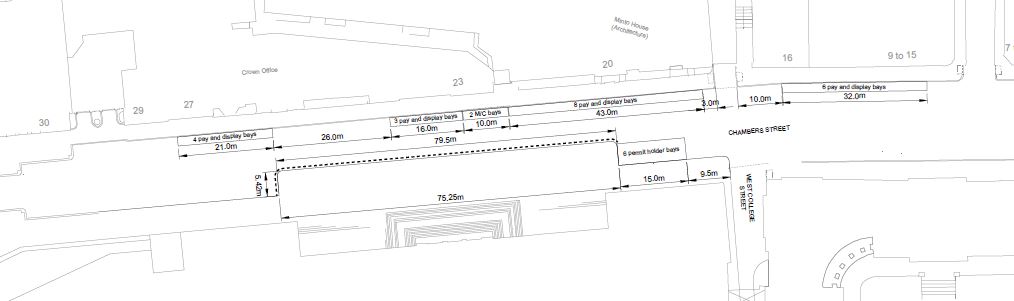
Response to Chambers Street TRO

Living Streets Edinburgh is pleased to support the initiatives to make better use of Chambers St.  We support the principles proposed in the TRO.

Chambers-Street-TRO

(The original Traffic Regulation Oder can be found here)

However, in the interests of taking placemaking seriously, we would like to see the proposal go further than simply creating a performance/gathering space in front of the NMS.  Any placemaking project  should surely consider the street as a whole, and not simply one short stretch.

Chambers-Street-Widen-Full-Length-2We would like to see the widened pavement stretching at least the full block from West College St to George IVth bridge, and preferably the full length of the street.

This would provide a more balanced effect, rather than creating an uneven patchwork. It would also respond to the congestion that regularly occurs on the pavement around the new, tower entrance to the NMS building.

This buildout would provide a much enhanced pedestrian experience both for those travelling along the street, and for those visiting the museum.  Similar consideration should also be given to the junction with South Bridge, which records very high footfall, but which is often an unpleasant experience for those on foot.

Chambers-street-Crossing-2Finally, to enable pedestrians safer access to the Cowgate, we propose a zebra crossing  across Chambers Street at West College St. This would link up NMS to the steps down to Guthrie Street, as well as making it easier for staff and students moving between George Square and University buildings on the far side of Chambers st.