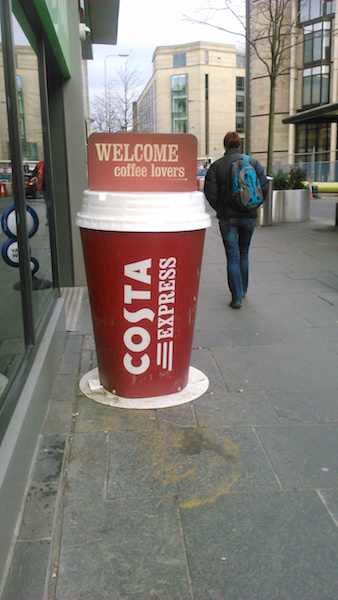
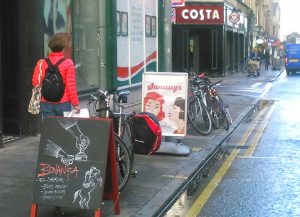
Tag Archives: A-Boards

LSEG deputation on A-boards, September 2026

Deputation to Transport and Environment Committee, 10 September 2026 by the Living Streets Edinburgh Group

Item 7.3: Petition for Consideration – Make Edinburgh Tables and Chairs Charges Fair and Introduce Licensed A Boards for Local Businesses

Living Streets Edinburgh Group is the local voluntary arm of the national charity, Living Streets, which campaigns for better conditions for everyday walking and wheeling.

‘Pavement clutter’ is a significant problem on Edinburgh streets, with trade waste bins, roadworks debris and overhanging hedges among the many problems that pedestrians face on a daily basis. As so often, it is blind, older and less mobile pedestrians who are worst affected by obstructions encountered on the pavement. We regularly highlight these problems, for example: https://www.livingstreetsedinburgh.org.uk/2020/12/11/cut-the-pavement-clutter/.

We therefore strongly oppose the request in the petition that advertising ‘A-boards’ should once again be permitted, under licence, on city streets.  We played a leading role in persuading the Council to introduce the ban on A-boards and other temporary advertising structures in 2019. We urge councillors to maintain the ban, which the Council has by and large enforced well, adopting a consistent and fair approach for all businesses.

We agree with the petitioners that outdoor seating can bring life to streets and we have no objection to ‘tables and chairs’ on the pavement in principle. However it is essential that  they leave adequate space for pedestrians and follow Council’s guidance on their layout. This means effective management and where required enforcement by Council officers. We have no comment as to whether or not the level of fees charged for permits is reasonable.

David Hunter

Convener

August 2026

WALKING CAMPAIGN CALLS FOR MORE ACTION ON STREET CLUTTER AFTER A-BOARD BAN SUCCESS

Following the success [1] of the City of Edinburgh Council’s ban on pavement advertising boards (A-boards), the local walking campaign has called for further action to clear the city’s pavements of clutter. Living Streets Edinburgh Group [2], which campaigned for years for the Council to tackle the A-board problem, says further measures are needed to build on the A-board action to create safe, obstruction-free pavements across the city. David Hunter of Living Streets Edinburgh commented:

“ ‘A-board’ clutter had become a significant problem on many Edinburgh streets, especially because so many pavements aren’t wide enough. The ban has made it easier, safer and more enjoyable to walk in many local streets across the city. But there are still far too many obstructions on pavements: waste bins need to be sensibly sited, roadworks signs managed properly and unnecessary signage poles removed. All pavements should have an absolute minimum ‘clear zone’ of 1.5 metres for pedestrians as laid down in the Council’s own Street Design Guidance [3]. And in residential areas, hedges are too often allowed to grow over pavements, obstructing safe passage by pedestrians.”


NOTES FOR EDITORS:

 1.      A report on the success of the A-board ban is to be discussed at the City Council’s Transport & Environment Committee on Thursday 5th December.

2.      Living Streets Edinburgh Group (LSEG) is the local voluntary branch of Living Streets, the national charity promoting ‘everyday walking’: http://www.livingstreetsedinburgh.org.uk/

3.      Edinburgh Street Design Guidance is at http://www.edinburgh.gov.uk/downloads/file/11626/p3_-_footways_-_version_11


Notes of Living Streets Edinburgh Group Annual Public Meeting

Notes of Living Streets Edinburgh Group Annual Public Meeting, Friends Meeting House, Edinburgh, 7.45pm, 11 October 2018

  1. Convenor’s welcome and report

David Spaven welcomed supporters to the meeting and summarised the Group’s activity over the past year. A number of achievements and welcome developments included:

  • The Council agreeing to a complete ban on ‘A-boards’ (from 5 November)
  • Progress on the ‘Festival Streets’ campaign, to make more car-free streets in the Festival, with the partial closure of Cockburn Street, and the prospect of wider closures in 2019
  • Encouraging signs that routine maintenance works will introduce significant walking improvements (Signals team design for the Lothian Road/Morrison St junction)
  • We’ve produced a ’10-point plan’ to influence the City Centre Transformation initiative
  • collaboration with Spokes on planning and transport schemes, including the importance of providing separate (not shared) walking and cycling space.

On the other hand, there had been some disappointments:

  • The Picardy Place/Leith Street debacle
  • Failure to widen pavements significantly in major works on South Bridge/Nicolson St
  • endless cycle consultations, almost always involving some shared cycle/walk space (although also usually with some walking improvements)
  • the review of walking and cycling safety on the current tram route ignored walking entirely
  • continued planning approvals of traffic-generating sites, over-provision of parking etc.

Looking to the year ahead, David highlighted some key LSEG priorities as to:

  • monitor the implementation of the A-board ban
  • press for more car-free Festival Streets
  • have a ‘Walking Champion’ appointed by the Council
  • press for more progress in implementing the Active Travel Action Plan
  • contribute to the City Centre Transformation Initiative.

David then introduced and welcomed Daisy Narayanan, who has been seconded from Sustrans to lead the City Centre Transformation Initiative.


  1. Daisy Narayanan presentation

Daisy spoke about the vision for the project, which brought together a range of complex projects and initiatives, all at different stages. The aim was to provide a coherent vision to guide the development of the city centre across all parties and professional disciplines. The initiative will also embrace development of the Low Emission Zone and the City Mobility Plan (transport strategy). The starting point was that with a growing city (at least 100,000 more people by 2040) the status quo is not an option in terms of how people, goods and services function and move about the city. Daisy emphasised the importance of walking (No.1 of 15 issues) and of equality and inclusion, so that no one was excluded from being able to enjoy and participate in the city’s life.

Daisy took a number of questions from the floor including on the challenges that she faced and on whether planning policy was sufficiently joined up with the emerging vision.


  1. Workshop sessions

The meeting then broke into three informal groups to look at three issues that were part of the City Centre Transformation challenge: Accessibility, Strategic Walking Routes and a Walkable City. Points noted included the need:

  • for better understanding of pedestrian movements, including data on where people walk
  • to focus scarce resources on street improvements (wider pavements, easier road crossings, decluttering, pedestrianisation, tree planting etc) on busy walking streets
  • to maintain and manage improved streets and public spaces.

David Spaven closed the meeting by thanking everyone for their participation and promised that a note of the meeting would be sent to everyone who had left their contact details.
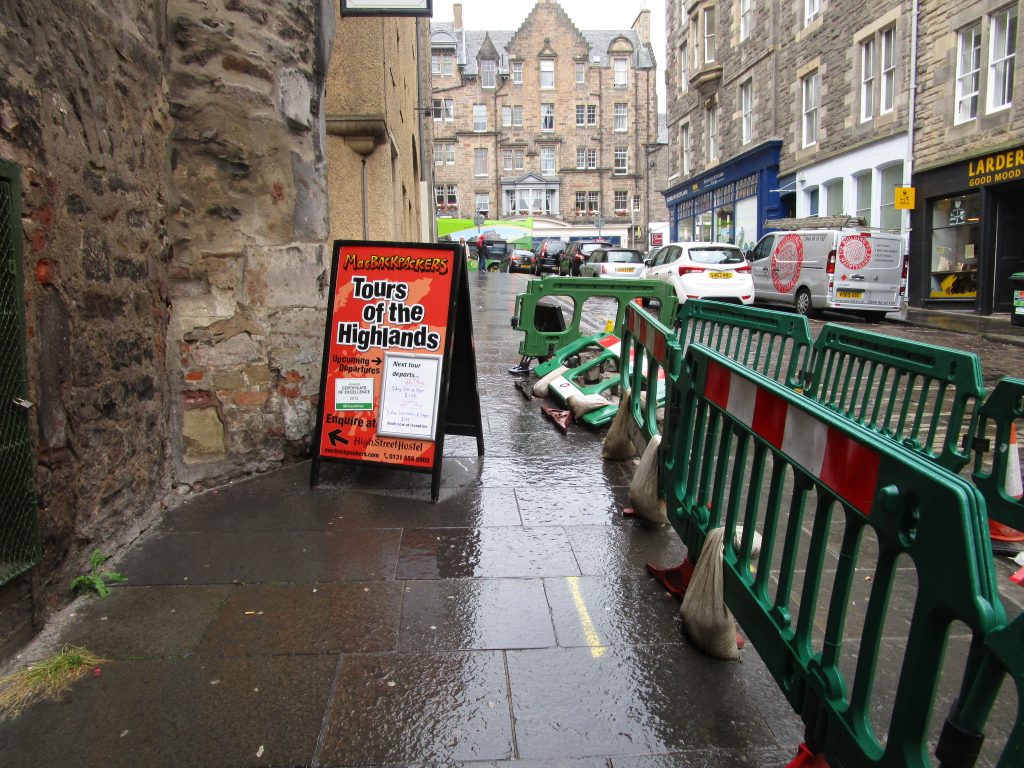
LSE delighted at proposal for fundamental review of Advertising Board Policy

Living Streets Edinburgh is delighted that the City Council’s Transport and Environment Committee is being recommended to back undertaking a strategic review of the growing problem of A-board clutter across the city. As the Committee paper – http://www.edinburgh.gov.uk/download/meetings/id/53632/item_76_-_a_boards  – acknowledges:

Concerns have been raised by organisations including community councils, Living Streets and the Council’s Access Panel that street clutter is impeding the ability for pedestrians to move through the city safely, and that the situation is worsening.’

Feedback from our supporters shows that A-boards:

  • are widely disliked by the public
  • narrow the walking space on pavements, often contravening the Council’s own Street Design Guidance
  • cause obstructions and sometimes hazards, for example for visually impaired people, which is potentially unlawful under the Equality Act 2010.

Since organising – in conjunction with Tollcross Community Council and the Edinburgh Access Panel members – a representative street audit at Tollcross in late 2015, we have been pressing the City Council to undertake just such a strategic review of policy – and its enforcement. http://www.livingstreetsedinburgh.org.uk/consultation-responses/street-audit-tollcross-edinburgh/street-audit-tollcross-edinburgh-summary-of-recommendations/

If Councillors back the recommendation, we will be fully consulted by officers. Other UK cities have undertaken such reviews, with the result that A-boards are licensed, better controlled or simply banned.  Edinburgh’s review should cover what should be allowed on which streets and how the rules are enforced. The issue has wider implications of course – on the quality of public space in the city, the vitality of its businesses and the potential for better Council management of our streets – the latter being one of the four proposals in our ‘Manifesto for Walking’ in the run-up to the Council Elections in May. at http://www.livingstreetsedinburgh.org.uk/2016/12/21/living-streets-edinburgh-manifesto-for-walking/ ‘

Local Group Calls For ‘Blitz’ On Edinburgh Street Clutter

An Edinburgh campaign group has called for City of Edinburgh Council to undertake a ‘blitz’ on advertising ‘A-boards’ and other street clutter. The call was made by Living Streets Edinburgh [1] which campaigns for pedestrians’  interests, at its annual public meeting last night [2].

“Many of Edinburgh’s pavements resemble an obstacle course” [3] said the Convenor of Living Streets Edinburgh, David Spaven. “It is often impossible for people to walk two abreast even in busy shopping streets such as South Bridge, Home Street and Raeburn Place. The number of A-boards appears to be increasing every year and they are getting bigger too; this is making our streets more and more unpleasant and difficult to use, at a time when we are supposed to be promoting walking for the economic, health and environmental benefits it brings. A-boards also represent a specific hazard for blind people.”

“We don’t want to see bare streets stripped of their local character, but there must be a fundamental review of Council policy in this area, together with a blitz of effective enforcement, as this type of street clutter is getting out of hand” he added.


NOTES FOR EDITORS: 

  1. Living Streets Edinburgh Group (LSEG) is the local voluntary branch of Living Streets, the national charity promoting everyday walking.
  2. The LSEG meeting at the Quaker Meeting House in Victoria Street was attended by 60 members and supporters of Living Streets.
  3. Selected photos of street clutter attached.

MORE INFO:

David Spaven on 0131-447-7764 or 07917-877399.

http://www.livingstreetsedinburgh.org.uk/

END OF RELEASE

Costa cup stockb3 viewforth2