Category Archives: Consultation Response

Response: Roseburn-Leith Walk Cycle Route Consultation

Living Streets Edinburgh (LSE) campaigns for improved conditions for everyday walking in Edinburgh’s streets and public spaces.  Walking is the most important transport mode in the city, since over half of all journeys by Edinburgh residents are made either entirely on foot (35%) or by bus (18%), the latter involving a walking stage.  It is also the most socially inclusive mode – it’s as natural as breathing – and is critical to the city’s economy (including the important tourist sector).

1. Key principles

1.1  LSE is strongly supportive of measures to improve sustainable transport generally and will support segregated cycle routes where these do not adversely affect the safety and/or convenience of walking, and particularly where they provide general improvements to the walking environment as well. This is the case for the large majority of this route.

1.2  We have big concerns about ‘floating bus stops’, as – irrespective of any ameliorative measures – there will inevitably be some deterioration in the convenience and safety of walking, as pedestrians have to cross the cycle path from the pavement in order to access the bus stop. Our view is that no floating bus stops should be created in Edinburgh until after the evaluation of a pilot (with multiple safeguards) within the next phase of the Leith Walk upgrade (see separate submission to Anna Harriman at City of Edinburgh Council). Options to avoid these conflicts should be explored.

1.3  Walking in the city centre and bus use are closely linked. The impact of reduced bus priority needs to be considered in relation to journey times and air pollution impacts on pedestrians. We urge the council to view the project in a multi-modal context, which balances the needs of cyclists with bus users (as well as people on foot) – especially on busy bus routes.

Read the full response to the Roseburn to Leith Cycle Route here
Briefing: The way forward for George Street

In October 2015 Living streets Edinburgh responded to the local Councils request for comments on the future plans for George Street.

The full response can be found here

The briefing sets out the views of Living Streets Scotland and Living Streets Edinburgh (the local campaign group) on the future of George Street and the scope to restore it to its rightful place as one of the capital’s and Scotland’s finest streets. It summarises 10 principles that we believe will allow Edinburgh to match and compete with other similar north European capital cities, with principal streets that offer a high quality experience to visitors and residents.

Achieving the vision

  • Recognize that George Street is an internationally important asset
  • Redress the chronic lack of high-quality urban space in Edinburgh
  • More people – not more parking – is the key to George Street’s future success
  • Create fully pedestrianised European style spaces
  • George Street is not a transport artery, so prioritise place over movement
  • Quality materials are not enough to deliver a quality street
  • Shared space must protect vulnerable users and restrain vehicle speeds
  • George Street must be at the heart of a lively, sociable walkable New Town
  • Proactively manage and regulate the new street from the outset
  • Edinburgh must not fail again


The opportunity must be taken to demonstrate Edinburgh’s streetscape can match its world-class architecture. 


Response to Chambers Street TRO

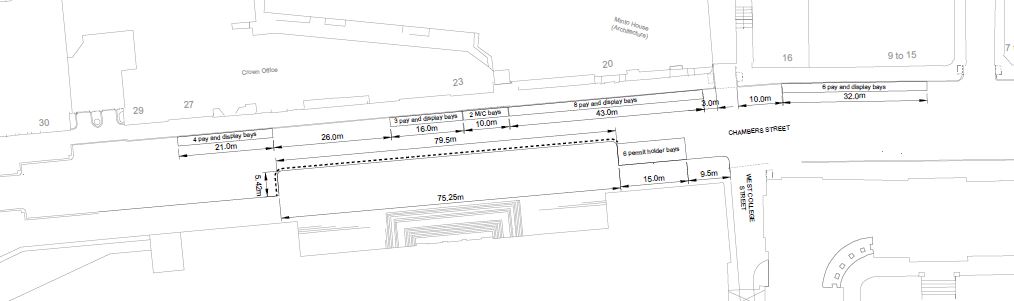
Living Streets Edinburgh is pleased to support the initiatives to make better use of Chambers St.  We support the principles proposed in the TRO.

Chambers-Street-TRO

(The original Traffic Regulation Oder can be found here)

However, in the interests of taking placemaking seriously, we would like to see the proposal go further than simply creating a performance/gathering space in front of the NMS.  Any placemaking project  should surely consider the street as a whole, and not simply one short stretch.

Chambers-Street-Widen-Full-Length-2We would like to see the widened pavement stretching at least the full block from West College St to George IVth bridge, and preferably the full length of the street.

This would provide a more balanced effect, rather than creating an uneven patchwork. It would also respond to the congestion that regularly occurs on the pavement around the new, tower entrance to the NMS building.

This buildout would provide a much enhanced pedestrian experience both for those travelling along the street, and for those visiting the museum.  Similar consideration should also be given to the junction with South Bridge, which records very high footfall, but which is often an unpleasant experience for those on foot.

Chambers-street-Crossing-2Finally, to enable pedestrians safer access to the Cowgate, we propose a zebra crossing  across Chambers Street at West College St. This would link up NMS to the steps down to Guthrie Street, as well as making it easier for staff and students moving between George Square and University buildings on the far side of Chambers st.

Living Streets Edinburgh response on Draft Parking Action Plan

The Living Streets Edinburgh response on Draft Parking Action Plan can be found here – Response on Draft Parking Action Plan

The main points include

  • Generally this plan is very welcome – an excellent initiative
  • Take space from on-street parking and give it to people on foot
  • Ensure that Council’s Equality Act duties are included in plan’s actions
  • Proposed actions on footway parking are insufficient
  • Don’t let more parking controls mean more street clutter
  • Increase the public acceptability of the plan
  • Evidence on use and demand should support the Action Plan

Edinburgh Tram Inquiry Call for Evidence – Response of Living Streets Scotland

The Living Streets Scotland official response to the Edinburgh tram enquiry can be found here – Edinburgh Tram Inquiry Call for Evidence – Response of Living Streets Scotland

The main points of the response:-

  •  Poor crossing facilities, using out-dated concepts such as barrier islands with inadequate space for volume of pedestrians (example York Place)
  • Unnecessary controlled crossings, not justified by the volume of traffic – which needlessly hinder pedestrian movement (example St Andrews Square)
  • Significant impacts on existing signalised crossings, causing extensive delays for pedestrians and dangerous crowding at junctions. This has led to risky crossing behaviour due to frustration (example Princes Street)
  • Conflicts with cyclists through poorly designed shared space (St. Andrews Square, / North St. Andrews Street)
  • Poor routes and integration between the tram route stops and major destinations and interchanges, creating indirect and diversionary routes to major facilities (Examples include: Gyle Shopping Centre / Edinburgh College / Bankhead Stop and Waverley railway station / St. Andrews Square)
  • Generally, worse conditions for walkers and cyclists in terms of safety, convenience and comfort (example Haymarket)