Category Archives: Consultation Response

Picardy Place Position Statement – November 2017 (Updated)

Introduction

Picardy Place is a crucial part of Edinburgh’s UNESCO World Heritage site. The area is already traffic dominated and will become worse if proposals for a three-lane gyratory go ahead. If the City of Edinburgh Council does not apply its own policies – prioritising walking and cycling – to its big projects, it clearly sends out the wrong signal on transport priorities.

Our position

A gyratory traffic system (major roundabout) is totally inappropriate in a modern city centre, due to the impact of multiple traffic lanes. This type of infrastructure is being ripped up in London to improve conditions for pedestrians and cyclists. Building one in Edinburgh would be a backward step for the city because:

    • The design is outdated and has not been subject to modern standards of consultation which focus on ‘place making’ in the public realm.
    • It does not comply with Scottish Government or the Council’s own policies, especially in terms of prioritising ‘movement over place’ and a sustainable transport hierarchy.
    • Footways are not wide enough – failing to meet the Council’s own Street design Guidance in places.
    • There will be a loss of important areas of public realm / cultural / green space.
    • There are potential conflict points between pedestrians and cyclists in a busy part of the city.
    • It fails to provide a proper bus interchange with the tram stop which is easy to walk to and encourages people to arrive by public transport and not by car.

What needs to happen?

    • The council need to take a place-based approach to this important area of the City, putting pedestrians at the heart of their transport policy. This means a T-Junction, not a roundabout.
    • This approach should make it easier for people to cross roads using direct routes and desire lines, without diversions and multiple staged crossings.
    • Pedestrians and cyclists need their own dedicated space to avoid frustration, conflict and safety concerns.
    • Footways need to be wide enough, especially beside the Cathedral, and important areas of public space and art should be retained.
    • Design in space and convenient crossings to a tram / bus interchange which is easily accessible for people with disabilities.

Conclusions

There is a significant opportunity here to create a great new public space, transport interchange and gateway to the city centre: by reviewing the current proposals and applying modern approaches to public consultation and place-based design. The Council must realise this opportunity by working with citizens and key stakeholders, including Living Streets Edinburgh, through a meaningful consultation process over the coming months.

Take action now


You can have your say by responding to the official Council consultation on https://consultationhub.edinburgh.gov.uk/sfc/picardy-place

Update 22 November

Amended plans announced by the Council on 17 November involve some modest improvements, including more public space in front of the cathedral, but adding circuitous multi-stage pedestrian crossings, plus a range of potential walking / cycling conflicts. And the massive, 1960s-style, gyratory road system remains in place – this is just not good enough when the Council’s own plans envisage the car’s share of city transport dropping from 42% in 2010 to 29% in 2020.
LSE Objection to multiple Lower Gilmore Place Planning Apps

Dear CEC

Regarding panning apps 17/04462/CON, 17/04235/PPP and 17/04234/FUL (Lower Gilmore Place)

We object to this development on the following grounds.

We are generally supportive of the development because it has a low level of parking provision. As Edinburgh continues to grow, we need to curtail and discourage more car travel from the city. Housing in dense brownfield sites like this this are the most sustainable kind of development, not only for the environment and transport purposes (beaches it is so easy to walk, cycle or go by bus) but also for the neighbourhood economy – local shops, community facilities etc get more customers  This would support council policies which aim to promote car-free or car-lite developments: http://www.livingstreetsedinburgh.org.uk/common-issues/policies-of-city-of-edinburgh-council-promoting-car-freecar-light-developments/

However, the public realm in the immediate area is very deficient for people walking, despite this being a key North/South walking route. We would therefore like to see significant improvement in the nearby public realm funded from the developer. These improvements are (in approximate order):

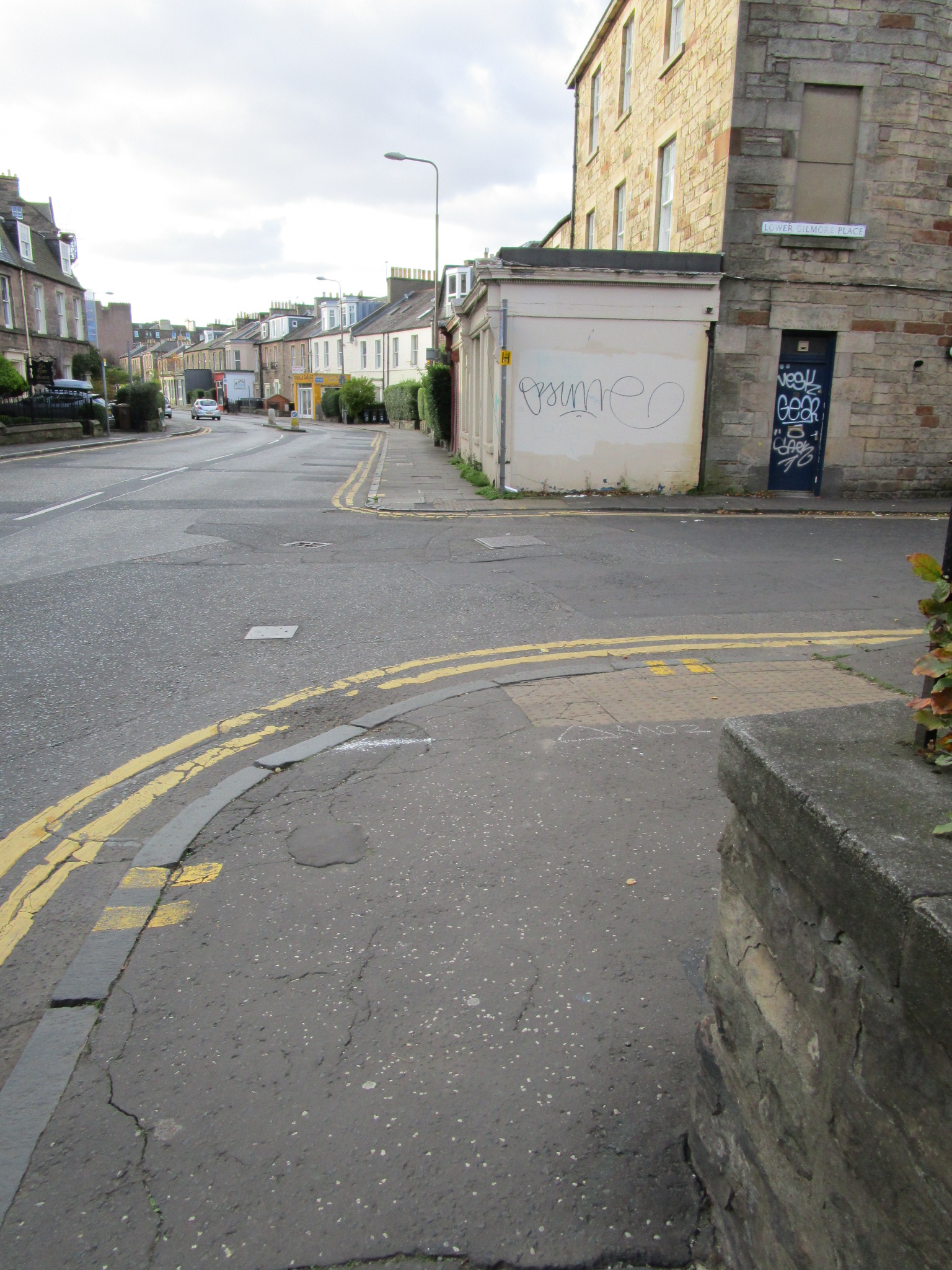
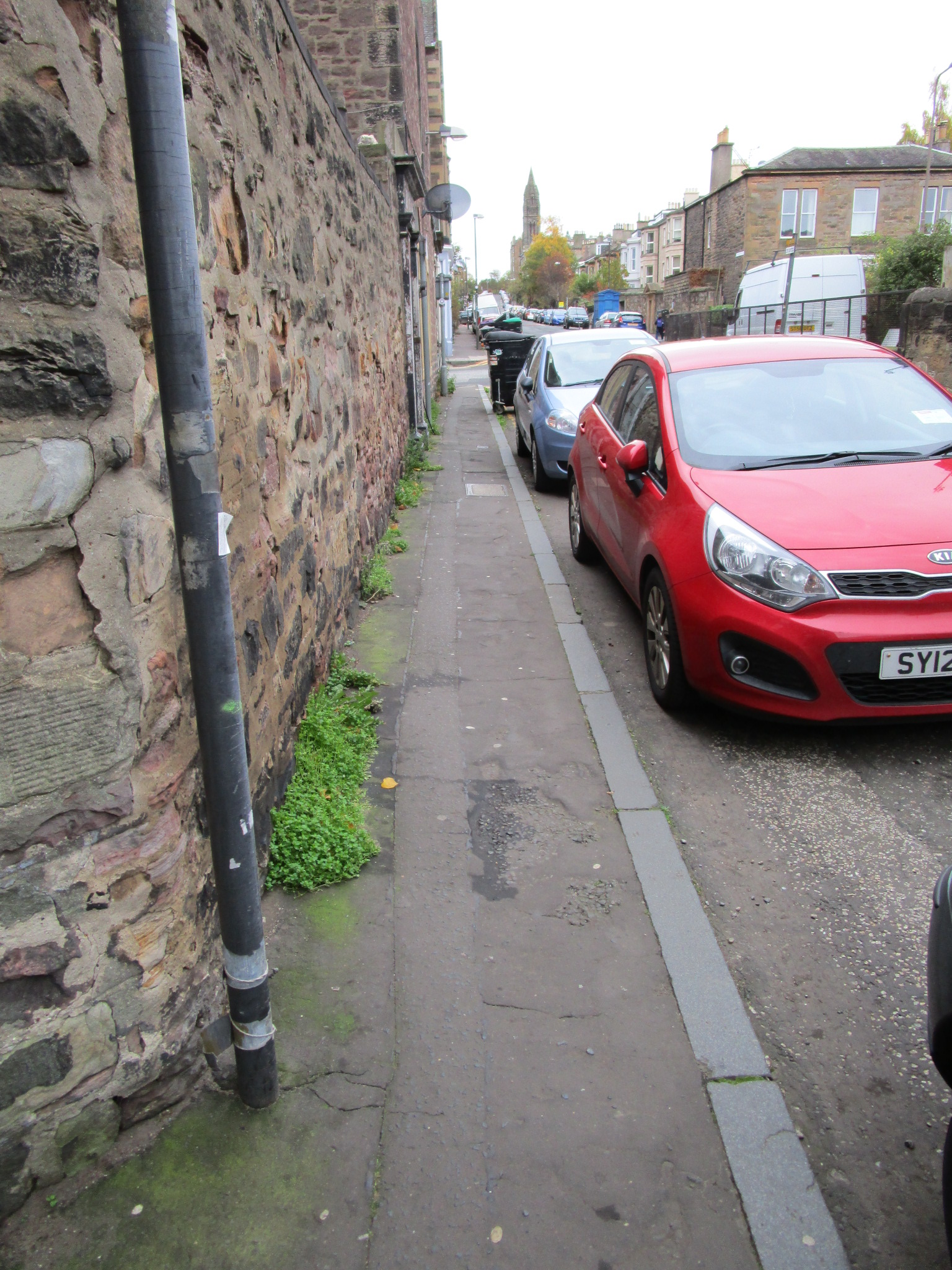
  • Widening the pavement on Leamington Road, and to de-clutter it (almost all signage should come off it). This very important walking route between the Haymarket and Bruntsfield area is absolutely atrocious; the pavement should be at least 2 metres wide (preferably 2.5 metres) to conform to the Council’s own Street Design Guidance  http://www.edinburgh.gov.uk/info/20089/roads_and_pavements/906/edinburgh_street_design . Unfortunately, it is hard to see how this can be achieved without removing the existing residents’ parking, which will clearly be unpopular with those that currently park there. Could alternative (off street) spaces be provided for them in the new development ?


  • Installing a ‘continuous pavement’ across Leamington Road at the junction with Gilmore Place. There is not even a ‘dropped kerb’ there at present and as a result Gilmore Place is a very difficult place for disabled people to move along. It would be criminal to miss this opportunity to address this (arguably even a breach of the Equality Act?)


  • Considering stopping up Leamington Road at the Gilmore Place junction, permitting access only by bicycle and on foot. (Vehicle access to be through the eastern end of Lower Gilmore Place)
  • Improving public realm on the north and east sides of Lower Gilmore Place. This might involve removing the canal-side wall to open up views and access to the canal towpath and decluttering the northern pavement of signage (which should have been done when the pavement was recently widened).


  • A continuous pavement should be installed across Lower Gilmore Place at the junction with Leamington Road, providing a flat surface for people walking along Leamington Road to and from the lift bridge.

yours sincerely

David Hunter

for Living Streets Edinburgh Group

Living Streets Edinburgh Group objects to Leith Street RSO

RSO/17/13 Leith Street, Calton Road, Greenside Row, Waterloo Place

Living Streets Edinburgh Group objects to RSO 17/13 on the following grounds:

1) All – pavement widths

Leith Street is designated as a Strategic High Street, according to the Street Design Guidance adopted by the Council in 2015 (i). This specifies that the pavement should be a minimum width of 3 metres (2.5 metres allowed only in short sections), with a desirable minimum width of 4m or wider. We cannot determine the exact pavement widths from the drawings, but it is clear that the pavement widths proposed in the order are far below the Council’s own specified standards on both sides of the street.

(i) http://www.edinburgh.gov.uk/downloads/download/550/edinburgh_street_design_guidance


2) Crossing point of Leith Street East at Greenside Row

The drawing seems to imply that the entire pavement both the north and south sides of the Greenside Row corner is re-determined as cycle way from both footway and carriageway (10, 12, 16, 13). This leaves no footway whatsoever exclusively for pedestrians crossing Greenside Row. The drawing suggest that pedestrians are expected to wait in a designated cycle way before crossing Greenside Row. This is a busy pavement at all times – and is already excessively busy at certain times of the year (eg during the August festivals). It is unacceptable that pedestrians at this location should mix with cyclists. Of course, it would also be also extremely unhelpful for cyclists to encounter pedestrians on the cycle track.


3) Junction of Leith Street East at Greenside Row

The corner radii of Greenside Row (at 10, 16) are excessively large, which will encourage vehicles to travel fast when entering and exiting Leith Street. This is an inappropriate design for a 20 mph street. The Street Design Guidance (see above) specifies that the maximum radius for a corner of this type of street is 3 metres, and although not shown, the radii proposed are clearly far in excess of this.


4) Cycle manoeuvres, Leith Street (west) to Greenside Row

We are unclear what manoeuvres cyclists are expected to make heading north from the west side of Leith Street (6) to join the cycle track on the east side (10). We are concerned at the risk of conflict between cyclists and pedestrians involved in this manoeuvre.

5) Junction of Leith Street (east) at Calton Road

It is our understanding that the junction of Leith Street and Calton Road will be governed by a signalised crossing, although this does not appear to be indicated on the drawings. We would support this, so long as adequate pedestrian priority is provided in signal timings to permit the heavy pedestrian traffic to proceed effectively north/south. However, we have concerns that the cycle track on Leith Street heading south ends abruptly at Calton Road (10). There could be conflict at this junction between pedestrians and cyclists wishing to continue south, for example to the Bridges,


6) ‘Floating Bus Stop’ Leith Street (East).

The drawing shows a ‘floating bus stop’ (17). Living Streets’ opposes the further introduction of this feature until an objective and thorough monitoring is completed on the first such floating stop, introduced on Leith Walk (ii). This is because we are concerned at the risk of conflict between pedestrians (especially elderly and or disabled bus passengers alighting from a bus) and cyclists, where the cycle way lies between the bus stop and the pavement. This would be especially the case if the cycle way is, as we think 2-way, so downhill (northbound) cyclists may be going quite fast. No such monitoring has yet taken place or been planned to our knowledge and so we therefore oppose the redeterminations introducing this feature.

(ii) http://www.livingstreetsedinburgh.org.uk/2016/02/08/living-streets-edinburgh-backs-floating-bus-stop-pilot-on-leith-walk/


David Hunter
for Living Streets Edinburgh Group

Thorn House
5 Rose Street
Edinburgh
EH2 2PR

17 October 2017

Response to consultation on Meadows to Castle Terrace cycle route proposal

You can read the full report here – LSE Response to Meadows to Castle Terrace cycle route

We welcome the measures included in this proposal to improve walking, although these are often fragmented and largely incidental to the continuous corridor-based approach to the cycling design – a particular example being the lack of continuous footways (avoiding changes of level for pedestrians) across side streets where they join the cycle corridor, despite this being a requirement of the Edinburgh Street Design Guidance (ESDG).

Worryingly, we have identified a number of other instances of the route design failing to comply with the ESDG. A fundamental principle of all such schemes is that designs should explicitly conform to the ESDG for the category/categories of street affected. Until the adoption of finalised Detailed Design Sheets for the ESDG, the latter’s Design Principles (as already adopted by the Council) should be adhered to, for example with regard to frequency of pedestrian crossing points, footway width, decluttering, crossfalls, improvements of currently sub-standard pedestrian crossing facilities and junction corner radii (amongst many other issues). These Principles are Council policy, and should also be adhered to in order to avoid the Council being subject to legal challenge under the Equality Act duty to make reasonable adjustments to assist protected groups.

We suggest that a workshop or seminar should be held in order to get the design right for both cyclists and pedestrians.

Key points of principle

Space:

  1. An increase (or no net loss) of pedestrian space.
  2. Footways meet recommended widths.
  3. Conflicts with cyclists are avoided, with dedicated and well-defined space provided for pedestrians (including separated ‘tiger’ crossings).

Crossings:

  1. Junctions make foot crossing easier by being raised, with radii of corners and widths minimised
  2. In busier areas, controlled crossings are provided in convenient places, with acceptable waiting and crossing times.
  3. Pedestrian priority is made clear at all the key crossing points of the cycle routes, eg with continuous footways across side streets at junctions.

Equalities:

  1. The design incorporates features to assist people with disabilities, including dropped kerbs (where continuous footways are not feasible), seating and tactile paving.

Public realm:

  1. The footway is made free from clutter.
  2. Guardrails are avoided / removed.

Impact of traffic:

  1. If the area is a residential or shopping street or busy pedestrian route the speed is 20mph and the design helps to achieve this speed.
  2. The level of parking and access to motor vehicles is appropriate and does not dominate the space.

You can read the full report here – LSE Response to Meadows to Castle Terrace cycle route

overall-plan

LSE press statement on east – west cycle route through Roseburn

This is a lot more than a cycle route – it brings plenty of benefits for pedestrians too, in terms of safer junctions, wider pavements and more road crossings.

At an early stage of the consultation we were concerned with aspects of the design which would have caused conflict between cyclists and pedestrians, but we’ve been impressed by the way the Council took on board our constructive suggestions.

A key point is that the pavements will now be widened on both the north and south sides of the busy stretch of Roseburn Terrace, and they will both meet the minimum width standards stipulated in the Council’s own Street Design Guidance.

That will help to make Roseburn Terrace a more people-friendly place, less dominated by road vehicles.

roseburn-plan-a