Walking campaigners Living Streets Edinburgh have called for the Council to put pedestrians first in new active travel schemes – as council policy states. The call comes as the group criticises plans for Dundee Street which would see large sections of busy pavement narrowed to accommodate new cycleways. The group has learnt that pavements would be reduced in at least 12 locations, in some places by as much as 2.4 metres. One pavement (at the Edinburgh Printmakers) would be left little more than a metre wide.
David Hunter, the group’s Convener, said: ”Despite a £10 million price tag, the plans for Dundee Street would not only leave many pavements below the minimum width recognised in both local and national guidance, they would actually reduce pavement space.
“New cycle lanes shouldn’t come from walking space. We’ve already seen how pedestrian space was squeezed out in Leith Walk, and Dundee Street would make the same mistake. We really need to see the Council stick to its own policy – that means putting pedestrians’ needs first, above other road users.”
Living Streets also criticises the lack of pedestrian improvements at Boroughmuir, Tollcross and Craiglockhart schools, and the introduction of nine ‘floating’ bus stops, which means that passengers have to cross a cycle way to get on or off a bus.
Living Streets Edinburgh Group supports the provision of alternative routes for cyclists to the Union Canal towpath, but suggests this should be achieved using traffic-free and quiet streets in Shandon and North Merchiston rather than on Dundee Street. Their full response is here: https://bit.ly/3LbYDPi
***
Note to Editors: this is the link to the council’s public consultation on the scheme, which closes on 12 January 2026 bit.ly/4nOpDCN
We support the overall objectives to provide an attractive east-west route for cyclists as an alternative to the increasingly-congested Union Canal towpath, to enhance cycling, walking and wheeling on the corridor and to make the street more accessible for everyone. There are a number of proposed improvements for pedestrians especially in the form of new opportunities to cross the road and better side road treatments.
However, the plans as a whole not only fail to prioritise pedestrian movement but in several places, space for walking and wheeling is actually significantly reduced. There are large sections of pavement which are left well below the “absolute minimum” width specified by the Council’s own guidance for the street (and indeed for any street, let alone one as busy as this). There is negligible improvement in the pedestrian space at the schools which should have been a primary consideration. Every bus stop has a cycle bypass (‘floating’ bus stop), most of which also do not conform to the council’s own minimum standards and will cause significant concern to many pedestrians, especially those who are blind or disabled.
As a result, we do not support the proposals.
Dundee Street/Fountainbridge
Pavements (footways)
With ‘walking and wheeling’ recognised by the Council and nationally as at the ‘top of the sustainable travel hierarchy’, the most basic need is adequate pavement space. Unfortunately, this isn’t provided in the proposals, a fundamental weakness of the proposals. As we saw in Leith Walk, walking space is increased only where space is left over after other considerations; where space is most contested it is walking which suffers.
There is no general widening of the footway along the main road (Dundee Street/Fountainbridge), including at some of the narrowest sections. According to the ESDG, the pavements on Dundee Street/Fountainbridge should be at least 2.5 m wide (Factsheet P3). Several sections (southern pavement at the Diggers junction, northern pavement west of the Telfer Subway, southern section at the Edinburgh Printmakers) are below the council’s “absolute minimum” permitted width of 2 metres for any street.
The extent of substandard footway widths may be greater than appears. For example the plans show the southern pavement at the western end of Dundee Street (“Diggers”) as 2.1 metres wide, rather than 1.7 metres in reality.
We have been notified of at least 12 sections of footway which are actually being reduced in width – by as much as 2.4 metres (see appendix 1).
There are positive aspects in the plan with regard to pavements too. ‘Continuous footways’ across almost all side streets give pedestrians enhanced priority and should slow down traffic. It is essential that they have appropriate tactile paving to alert visually impaired people that they are entering a space where they are likely to encounter a turning vehicle. Some side road junctions are also being narrowed which again is important to slow down traffic. Especially hostile junctions are the entrances to the Fountainpark Centre and the Western Approach Road (where we would like to see traffic calming measures through a raised carriageway).
Once the Fountainbridge developments are complete, we understand that there will be significant amounts of new pedestrian space on the south side of the street, which will be welcome. If and when this materialises, it will provide an opportunity to reconsider the balance of pavement widths between the north and south sides of the street.
We want to see a pedestrian (and ideally cycle) link from Yeaman Place to the canal. The Walker Bridge is the only bridge over the Union Canal in Edinburgh which doesn’t give access to the towpath. There is no access to the canal between Harrison Park East and Gibson Terrace, a distance of over 650 metres. This gap effectively denies the general Polwarth community access to the canal. It also reduces the sense of safety for people (especially women) using the towpath on foot, running or cycling. Our understanding is that plans for the former Dalton scrapyard on Yeaman Place could deliver this vital link.
Schools
Providing adequate pedestrian space at schools on a busy road should be a primary objective of the scheme. Sections of the street have very high footfall from children at Boroughmuir High and Tollcross Primary schools. Edinburgh Street Design Guidance Factsheet p3 states “A 3m minimum footway width is to be provided outside schools and other buildings likely to generate concentrated pedestrian flows.” (page 3)
The section of pavement immediately west of BHS is being widened by only 30 centimetres to 2 metres, despite being used by hundreds of children every day to access Sainsbury’s and other shops. This modest widening (introduced in response to our comments on an earlier draft) is achieved by reducing the width of the northern footway.
There appears to be no change to the footway dimensions at Tollcross Primary School on either side of Fountainbridge. The pavement at the school gate is currently just under 2.5 metres wide and has guardrails which narrow it further.
Immediately at the entrance to both schools, a cycle bypass/floating bus stop is proposed. This is despite the council’s own guidance cautioning that “the provision and design of floating bus stops in close proximity to schools, hospitals, sheltered housing etc. should be given careful consideration.” (Factsheet C4, page 18).
Pedestrian /cycle crossings
A number of new and amended crossings are introduced. These are mostly very welcome. Of note is the installation of pedestrian phases across the Henderson Terrace/WAR ‘Diggers’ junction. This will rectify one of the most notoriously hostile junctions for pedestrians in the whole city. Also welcome are the signals at the Yeaman Place and Grove Street junctions and the zebra crossing over Drysdale Road, although this should be more directly on the walking desire line.
The junction at Gardners Crescent would be converted to a ‘CyclOps‘ style (Cycle-Optimised) junction which we think would be the first such junction in Edinburgh; as such it needs the most careful thought. As we understand it, pedestrians will have to cross a cycle lane before being able to cross the road but cyclists will not have to stop at a red light for many manoeuvres, being instead expected to give way to pedestrians at zebra-style markings. This has the potential to result in conflict because pedestrians who see the green man invitation to cross may encounter cyclists who do not stop. This will be especially difficult for older, disabled and blind people. We understand that in the Netherlands, such junctions have pedestrian crossings towards the outside of the cycle roundabout, with clear yielding markings and speed calming measures for cyclists.
Cyclists are expected to navigate the junction in a clockwise direction, but cyclists heading north from the canal basin will mostly instead want to cross the cobble-free eastern arm of the junction (anti-clockwise) to access the popular shared-use path at Lochrin Square. Again, this will cause conflict with pedestrians (and likely, other cyclists).
Although there is logic in the positioning of the crossings, the design introduces big new gaps in crossing opportunities across Dundee Street. There are three signalised pedestrian crossings clustered in the space of 130 metres – Yeaman Place, Telfer Subway and Gibson Terrace – while the next crossing to the west is 300 metres away at Henderson Terrace.
Removing the crossing at the centre of Fountainpark/KwikFit also creates a long gap from Gibson Terrace to the Viewforth junction. The plans remove the heavily-used pedestrian island refuge which is directly on the natural walking desire line from Boroughmuir High School to the Fountainpark centre. We do not envisage that pedestrians will take a detour from the school area to use the controlled crossing at the Viewforth junction and consider that these changes will increase danger crossing Dundee Street, especially for children.
Bus stops
Every one of the nine bus stops will have a cycle bypass (‘floating bus stop’) so that the cycle lane passes between the pavement and the bus stop. Most of these bus stops do not meet the minimum standards set out in the Council’s Street Design Guidance, which stipulates a minimum footway of at least 2.5 metres wide, in addition to the bus stop ‘island’ (Factsheet C4). The bus stop on the north of Dundee Street over the West Approach Road has no footway at all; all pedestrians therefore have to cross the cycle way twice (or simply walk in it) to move along the footway. Having to cross a cycle lane on a pavement and especially at a bus stop is recognised in all guidance (local and national) as a concern for disabled and especially blind people.
Ashley Drive to Fowler Terrace
We agree with the intention to provide quiet routes for cyclists through low traffic streets to offer attractive alternatives by bike to the congested towpath. We think it likely that most city-bound cyclists would wish to turn off the canal at Harrison Park rather than Ashley Drive and many would prefer to use the traffic-free path through the centre of Harrison Park or Harrison Road, rather than cycle down Ogilvie Terrace to Harrison Gardens and then uphill again to West Bryson Street.
If Ogilvie Terrace is to feature as a key cycle route, a principal aim should be to connect to the under-used former railway path accessed through Harrison Place, which joins Dundee Terrace. It seems strange that the designs ignore the potential to promote and enhance this traffic-free cycling and walking route (eg with improved lighting, surface and signing).
The route from Harrison Park East to Watson Crescent could be another quiet route.
There are three zebra crossing proposed in this section, which in general terms is of course welcome for pedestrians. However, they are not located where they are most needed. The priority should be installing a zebra crossing on Ashley Terrace at the primary school, as the local community has long campaigned for. Some of the short sections of segregated cycleway appear to be of little use to cyclists and build in potential conflict with pedestrians where they criss-cross the footway areas, to everyone’s disadvantage.
There is no attempt to ensure that pavements in the Shandon/North Merchiston areas generally meet 2 metre minimum width required by Council standards.
Conclusions
Until recently, there has been a general presumption that street space for segregated cycling facilities should come from motor vehicle space, not walking space. This presumption has been effectively abandoned here. As we saw in Leith Walk (and in draft proposals like Hawthornvale-Salamander Street, Meadows to George Street, etc) trying to accommodate too many competing claims for travel modes into insufficient space results in sacrificing minimum standards for walking space.
The Council should investigate the possibility of accommodating cycle lanes in Dundee Street/Fountainbridge while retaining acceptable walking space, by reducing carriageway space radically. However it is not clear whether that this is realistic given the requirement for essential motor traffic including buses, even if general traffic was significantly reduced.
The proposed cycle lane should at least be deferred until the Fountainbridge development is completed. This should clarify whether there is sufficient public realm which can better accommodate the competing claims for adequate footway, carriageway and cycle way. In the meantime, some of the less controversial aspects of the scheme (such as improved crossings) could be introduced, with a much reduced budget.
Another approach to providing cyclists with alternatives to the Union Canal towpath would be to invest more in ‘quiet route’ networks, where cyclists are routed through low traffic streets, with filters if needed. This would avoid the major loss of pedestrian space on Dundee Street and may be more useful for cyclists. It would also be far cheaper.
Either way, if the Council is really committed to a travel hierarchy which places walking and wheeling at the top, it cannot continue to design schemes which do not meet even minimum standards for pedestrians, at schools and for older and disabled people. We ask the Council to reconsider its whole approach to bidding for major active travel funding until it develops a better understanding of how to integrate walking, cycling, public transport and general traffic in a way which respects the sustainable travel hierarchy.
December 2025
***
Appendix 1: proposed reductions in pavement widths
Dundee Street/Fountainbridge
Reduction in footway width (metres)
North side, bridge over WAR
-0.3
South side between Dundee Terr/Yeaman Place
-1.2 to-1.5
North side, between Telfer Subway and Fountainpark entrance
-1.3
North side, between Fountainpark entrance and Gibson Terrace
-1.8
North side, between Gibson Terrace and Fountainpark centre
-2.1
North side, between Fountainpark centre and Fountainpark exit
-0.3
North side, between Viewforth and Drysdale Road
-1.00
North side, between Drysdale Road and Gilmore Park
-1.5
North side, between Gilmore Park and hotel loading bay
-2.4
North side, between Grove St and Freer Gait
-1.4
South side, between Freer Gait and Gardner’s Crescent
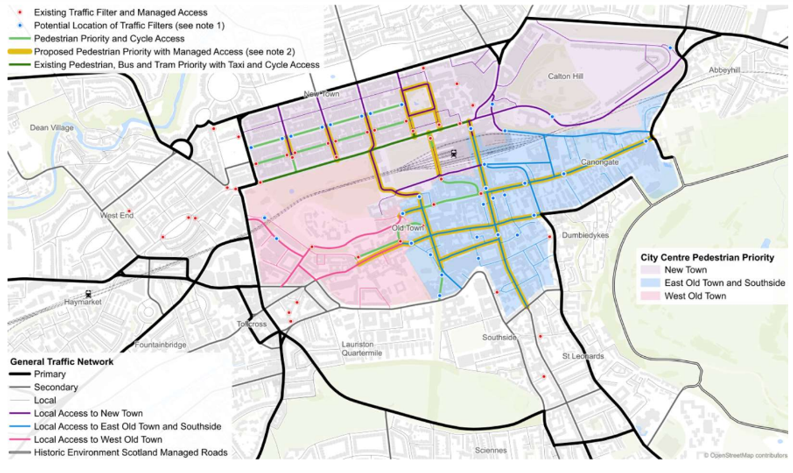
Thank you for attending our webinar with Daisy Narayanan, head of placemaking and mobility at Edinburgh Council, and Cllr Scott Arthur, convener of the Transport and Environment Committee, who discussed changes to central Edinburgh i.e. the North / South Bridges, Canongate, Cowgate, the Mound and more.
Edinburgh is very congested and that’s something we have to tackle to hit net zero, as well as accommodate growth: land has been set aside for around 37,000 new houses in and around the city over the next few years.
How and when these changes are happening are yet to be outlined in detail. But expecting some / most of it within a year.
Traffic modelling shows an expected 10% traffic evaporation once these new proposals go through – the Council has a 30% reduction target in car kilometres by 2030.
The proposals to restrict traffic on the bridges etc partly depend on letting traffic flow (partially) through Holyrood Park – Historic Environment Scotland (HES) owns Holyrood Park and is currently consulting on the park’s future – the Council and HES will have to work together.
Scott Arthur said he does not foresee any changes to Lothian Bus routes through the city centre, but of course Lothian Buses makes up its own routes, not the Council.
This is not a car ‘ban’. Residents and businesses will retain access to areas like Cowgate [editor: unanswered questions if any of proposed areas will actually be pedestrianised].
The new proposals mean re-examining plans to make Lothian Road a ‘boulevard’.There is an opportunity to widen pavements on the bridges as well as restrict through-traffic.
The Council is considering restricting vehicle access to Calton Road from Leith Street i.e. where the back of Waverley Station is.
Any changes to Picardy Place will be incremental e.g. possibly again allowing vehicles to turn onto London Road.
The fundamental challenge is the volume of traffic in the city. However, the plans aim to make it easier for people who really need to drive. The tram network is planned to double and bus journey times are planned to decrease by 25% within a decade.
The Council and Network Rail are talking about opening certain sections of the South Suburban Railway i.e. Slateford to Portobello, but not the entire loop. Timescale? 2035. Ultimate permission will come from Network Rail.Please email us if you’d like to be sent the slide deck / Zoom chat.
We broadly support the new draft Public Transport Action Plan and the central aim to increase modal share of public transport. Good environments for walking (and wheeling) are absolutely fundamental to successful public transport systems because (as acknowledged in this draft Plan) virtually every public transport journey (certainly for bus) begins (and ends) with a pedestrian phase.
However, as with other City Mobility plans (such as for Active Travel, Parking and Road Safety), we think that many of the proposed actions are too slow, too vague – and possibly too numerous. The proposals – and especially the envisaged timescales – cannot possibly deliver the scale of change needed to achieve the 2030 target of a reduction of car travel by 30%.
Delivery of essentially sound plans has been problematic for the Council for at least a decade and we suggest that the 40 “actions” should be reduced to the most important ones so that budgets, staff time and energy are directed to the most effective measures. Accordingly, we suggest that several ‘actions’ could be omitted: around ‘Behaviour change’ (PC1), MaaS (PT12), ‘Data Driven Innovation’ (PT13) and City Centre Transformation (PV 1 and 2) for example. We would favour a tighter focus on tangible service improvements to bus priority and public realm infrastructure including bus stops.
Safety and Accessibility
We welcome the intent to improve access to bus and tram stops (PT1), but the action should be more ambitious, in line with the EASI (Edinburgh Accessible Streets Initiative) outlined in the draft ATAP. The focus on improved lighting is welcome, but other aspects of the quality and accessibility of pedestrian routes to stops need to be included too. Previous versions of the ATAP included targets (not delivered) to improve at least 20 routes a year to public transport stops and we would like to see a similar target maintained.
Bus Services
We strongly support the proposed measures to give buses more priority, particularly through PG3, PG4 and PG6. We want to see early implementation of the 7-7-7 model of enhanced bus lanes (bus lanes operating seven days a week, from 7.00am to 7.00pm). It should be noted that bus lanes also give significant improved protection to cyclists from other traffic. We would like to see the Plan say more about enforcement of bus lanes (and protection of bus stops from parking). We welcome the PG4 intent to give buses priority at signals and suggest that this should also consider enhanced pedestrian priority ‘ABC’ measures outlined in the ATAP.
We welcome the various references to the Bus Service Improvement Partnership and the Council’s intention to access the Scottish Government’s £500 million fund to promote bus use. However, we would like to see a clear explanation of what the Council’s plan is for this fund (or a date when it will be produced).
On the other hand, we do NOT support the notion of seeking to stop buses crossing the city (“to not through”, referred to on page 32); and we suggest that the action referring to ‘bus stop realignment’ (PG5) should be deleted. Bus stops which are unnecessarily close together can be removed but a wholesale programme to review the spacing of bus stops is unwarranted and would be a waste of valuable staff resource.
Bus stops
The plan does not give enough priority to the need to improve bus stops. PT7 focuses solely on ‘continuing bus shelter replacement’ which is inadequate. We need to improve the standard of bus shelters and seats. Crucially, build-outs (sometimes termed ‘boarders’) are needed at many bus stops. These ensure that passengers can have level boarding onto the bus, act as a strong deterrent to stopping/parking at bus stops and provide more space on the pavement for pedestrians to pass. The lack of such a programme is a serious omission in the plan at present.
The Plan (like the ATAP) is silent on the conflict with pedestrians which can be introduced at bus stops by cycle infrastructure. ‘Floating bus stops’ undermine the confidence of some bus users, especially blind people, to the extent that some people will avoid using them altogether. Their value in terms of providing priority and safety to cyclists needs to be balanced against the risk to pedestrians/bus users. We consider that the best way to manage these conflicts is to use floating bus stops sparingly: only where the case for cyclist safety is especially compelling. This may mean, for example that they should not be used in low-speed or low traffic streets (certainly, for example, where bus gates significantly reduce general traffic).
Trams
Living Streets Edinburgh has been a strong supporter of the tram for many years. However, with the welcome completion of the Newhaven extension, it would be prudent to pause and consider whether future major developments should take the form of tram or ‘Bus Rapid Transport’ (BRT). The cost, disruption and amount of public space taken up by the trams (which are poorly integrated with bus stops) are significant downsides. We note an inconsistency in the draft Plan which should be clarified: in the text, the section on Mass Rapid Transit (PR6) refers to a “mass rapid transit solution” which could be tram or BRT. However in Appendix A, PR6 refers only to tram.
Smokey Brae is currently at total odds with the transport hierarchy. It feels like a hostile environment for anyone not moving in a car. The current layout puts pedestrians in as an afterthought and is particularly unsuitable for anyone pushing a pram or using a wheelchair. The pavement is too narrow, and traffic moves incredibly quickly and close to those using it. The pavement creates a pinch point that when two adults walk through in opposite directions on foot, they struggle to pass. If a pram or wheelchair is involved, one party must give way. Currently, walkers and wheelers who choose to avoid this junction due to its inadequacies must make a 15-minute detour.
LSEG greatly welcomes the proposals to redesign Smokey Brae and create a space that respects the transport hierarchy more.
We strongly support the introduction of continuous pavement with raised table junctions. We would like you to implement these using pavement materials rather than road material as this will emphasise pedestrian priority.
The designs appear to reduce the overall footway space available for pedestrians by removing the pavement on the eastern side of the road. However, this seems to be a reasonable compromise as there is currently no safe crossing near the railway underpass, and the existing footway is too narrow.
If it’s possible to make the proposed new pavement even wider, LSEG will welcome this. However, we appreciate this may not be easy to do given the overall width available and the welcome introduction of safe infrastructure for cyclists. Perhaps you could achieve this by closing the road from the T-junction to the Meadowbank House entrance to both northbound and southbound traffic, except for emergency vehicles only. This change would allow the fire service quick access to the south and create ample room for walkers, wheelers and cyclists alike.
LSEG members have noted that the Jock’s Lodge crossroads have abysmal pedestrian crossing times. Those who need to cross the road must wait for 2-minutes between signals and only have 7 seconds to cross. People who want to go down Smokey Brae will need to use these crossings. Pedestrians coming from Portobello Road will now have to as the pavement has switched sides. Therefore we think it should be a requirement to adjust the timings of these crossings to give more priority to pedestrians; 7 seconds isn’t enough!
Lastly, we’ve mentioned in our other answers to the survey that we would like the introduction of seating and wildflowers. Due care should be given to the seating positioning so as not to obstruct the natural movement of people through the area.