Active Travel Campaigners Welcome Council Move On New Picardy Place Junction

Cycling and walking campaign groups have welcomed the decision of the City of Edinburgh Council (CEC) to look at new options to boost active travel in the re-design of the controversial Picardy Place / Leith Street junction associated with the St James Quarter development. Following a presentation [1] by a deputation from Living Streets Edinburgh [2] and Spokes [3], CEC’s new Transport and Environment Committee today backed a motion from Green Party Councillor, Chas Booth [4], which argued that:

‘ the redesign of a significant city centre junction and surrounding streets presents an opportunity for traffic reduction, development of active travel infrastructure, and improvement of the public realm’

The Committee agreed to receive a report within one Committee cycle, setting out options for achieving these objectives in Picardy Place and surrounding streets, and reporting on the decision-making processes to date on the Picardy Place junction, the proposed future decision making, and what the democratic oversight of the process has been to date.

David Spaven, Convenor of Living Streets Edinburgh commented:

‘We’re delighted that the T & E Committee has decided to look at the options for better provision for cycling and walking at this important new junction. At present, conditions for active travel are highly sub-standard in the area – but we hope that all interested parties and the public at large can now work towards a final design which is both a symbolic and very practical demonstration of the importance of first, walking and cycling, and second, ‘place’ rather than ‘movement’, in a highly-visible and much-used area of the city centre.

‘The Census and other surveys show that the Council is making progress on its targets to reduce car use and to boost cycling, walking and public transport.  It would be tragic if this success was jeopardised by a traffic-dominated design at this major city centre location.’

Martin McDonnell of Spokes commented:

‘There are a number of aspects of the currently proposed road design which give us cause for concern. We believe there is still too much emphasis on providing space for vehicles. While the provision of a dedicated cycle path and wider pavements is welcome, the cycle path and some pavements will narrower than they should be for these busy streets. It is also most unwise to incorporate shared cyclist / pedestrian space, particularly as many cyclists will be on ‘A to B’ journeys rather than mingling. This is a recipe for conflict, with the most vulnerable users (including pedestrians who are frail or have a disability) likely to come off worst.

‘Important green space and public realm (including mature trees) would be lost in front of the cathedral and on Picardy Place itself, in order to accommodate three lanes of traffic and the large island in the centre of the gyratory roundabout.

‘In light of concerns about the large gyratory intersection, which would be dangerous for cycling, and the loss of public space, we feel there is a great opportunity to explore removing the entire island at the centre of the proposed roundabout and the associated gyratory system from the design, thus creating improved conditions for cycling, and allowing the public realm and footway width to be increased on all three sides of the junction.


NOTES FOR EDITORS:

[1] The 2-page Living Streets / Spokes briefing paper to the T &E Committee can be found here.

[2] Living Streets Edinburgh Group is the local voluntary arm of the national charity which campaigns for improved conditions for ‘everyday walking’. http://www.livingstreetsedinburgh.org.uk/

[3] Spokes is the Lothian Cycle Campaign. http://www.spokes.org.uk/

[4] Councillor Booth’s motion (with minor amendments, not shown here) was as follows:

[The Committee]

  1. Notes the decision of council on 10 March 2016 in regard to the regeneration of the St James Quarter, including a decision on the future governance of the Growth Accelerator Model (GAM) works programme and cross-party members’ oversight of the project;
  2. Notes that the Edinburgh Tram Extension and Leith Programme all-party oversight group has not met since the council election in May;
  3. Expresses concern at the lack of public consultation on changes to a significant element of the city’s transport infrastructure;
  4. Agrees that full public consultation on proposed changes to the Picardy Place junction should take place as soon as possible;
  5. Agrees that the redesign of a significant city centre junction and surrounding streets presents an opportunity for traffic reduction, development of active travel infrastructure, and improvement of the public realm;
  6. Therefore agrees to receive a report within one cycle setting out options for achieving this in Picardy Place and surrounding streets, and that this report will also set out the decision-making process to date on Picardy Place, and the proposed future decision making, and in particular what the democratic oversight of the process has been.’

END OF RELEASE

Pedestrian Campaign Gives Cautious Welcome To Council Street Shake-Up Plan

City of Edinburgh Council plans to re-organise street management have been given a cautious welcome by the pedestrian campaigning group, Living Streets Edinburgh [1]. The Council’s Transport & Environment Committee meets on 10 August to consider a report which brands current street management arrangements as ‘unfit for purpose’ and proposes a new streamlined arrangement to look after roads and pavements. David Spaven, the Convenor of Living Streets Edinburgh, commented:


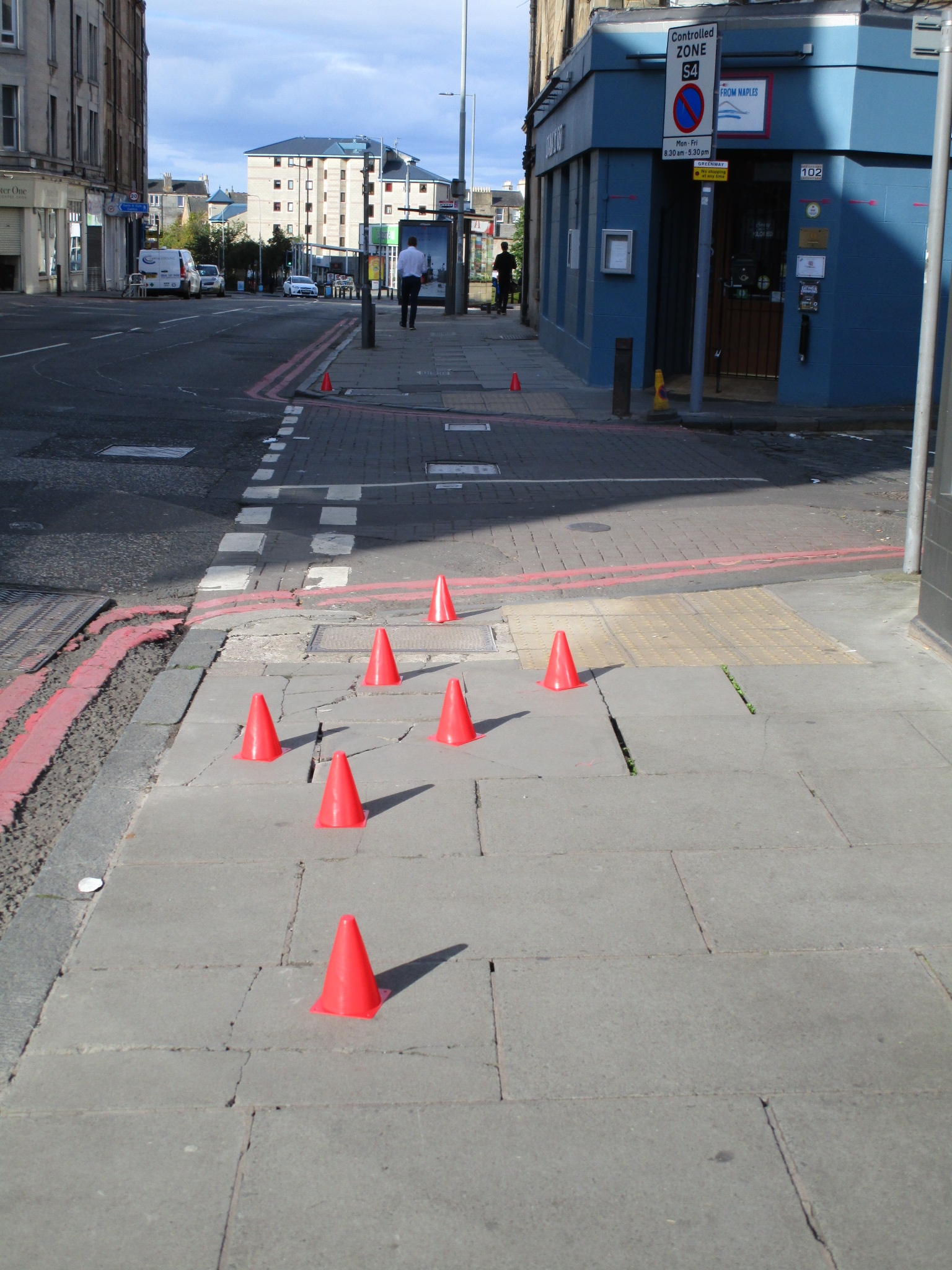
‘We’ve been monitoring the state of Edinburgh’s streets for years, and it’s fair to say that many are currently a shambles, with broken pavements [3] full of all kinds of clutter. In the run-up to the Council elections earlier this year, we called on all the parties to back a big shake-up in street management [2] with joined-up and accountable responsibility for looking after our streets, spotting faults and ensuring that they are fixed quickly. Much better conditions for walking – including wide, well-maintained and clutter-free pavements – are the key to making the city’s public realm much more civilised, and safer.


‘We welcome the Council’s recognition that the inspection and fixing of street faults is currently not working properly and that plans to improve efficiency and co-ordination are being brought forward. However, it’s not yet clear how far this new set-up will help to transform conditions for pedestrians – the new Roads Services Improvement Plan mentions ‘roads’ over 50 times, but ‘pavements’ on just five occasions.’

Photos below by Living Streets Edinburgh illustrate pavement problems across the city:


Bank of Scotland grounds at Holy Corner – footpath closure

The Bank of Scotland grounds at Holy Corner have been used as path off the main road to Bruntsfield on a daily basis for many years by cyclists and pedestrians. The narrow pavements in the area have meant that the preferred safe route for local people has been through the bank grounds.

Residents have raised concerns that the public access across the Bank of Scotland site may be lost when the land is sold. Local Councillor Melanie Main is working with residents to safeguard public access: the public have been using this as a route for very many years, and it may well therefore be a Right of Way.  A recorded Right of Way would safeguard continued access across the site, which may be important if there were proposals for changes, e.g: a building development in the grounds in the future. To establish the right and have it registered it is necessary to provide evidence from those who have used the route.

Local city of Edinburgh councillor Melanie Main is seeking evidence that the path has been open and used by people – this can then be taken forward to ensure the path is made a permanent right of way.

Please see the attached questionnaire

2017-08-08-BoS-Holy-Corner-Path-Questionnaire

Party Manifestos Edinburgh: 2017 Council Elections

Our analysis of all the parties’ manifestos for the recent elections (see below) shows that there is much common ground on the need to improve conditions for walking in Edinburgh, as a key means of improving the health, environment, economy of the city.

Edinburgh has inherited – from the vision of politicians and planners hundreds of years ago – a compact pattern of development which still lends itself to walking, but that is not enough for the 21st century. We urge Councillors of all parties to work pro-actively together to deliver the transformation of the car-dominated public realm which Edinburgh residents and visitors deserve.

Labour:

Poor air quality presents a significant challenge to young and old, and broken surfaces on pavements and roads affect us all, whether walking, driving or cycling.

Create a dedicated ‘Budget for Walking’ to be used, for example to install more pedestrian crossings, more drop kerbs and increase the number of paths and pedestrian zones.

Make significant progress towards making our city ‘barrier free’ by improving accessibility to buildings, and making streets and pavements suitable for people with disabilities.


SNP:

 …ensuring Edinburgh remains a walkable city where the needs of pedestrians are central to how our streets are designed.

We will invest £100m over the next five years to fix our roads and pavements.

We will tackle pavement obstructions and further reduce street clutter. We will tackle parking at drop kerbs and parking on pavements as soon as we have the powers to do so and conduct a wide-ranging review on access issues for people with disabilities.

Utility companies continually digging up our roads and pavements can inflict damage to our infrastructure, increase traffic pressure and cause chaos in our communities. We will explore the introduction of a rent charge for utility companies to prevent such disruption.


Green:

 …create safe and attractive routes for cyclists and walkers

Review and set a target to significantly increase the current 58% share of people walking, cycling or using public transport to commute;

Introduce a number of days where public transport, cycling and walking are given priority

Make it easier and more attractive for people to choose walking and cycling

We back more money for well-managed services which improve day to day life: streets free of litter and dog-fouling; bin collections which are on time; and well-maintained pavements, cycle-paths and roads.

Tackle the state of roads and pavements by putting in place a Roads Inquiry and Action Plan with three priorities:

  1. Prevent (reducing large trucks and pavement mounting);
            1. Manage (better co-ordination of utilities’ road works and improving roads team customer service);
  2. Invest (push for the Scottish Government to switch money from high-profile “prestige” projects and towards maintenance and repair).


Conservative:

 Improve the condition of Edinburgh’s roads, paths and pavements for all.

Create an Edinburgh Index, published annually or more frequently, showing an assessment of road, path and pavement conditions…

Increase targeted provision for pedestrians such as safe school zones, pedestrian zones and addressing casualty blackspots.


Liberal Democrat:

 Pavements are in an equally dangerous state [to roads]

We want to make it easier for people to get around our great city, whether by walking, cycling, getting around by public transport and using the car where appropriate. It means ensuring the city is accessible for all, regardless of physical or sensory ability. Liberal Democrats will work with others to ensure the city improves the experience of people who walk in the city.

…will maintain the walking and cycling element of our transport budget at 10% {I pointed out to their transport spokesperson months ago that the 10% is all for cycling!]

…encourage more people to cycle and to do so considerately, especially where space is shared with pedestrians.

…we will focus on repairing potholes in the city and deteriorating pavements. 

LSE delighted at proposal for fundamental review of Advertising Board Policy

Living Streets Edinburgh is delighted that the City Council’s Transport and Environment Committee is being recommended to back undertaking a strategic review of the growing problem of A-board clutter across the city. As the Committee paper – http://www.edinburgh.gov.uk/download/meetings/id/53632/item_76_-_a_boards  – acknowledges:

Concerns have been raised by organisations including community councils, Living Streets and the Council’s Access Panel that street clutter is impeding the ability for pedestrians to move through the city safely, and that the situation is worsening.’

Feedback from our supporters shows that A-boards:

  • are widely disliked by the public
  • narrow the walking space on pavements, often contravening the Council’s own Street Design Guidance
  • cause obstructions and sometimes hazards, for example for visually impaired people, which is potentially unlawful under the Equality Act 2010.

Since organising – in conjunction with Tollcross Community Council and the Edinburgh Access Panel members – a representative street audit at Tollcross in late 2015, we have been pressing the City Council to undertake just such a strategic review of policy – and its enforcement. http://www.livingstreetsedinburgh.org.uk/consultation-responses/street-audit-tollcross-edinburgh/street-audit-tollcross-edinburgh-summary-of-recommendations/

If Councillors back the recommendation, we will be fully consulted by officers. Other UK cities have undertaken such reviews, with the result that A-boards are licensed, better controlled or simply banned.  Edinburgh’s review should cover what should be allowed on which streets and how the rules are enforced. The issue has wider implications of course – on the quality of public space in the city, the vitality of its businesses and the potential for better Council management of our streets – the latter being one of the four proposals in our ‘Manifesto for Walking’ in the run-up to the Council Elections in May. at http://www.livingstreetsedinburgh.org.uk/2016/12/21/living-streets-edinburgh-manifesto-for-walking/ ‘