Notes of Living Streets Edinburgh Group Annual Public Meeting 2017

Notes of Living Streets Edinburgh Group Annual Public Meeting, Friends Meeting House, Edinburgh, 7.00pm, 28 September 2017


  1. Convenor’s Welcome and report

David Hunter welcomed supporters to the meeting and summarised the Group’s activity over the past year which included:

  • Preparing a manifesto for the May Council elections with four main asks;
    • transform the way our streets are managed
    • more investment in walking
    • a traffic plan for the city centre
    • major pedestrianisation project (George St)
  • Welcoming some evidence of CEC movement on transforming street management, eg review of A-boards policy.
  • Regular liaison with a number of CEC councillors and officers including recent walkabout with Cllr Macinnes. Welcomed Paul Lawrence’s vision of doubling the width of all pavements – more radical than us!
  • Responded to more than a dozen cycle route proposals – with some welcome walking improvements, but in most cases incidental and inconsistent, and frequent failure to apply Street Design Standards to pavement widths etc.
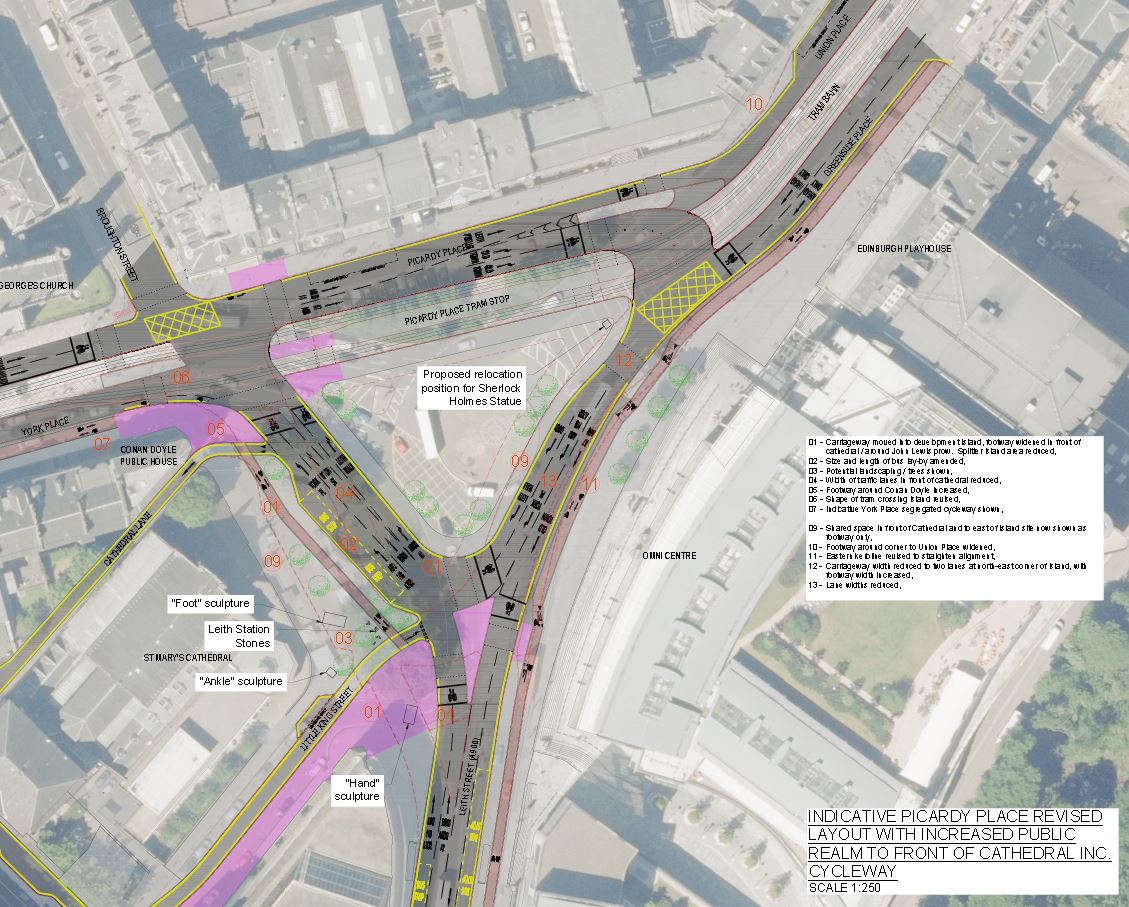
  • Inputted to planning and traffic management plans, notably Picardy Place, proposed as a giant roundabout
  • Commented on or reported countless road works impeding walking, demonstrating an endemic failure within CEC systems of management / enforcement
  • Kept pressing the Festival Streets concept (closing streets to traffic) and hope to see support developing for an initiative in 2018
  • Finally, we’ve strengthened our Committee and got involved in an ever widening range of campaign activities: we would be pleased to hear from anyone who wants to help in any way – responding to consultations, social media, or simply reporting faults and following up on them.

David then introduced and welcomed Cllr Lesley Macinnes, the new Convenor of Transport and Environment Committee.


  1. Cllr Macinnes

Cllr Macinnes spoke about her background and, as a new councillor, her wish to understand the issues and agendas that her position required, to build relationships within and outwith the Council and to prioritise the work plan of the administration which the SNP leads, with Labour. She emphasised the commitment to empower communities and citizens and encourage participation. She considered the 20mph scheme to be an outstanding success.

At the same time there have been some major issues which need urgent attention, notably the business case for extending the tram. She was an advocate of more pedestrian zones (not only in the city centre0, reducing congestion and car traffic generally, as the city is expected to grow to a population of 600,000 in the next 30 years. She was keen to tackle pavement parking and improve street cleansing and road/pavement maintenance. She is part of a ministerial working group to improve air quality and introduce Low Emission Zones in line with recent Scottish Government announcements.

She spoke of her recent decision to postpone decisions on the controversial Picardy Place plans and committed to a programme of intensive consultation before a final decision was made; however she also stressed the legal, financial and physical constraints. She pointed to Silverknowes as an example of her willingness to intervene (to halt a road scheme that was inappropriate for cyclists).

She welcomed the input of groups like Living Streets and would also appreciate their public support where possible, as there would also be vocal opposition to many proposals to improve active travel and curtail traffic.

Cllr Macinnes then took questions from the floor on issues including: the possibility of more, or better advertised Park and Ride, controlling or removing ‘A-boards’, improving fault reporting systems, the prospects for a joined-up approach to managing streets through ‘street marshals’ and the hazard caused by bollards and chains on the High Street.

The audience joined in thanks to Cllr Macinnes for her talk, insights and openness to ideas for improving walking in Edinburgh.


  1. Stuart Hay

Stuart Hay, Director of Living Streets Scotland, gave a presentation showing some possibilities of radical improvement to public space in Edinburgh and illustrating initiatives from around the world which other cities (some ‘competitors’ to Edinburgh for visitors) have introduced to make them more ‘places for people’.


  1. Workshop sessions

The meeting then broke into informal groups to look at maps and stimulate thoughts on specific locations and issues, in both the city centre and across the council area, where there were particular barriers to walking – or indeed, good practice.                (These have been collated and will be passed on to the Council).


The meeting closed at 9.00pm.

LSE Objection to multiple Lower Gilmore Place Planning Apps

Dear CEC

Regarding panning apps 17/04462/CON, 17/04235/PPP and 17/04234/FUL (Lower Gilmore Place)

We object to this development on the following grounds.

We are generally supportive of the development because it has a low level of parking provision. As Edinburgh continues to grow, we need to curtail and discourage more car travel from the city. Housing in dense brownfield sites like this this are the most sustainable kind of development, not only for the environment and transport purposes (beaches it is so easy to walk, cycle or go by bus) but also for the neighbourhood economy – local shops, community facilities etc get more customers  This would support council policies which aim to promote car-free or car-lite developments: http://www.livingstreetsedinburgh.org.uk/common-issues/policies-of-city-of-edinburgh-council-promoting-car-freecar-light-developments/

However, the public realm in the immediate area is very deficient for people walking, despite this being a key North/South walking route. We would therefore like to see significant improvement in the nearby public realm funded from the developer. These improvements are (in approximate order):

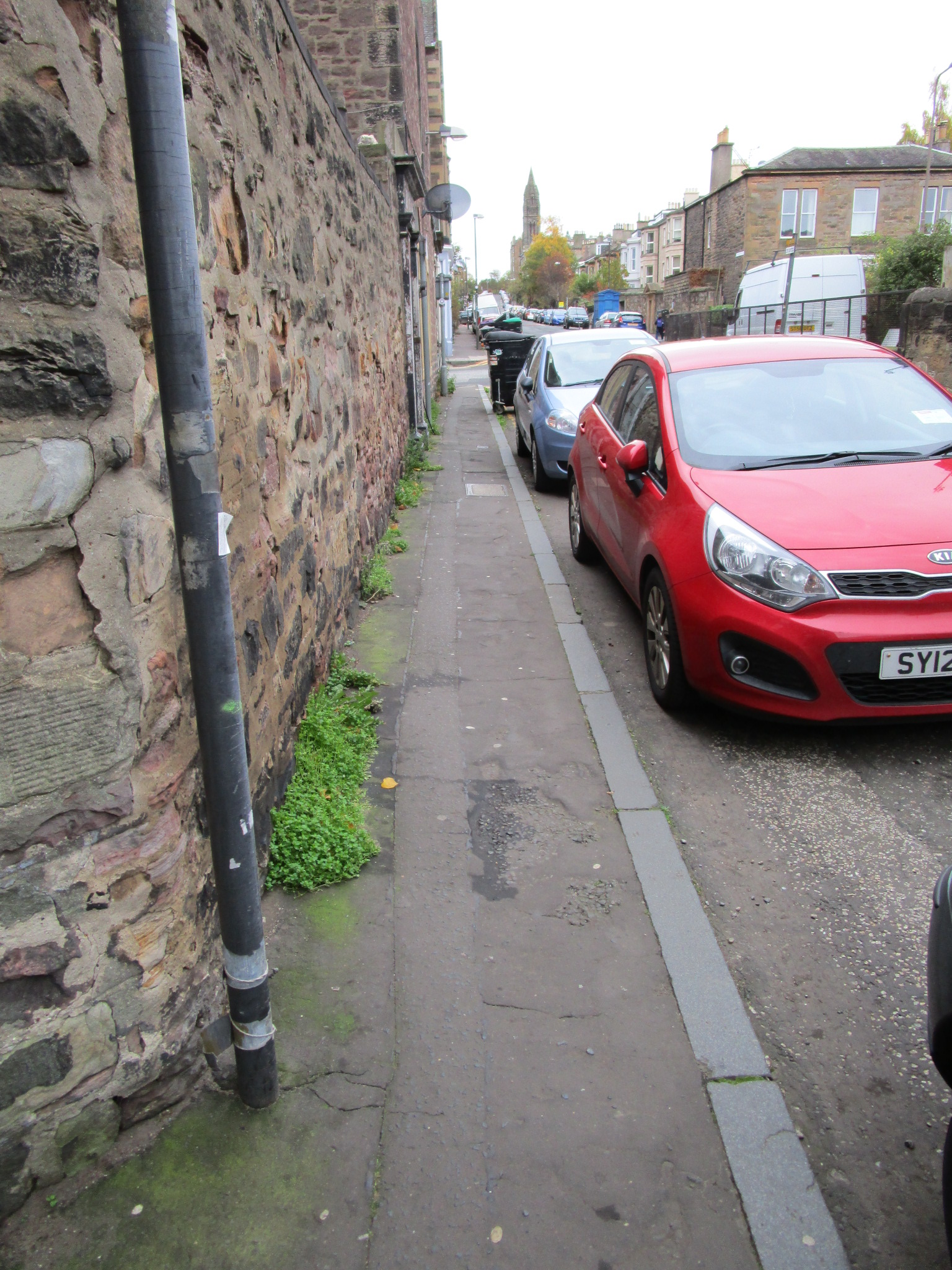
  • Widening the pavement on Leamington Road, and to de-clutter it (almost all signage should come off it). This very important walking route between the Haymarket and Bruntsfield area is absolutely atrocious; the pavement should be at least 2 metres wide (preferably 2.5 metres) to conform to the Council’s own Street Design Guidance  http://www.edinburgh.gov.uk/info/20089/roads_and_pavements/906/edinburgh_street_design . Unfortunately, it is hard to see how this can be achieved without removing the existing residents’ parking, which will clearly be unpopular with those that currently park there. Could alternative (off street) spaces be provided for them in the new development ?


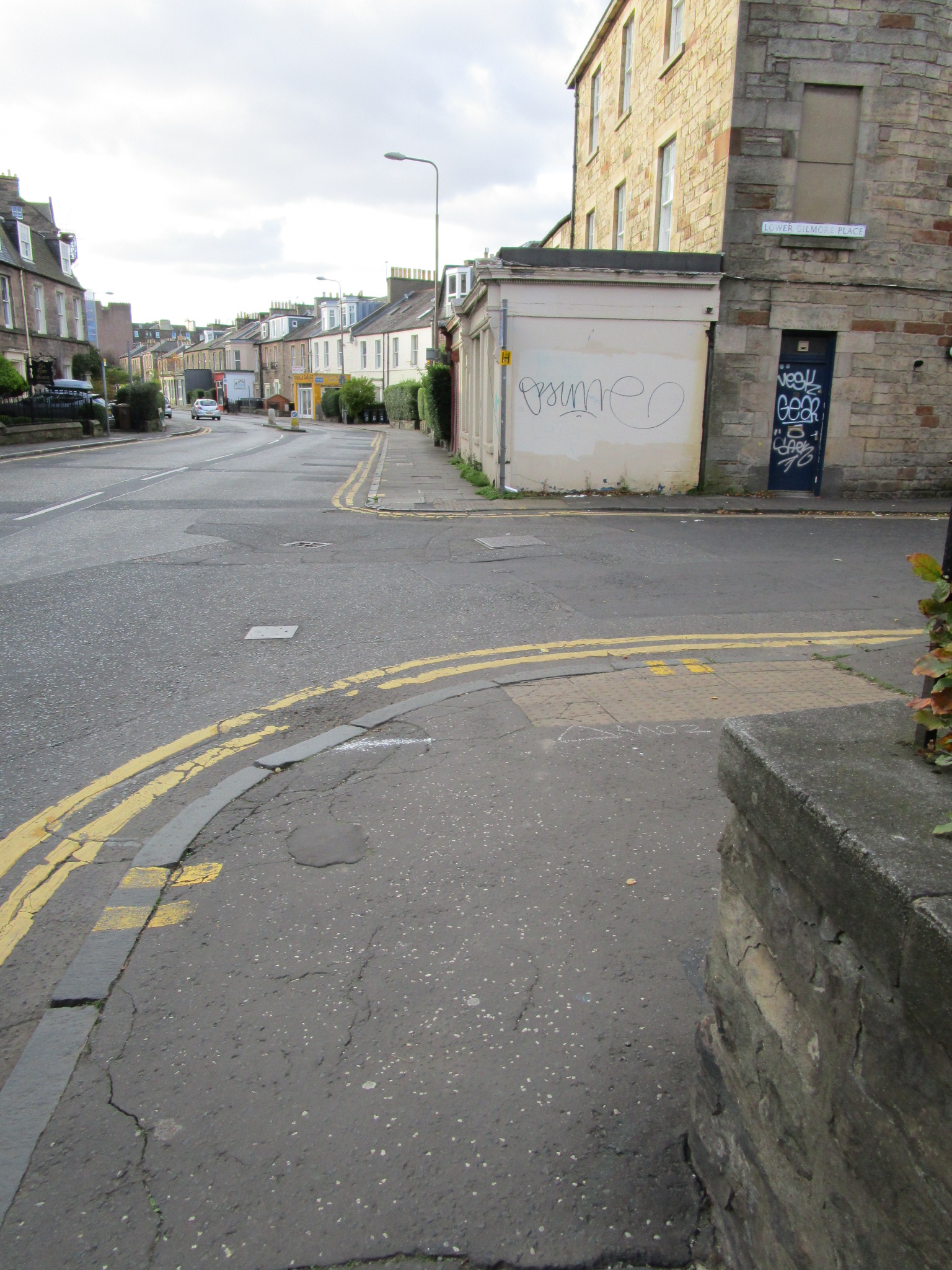
  • Installing a ‘continuous pavement’ across Leamington Road at the junction with Gilmore Place. There is not even a ‘dropped kerb’ there at present and as a result Gilmore Place is a very difficult place for disabled people to move along. It would be criminal to miss this opportunity to address this (arguably even a breach of the Equality Act?)


  • Considering stopping up Leamington Road at the Gilmore Place junction, permitting access only by bicycle and on foot. (Vehicle access to be through the eastern end of Lower Gilmore Place)
  • Improving public realm on the north and east sides of Lower Gilmore Place. This might involve removing the canal-side wall to open up views and access to the canal towpath and decluttering the northern pavement of signage (which should have been done when the pavement was recently widened).


  • A continuous pavement should be installed across Lower Gilmore Place at the junction with Leamington Road, providing a flat surface for people walking along Leamington Road to and from the lift bridge.

yours sincerely

David Hunter

for Living Streets Edinburgh Group

Living Streets Edinburgh Group objects to Leith Street RSO

RSO/17/13 Leith Street, Calton Road, Greenside Row, Waterloo Place

Living Streets Edinburgh Group objects to RSO 17/13 on the following grounds:

1) All – pavement widths

Leith Street is designated as a Strategic High Street, according to the Street Design Guidance adopted by the Council in 2015 (i). This specifies that the pavement should be a minimum width of 3 metres (2.5 metres allowed only in short sections), with a desirable minimum width of 4m or wider. We cannot determine the exact pavement widths from the drawings, but it is clear that the pavement widths proposed in the order are far below the Council’s own specified standards on both sides of the street.

(i) http://www.edinburgh.gov.uk/downloads/download/550/edinburgh_street_design_guidance


2) Crossing point of Leith Street East at Greenside Row

The drawing seems to imply that the entire pavement both the north and south sides of the Greenside Row corner is re-determined as cycle way from both footway and carriageway (10, 12, 16, 13). This leaves no footway whatsoever exclusively for pedestrians crossing Greenside Row. The drawing suggest that pedestrians are expected to wait in a designated cycle way before crossing Greenside Row. This is a busy pavement at all times – and is already excessively busy at certain times of the year (eg during the August festivals). It is unacceptable that pedestrians at this location should mix with cyclists. Of course, it would also be also extremely unhelpful for cyclists to encounter pedestrians on the cycle track.


3) Junction of Leith Street East at Greenside Row

The corner radii of Greenside Row (at 10, 16) are excessively large, which will encourage vehicles to travel fast when entering and exiting Leith Street. This is an inappropriate design for a 20 mph street. The Street Design Guidance (see above) specifies that the maximum radius for a corner of this type of street is 3 metres, and although not shown, the radii proposed are clearly far in excess of this.


4) Cycle manoeuvres, Leith Street (west) to Greenside Row

We are unclear what manoeuvres cyclists are expected to make heading north from the west side of Leith Street (6) to join the cycle track on the east side (10). We are concerned at the risk of conflict between cyclists and pedestrians involved in this manoeuvre.

5) Junction of Leith Street (east) at Calton Road

It is our understanding that the junction of Leith Street and Calton Road will be governed by a signalised crossing, although this does not appear to be indicated on the drawings. We would support this, so long as adequate pedestrian priority is provided in signal timings to permit the heavy pedestrian traffic to proceed effectively north/south. However, we have concerns that the cycle track on Leith Street heading south ends abruptly at Calton Road (10). There could be conflict at this junction between pedestrians and cyclists wishing to continue south, for example to the Bridges,


6) ‘Floating Bus Stop’ Leith Street (East).

The drawing shows a ‘floating bus stop’ (17). Living Streets’ opposes the further introduction of this feature until an objective and thorough monitoring is completed on the first such floating stop, introduced on Leith Walk (ii). This is because we are concerned at the risk of conflict between pedestrians (especially elderly and or disabled bus passengers alighting from a bus) and cyclists, where the cycle way lies between the bus stop and the pavement. This would be especially the case if the cycle way is, as we think 2-way, so downhill (northbound) cyclists may be going quite fast. No such monitoring has yet taken place or been planned to our knowledge and so we therefore oppose the redeterminations introducing this feature.

(ii) http://www.livingstreetsedinburgh.org.uk/2016/02/08/living-streets-edinburgh-backs-floating-bus-stop-pilot-on-leith-walk/


David Hunter
for Living Streets Edinburgh Group

Thorn House
5 Rose Street
Edinburgh
EH2 2PR

17 October 2017

LSE Group – Annual Public Meeting 2017

Thursday 28 September at 7pm
Quaker Meeting House, 7 Victoria Street EH1 2JL

You are invited to attend the 2017 Public Meeting of Living Streets Edinburgh, the local voluntary arm of the national charity campaigning for ‘everyday walking’. We’ve had a busy year, raising the profile of walking in the city, and engaging with Councillors and officers of the City of Edinburgh Council on a wide range of public realm issues.

Come along to catch up on our news, to hear from the new Convenor of the Council’s Transport and Environment Committee, and to feed in your ideas to workshop sessions on walking route campaign priorities for the city centre and localities across Edinburgh during 2017-18.

AGENDA:

18.40 Registration; tea, coffee and biscuits

19.00 Welcome and update from David Spaven, Convenor of Living Streets Edinburgh Group

19.10 Keynote address by Cllr Lesley Macinnes, Convenor, Transport and Environment Committee, CEC

19.30 Question time

19.45 The national perspective from Stuart Hay, Director of Living Streets Scotland

19.55 Workshop sessions:

  • Topic 1: Identifying strategic walking routes in the city centre and key pinch points / barriers
  • Topic 2: Identifying strategic walking routes in localities across the city and key pinch points / barriers

20.20 Swop workshop sessions

20.45 Sum-up

21.00 Meeting closes.

Edinburgh’s Street Design Guidance – key standards for clear pavements

In 2015, the City of Edinburgh Council adopted new Street Design Guidance. This sets out the standards and requirements for how the city’s streets are to be designed, maintained and managed. Fundamental to the Guidance is ‘walkability’ – wider pavements, less street clutter, less dominant traffic. “Everyone who manages, maintains, alters or reconstructs streets, including urban paths, will be expected to comply with the Guidance” (p8).

The Living Streets Edinburgh Group has prepared this briefing paper to help anyone wanting to campaign for a more walkable Edinburgh, by setting out some key requirements contained in the Guidance. For full details, see http://www.edinburgh.gov.uk/info/20089/roads_and_pavements/906/edinburgh_street_design


Pavement widths

The Council classifies all Edinburgh streets: for example as “Retail/High Street”, “High Density Residential”, “Low Density Residential“ etc. It further classifies streets as ‘Strategic’, ‘Secondary’ or ‘Local’.

A minimum, and desirable, width applies for each different type of street. However, no pavement on any street should be less than 2 metres wide. Some key standards are:

Retail/High streets:
“absolute minimum 2.5m (only allowed in short sections), general min 3m, desirable min 4m or wider”

High density residential (Strategic and secondary):
“absolute min. 2m (only allowed in short sections), general minimum 2.5m, desirable min 3m or wider”

All streets:
“absolute minimum of 2m (only allowed in short sections), general min of at least 2.5 m or wider.”


“Clear Walking Zone”

 This is the space on a pavement that must be kept clear of *any* obstructions (lamp posts, A-boards, bins, bus shelters, signage poles, etc):

All streets: 1.5 metres minimum Clear Walking Zone


This document is available as a downloadable PDF here – Living-Streets-Edinburgh-Street-Design-Clear-Pavements