Some cycling campaigners have indicated that we are opposed to segregated cycle ways. This is categorically not the case. After walking most of the proposed Edinburgh East to West cycle route, and auditing the design, we have supported the vast majority of the proposal and recommended some detailed design improvements. However, we have concerns about two sections of the route, due to impacts on the safety and convenience of walking.
The first concern is that Roseburn Terrace will not be able to accommodate a well-designed cycle bypass / floating bus stop which minimises conflicts with pedestrians queuing, alighting from or getting on buses. Conflicts of this nature will not be good for cyclists either. So far, the experience of such infrastructure in the UK has not been good, especially TFL’s efforts in London, where Living Streets has observed significant problems at a number of busy high streets. We are especially concerned at the effect on elderly and disabled bus passengers who will not be expecting to encounter cyclists on alighting.
We have suggested an alternative route for this short section – which actually links better with the Family Friendly route through Roseburn Park. We also believe widening both pavements at Roseburn Terrace is a priority for improving the public realm and maximising active travel benefits. We suggest further work is needed with all parties on the design of this section of the route and are happy to work with cycling groups to understand their perspective and look at options which address our concerns.
Our second concern is that the east end of Princes Street proposal – running straight through the middle of the pavement – is highly problematic due to the sheer volume of pedestrians and the inevitable conflicts which would be created. We want to see re-allocation of road space to accommodate cycling and minimise conflicts.
We look forward to supporting the project as a whole and ensuring it maximises benefits to pedestrians as well as cyclists. Where there are problems, we will work constructively with other interests to resolve them.
Living Streets Edinburgh (LSE) campaigns for improved conditions for everyday walking in Edinburgh’s streets and public spaces. Walking is the most important transport mode in the city, since over half of all journeys by Edinburgh residents are made either entirely on foot (35%) or by bus (18%), the latter involving a walking stage. It is also the most socially inclusive mode – it’s as natural as breathing – and is critical to the city’s economy (including the important tourist sector).
1. Key principles
1.1 LSE is strongly supportive of measures to improve sustainable transport generally and will support segregated cycle routes where these do not adversely affect the safety and/or convenience of walking, and particularly where they provide general improvements to the walking environment as well. This is the case for the large majority of this route.
1.2 We have big concerns about ‘floating bus stops’, as – irrespective of any ameliorative measures – there will inevitably be some deterioration in the convenience and safety of walking, as pedestrians have to cross the cycle path from the pavement in order to access the bus stop. Our view is that no floating bus stops should be created in Edinburgh until after the evaluation of a pilot (with multiple safeguards) within the next phase of the Leith Walk upgrade (see separate submission to Anna Harriman at City of Edinburgh Council). Options to avoid these conflicts should be explored.
1.3 Walking in the city centre and bus use are closely linked. The impact of reduced bus priority needs to be considered in relation to journey times and air pollution impacts on pedestrians. We urge the council to view the project in a multi-modal context, which balances the needs of cyclists with bus users (as well as people on foot) – especially on busy bus routes.
The briefing sets out the views of Living Streets Scotland and Living Streets Edinburgh (the local campaign group) on the future of George Street and the scope to restore it to its rightful place as one of the capital’s and Scotland’s finest streets. It summarises 10 principles that we believe will allow Edinburgh to match and compete with other similar north European capital cities, with principal streets that offer a high quality experience to visitors and residents.
Achieving the vision
Recognize that George Street is an internationally important asset
Redress the chronic lack of high-quality urban space in Edinburgh
More people – not more parking – is the key to George Street’s future success
Create fully pedestrianised European style spaces
George Street is not a transport artery, so prioritise place over movement
Quality materials are not enough to deliver a quality street
Shared space must protect vulnerable users and restrain vehicle speeds
George Street must be at the heart of a lively, sociable walkable New Town
Proactively manage and regulate the new street from the outset
Edinburgh must not fail again
The opportunity must be taken to demonstrate Edinburgh’s streetscape can match its world-class architecture.
Princes Street is the heart of Edinburgh and its busiest street for people on foot. But pedestrians get a very raw deal as they proceed along the street. We have recorded video footage of this junction in September 2015 and found that it can take to FOUR MINUTES 22 SECONDS for people to wait for the green man phase to cross just the Frederick Street junction. This is an unacceptable wait time for people on foot and not only leads to delays for the great number of people on foot but is dangerous as some people will inevitably seek to cross before the ‘green man’ phase comes on, resulting in frequent ‘near misses’.
The problem lies with the timing of the traffic signals. According to council policy, “absolute priority” is given to trams; this has had a knock-on effect of increasing the time that pedestrians have to wait to cross the roads which join Princes Street. However, the Council has responded to our concerns by tweaking the signal timings and we understand that pedestrian wait times have reduced recently. We will make more video recordings in the future, so that the pedestrian experience and actual wait times can be accurately documented and monitored. We also want to ensure that, should trams be extended to Leith or Newhaven in the future, there is no detriment to the pedestrian experience on any other part of the tram route.
Ten leading disability and environmental Scottish charities (1), brought together by Living Streets’ Edinburgh Group (2), have written to the Scottish Government urging action to be taken to turn Holyrood Park into a safe and attractive space for all.
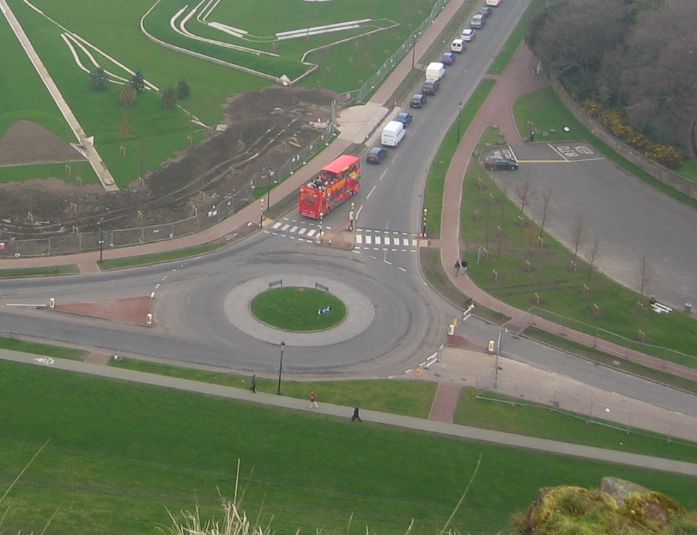
While the city of Edinburgh gears up to reduce speeds to 20 mph, most of the sprawling park, meant to provide leisure opportunities for residents and visitors alike, remains a 30 mph limit with only one pedestrian crossing. The call follows concerns about the growing number of traffic accidents in the park (3).
The ten co-signing charities are calling for Historic Environment Scotland to review visitor access and safety arrangements in the park more generally at a time when Historic Environment Scotland is consulting on its corporate plan (4).
David Spaven, Convener, Living Streets Edinburgh, said:
Park should be a green space
“Holyrood Park is a unique green space, close to the heart of Edinburgh, but it’s become far too dominated by the speed and noise of vehicle traffic.
“People who want to enjoy this special park quietly and safely face far too many obstacles – speeding traffic, hardly any safe road crossings, and pedestrians and cyclists forced to use narrow ‘shared space’ paths.
“The time is right for Historic Environment Scotland and the Scottish Government to consider transport priorities for the park, with the needs of people on foot put right at the top of the list.”
“We want Holyrood Park to be a safe place that can be accessed and enjoyed by everybody. At the moment, the high volumes of traffic not only affect the air quality and noise but also people’s perception of how safe the park is.
“This can be very off-putting for many people with sight loss and can result in them not using the park, therefore denying themselves the pleasures of the great outdoors and being fit and healthy.”
John Lauder, National Director, Sustrans Scotland, said:
”While City of Edinburgh Council is rolling out 20mph zones across the city, the iconic Holyrood Park is being left behind. Right now it’s just not living up to its potential as a safe, attractive space for people on foot and bike to enjoy.
“In Scotland we have strong, cross-party support for walking and cycling and a government that has invested record levels in active travel over the past couple of years. Yet, on the door-step of the Parliament, one of Scotland’s most iconic parks is being used a rat-run – to the detriment of its users and those who live in the neighbouring communities.
“We want Holyrood Park to reflect Scotland’s ambition on active travel, by making it a safe attractive space for people making journeys on foot and by bike.”
Brian Sloan, Age Scotland Chief Executive, added his support to the campaign:
“Traditionally urban parks have been viewed as the ‘lungs of the city’ and we fear that given the current situation Edinburgh’s ‘lungs’ are being unnecessarily harmed.
“Holyrood Park could be a wonderful space for people of all ages to engage in an activity, such as walking or cycling, to enhance wellbeing and quality of life.
“Yet, given the current infrastructural prevalence for vehicular traffic this means that many people are put off from venturing into Holyrood Park. We urge the authorities to re-consider this so that Holyrood Park can rightfully be restored as a beneficial place for citizens and visitors alike to enjoy to its full potential.”
Contact
For more information or to arrange interviews, please contact Kathryn Shaw, Media and PR Coordinator: Kathryn.Shaw@livingstreets.org.uk / 020 7377 4914.
Zebra crossing installed in 2005 removed by end of 2008This crossing point was removed
Notes to editors:
RNIB Scotland, Guide Dogs Scotland, Age Scotland, Spokes (Lothian Cycle Campaign), Sustrans Scotland, Paths for All, Living Streets Scotland, Transform Scotland and Ramblers Scotland
Living Streets Edinburgh is a local campaign group of Living Streets, the UK charity for everyday walking. We want to create a walking nation, free from congested roads and pollution, reducing the risk of preventable illness and social isolation and making walking the natural choice. We believe that a walking nation means progress for everyone.Our ambition is to get people of all generations to enjoy the benefits that this simple act brings and to ensure all our streets are fit for walking. For more than 85 years we’ve been a beacon for walking. In our early days our campaigning led to the UK’s first zebra crossings and speed limits. Now, our campaigns and local projects deliver real change to overcome barriers to walking and our ground breaking initiatives such as the world’s biggest Walk to School campaign encourage millions of people to walk.