All posts by Living Streets Edinburgh

LSEG comments on proposed development Yeaman Place, November 2022

The Edinburgh chapter recently made representation to the CEC planning department in respect to comments on the planning application for new student housing at Yeaman Place and in proximity to the Union canal.

The representation was supportive of the development in principle, given the net benefit to pedestrian access in the area, as well as increasing personal security for vulnerable users of the canal towpath. We would however, like to see this access being formalised and that waymarking signage should be applied given that the access might not be obvious or intuitive.

The application could improve and crucially, the developers have indicated that they cannot provide direct ramped access between Yeaman Place and the canal. The access will only be stepped, which will be a significant disadvantage to those with additional mobility needs. In our representation, we asked that the CEC planners interrogate the engineering constraints outlined by the developers as to why they could not provide ramped access.

Finally, our representation also acknowledged that the development does not provide parking provision, which is welcomed so that it does not “bake in” car-dependency, but we have asked that the CEC planners be considerate of the impact that drop-off/pick-up could have on the pavement and cycle lane on Dundee Street.

If there’s a planning matter which you’d like to bring to our attention in your local area, then why not touch base with us to see how we can help you. Please contact planning@livingstreetsedinburgh.org.uk.

Living Streets Edinburgh Group – Public Meeting

Living Streets Edinburgh Group
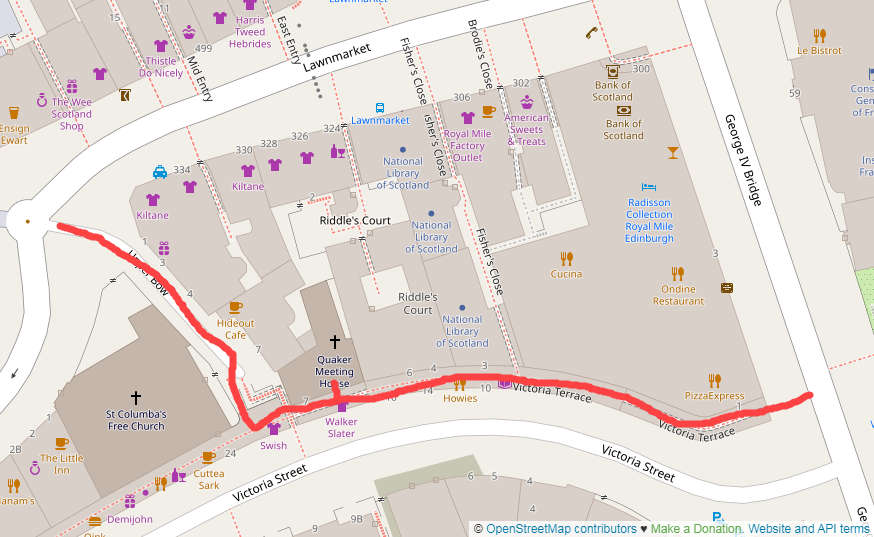
Public Meeting – 6.30pm, Monday, 14 November 2022
Friends Meeting House, Victoria Terrace

AGENDA

  • Introductions / apologies
  • Minutes of last AGM, 26 May 2021.
  • Convenor’s report.
  • Treasurer’s report.
  • Agreement of lead roles including Convener and Treasurer
  • Guest speaker: Professor Scott Arthur, Convener of Transport and Environment Committee, City of Edinburgh Council
  • Questions and Answers
  • Discussion: our priorities, campaigns, getting involved.
  • AOB.

Finish: 8.00pm

Tollcross Primary School – Travel Survey 2022

Tollcross Early Years Campus is a combined nursery/primary-level educational setting – comprising Tollcross Primary School  (est. 1912), Tollcross Nursery and Lochrin Nursery School – with an approximate combined attendance of 300 students. 

Within this most recent travel survey, the families of Tollcross Early Years Campus sought to reflect on our school run and highlight solutions which place safe, convenient and active travel at the centre of the school run.

Our data highlights that the majority of respondents – 73% – walk to school over a distance of less than 2 miles. However, many respondents reported that shortcomings in the quality of infrastructure made active travel unpleasant at best or impossible at worst. Looking toward solutions, respondents indicated that widening pavements and improving cleanliness (e.g. emptying over-flowing bins) would make them more likely to choose active travel modes to get to school. More ambitiously, overhauling the design of Tollcross Junction to prioritise pedestrian throughput would bring positive, sustainable and long-lasting improvements to the lives of many of our families and to the safety of our children.

The full report can be read here – 2.2mb PDF

The Wisp / Old Dalkeith Road

A Living Streets Edinburgh volunteer paid a detailed visit to this junction following social media reports. She described it as “one of the worse junctions I’ve seen. Truly shocking, and feels unsafe to walk across.
Pedestrian is vulnerable crossing three lanes of traffic with vehicles passing close by at up to 40mph. I would avoid using this crossing, and it would be especially risky for slower walkers, eg. with children, wheelchairs, sight impairment, or elderly, etc.”

Summary:
• Inadequate green man illumination (7 seconds).
• Wide splay, no islands, cyclists swirling along pavement.
• Small crossing signals, poorly positioned and difficult to see.
• Absence or invisibility of road sign for change of speed limit.
• Two cars observed speeding through crossing while woman was walking on Green Man phase.

Details:

Old Dalkeith Road (A7) / The Wisp
Traffic signals
Not automated
No audio (beeps)
Tactile cones – present and workoing
Max waiting time for GM: 59 seconds
Length of GM phase: 7 seconds
Date Fri 23/9/22
Time 12.30

Description:

This is a busy junction designed to ease vehicle flow, not protect pedestrians. The Wisp runs north-south onto Old Dalkeith Road which is in west – east direction (before bending south). There are two lanes of traffic both ways on Old Dalkeith Road travelling at 40mph. It is a complex traffic light system with filters for different traffic lanes going straight ahead or turning.

The speed limit changes at the junction, from 40mph on Old Dalkeith Road, to 30mph on The Wisp. There is a 30mph sign visible to vehicles turning right into The Wisp from east side of junction, but no sign is visible to vehicles turning in from the west. Without visible signage, vehicles turning left into The Wisp may continue to drive at 40mph in the 30mph zone past Danderhall village.

I’ve reported this speed signage problem to CEC and to Midlothian Council (as the junction is on the border).

Junction is splayed wide and traffic turns corner at 40mph.

There are two pedestrian crossings, operating separately from each other – south end of The Wisp, and Old Dalkeith Road at east side of junction. Both crossings span three traffic lanes with no islands offering protection. Pedestrian road markings are not easily visible, camouflaged by colour of road.

People must ‘cross with traffic’ which feels dangerous while vehicles alongside are moving through filter lights.

The new pavement on the west side of The Wisp is extra wide -maybe it is for shared use with bicycles? There are no signs on the pavement, but the pedestrian crossing includes cycle lights. Cyclists were observed using the pavement. (Not surprised – cycling on the road here would be hazardous or frightening, given the multiple traffic lanes and high speeds.)

There is a new housing estate under construction to the north-west of the junction.
The bus stop on the south side of Old Dalkeith Road is accessible only via the pedestrian crossing.

The crossing light for pedestrians is mounted at waist height and faces in the direction of the road, not the pedestrian’s crossing route, so the GM on the far side is not visible when walking across.
The GM is illuminated for only 7 seconds and changes to red before people have crossed the road, even when walking quickly.

By the time the pedestrian light on the far side becomes visible, it has changed to red, which is alarming since you have no way of knowing how long before traffic starts to move again.

Together with vehicles moving through the junction alongside while GM is illuminated, the pedestrian feels feels vulnerable and insecure.

Total cycle time varied from 1 minute to 1 min 45 sec, so the GM appearance was unpredictable. There are no beeps, and the pedestrian crossing light is small and poorly positioned, so it is easy to miss the change from red to green, and then have to wait another minute or more. It is also possible to miss the GM phase because it is so short, especially if watching the traffic to gauge when the lights will change.

I saw a person crossing without waiting for GM light, which is very risky because of unpredictable traffic flow from traffic filter lanes.

In one phase I saw two cars drive fast through the green man while a woman was crossing The Wisp. She was visibly shaken. She was on The Wisp crossing and the cars were turning left into The Wisp from Old Dalkeith Road (west) where traffic was moving at 40mph.

Either the drivers deliberately drove through their light on red, or they were confused by the filter lights (which were red for left but green for ahead). The cars went through the crossing a long time after the GM appeared, as the woman was already half way across.

Spoke to two women with pushchairs who were obviously frustrated with this crossing. They said it had been installed quite recently. The previous system had both pedestrian crossings green at the same time, and all traffic stopped at once, which felt safer as pedestrians could cross without vehicle movement. They miss the audio beeps that have disappeared.

The women were very glad to speak as they feel ignored by council and road planners.

Photos attempt to show poor visibility of pedestrian lights, and wide splay of roads at junction.

Leamington Terrace to Lower Gilmore Place: street review

This short review of streets in the Bruntsfield/Tollcross area was produced by Annie Pollock, local resident and LSEG supporter. It was compiled using observations from a ‘walkabout’ with new City Centre councillor Margaret Graham and local Living Streets volunteers on 13 July 2022.