Tag Archives: Traffic

Deputation to TEC on Road Safety, November 2025

Deputation by Living Streets Edinburgh Group regarding TEC Item 7.6, 13 November 2025 (Road Safety Plan Update)

This report includes a number of important topics particularly school travel plans and pedestrian crossings as well as road safety. We would like to make the following brief comments on some key aspects.

Resources

All these crucial activities are hampered by lack of both capital budget and staff resources. We were disappointed that these themes were not included in the list of programmes for capital funding when this committee carried out its prioritisation exercise in May. We hope that at there will be explicit programmes for these items when TEC next reviews capital priorities. For example, funding for the ‘Action for Better Crossings’ initiative, which is a central part of the CMP’s active travel plan, would enable a much more strategic approach to investing in traffic signals and pedestrian crossings. This would not only help people to cross the road safely and easily, but also enhance bus and cycle priority through better use of smart technology. Capital funding needs to be matched by appropriate levels of staff capacity.

School travel plans

We understand that the onus on completing and publishing school travel plans is increasingly shifting from transport staff to schools. We think this is a mistake and will only weaken efforts to encourage safe and sustainable travel to school, given that schools and their head teachers have so many other responsibilities and priorities. Committee has previously observed that only nine school travel plans are currently published on the Council’s website https://www.streetsaheadedinburgh.org.uk/school-streets-1.

Communication and coordination between plans for school travel on the one hand, and active travel on the other, need to be improved. This is illustrated by the recent proposal for three zebra crossings in the Shandon area as part of the Dundee Street active travel scheme. The proposed crossing on Ashley Terrace linking with a new cycleway is more than 50 metres away from the location where the community has wanted for 10 years or more: Craiglockhart Primary School,

Pedestrian crossings

We are disappointed to see continued (partial) reliance on the so-called PV2 method to assess the need for pedestrian crossings which we consider to be obsolete. We would welcome discussion with officers on the methodology, in line with the suggestions which we made in 2022: https://www.livingstreetsedinburgh.org.uk/2022/07/19/lseg-suggestions-on-a-new-approach-to-pedestrian-crossings-july-2022/

Enforcement of speeding and other traffic offences

We have actively supported the Council’s introduction of 20mph speed limits for more than 10 years, and continue to support measures to reduce speed which have undoubtedly saved many injuries and prevented some deaths. However, we are surprised at the absence of any mention in the report of speed and red light cameras, which are a crucial tool to encourage responsible driving. This is especially true for roads which are engineered for higher speeds than 20mph, where compliance with speed limits will be low. Our Freedom of Information request in August revealed that one third of cameras in the city are currently ‘bagged’ and no fewer than 8 were taken out of action this summer alone: bit.ly/47Vjm2W. We recognise that it is the Safety Camera Partnership led by Police Scotland which is responsible for these cameras, not the Council; but as a key partner, we urge the City of Edinburgh Council to press for more use of safety cameras.

We have also written to both Scottish and UK ministers calling for the revenues from these cameras to be retained by the enforcement agency, Police Scotland bit.ly/4mEjR5B. This is necessary because Police Scotland bears the cost of maintaining and replacing cameras which generate no income to them from penalties. This provides an unhelpful financial incentive to withdraw cameras, rather than to extend their deployment as needed.

Living Streets Edinburgh Group

November 2025
LSEG response to Consultation on the National Speed Limit Review, March 2025

Consultation Submission submitted on behalf of the Living Streets Edinburgh Group (LSEG)

This submission is being made as a direct email rather than through your standard consultation form since the design of that form does not allow us to be able to adequately express our concerns for pedestrians. We trust that our views, as below, will nevertheless be considered seriously.

The LSEG very strongly supports the proposed lowering of the default national speed limit from 60 to 50 mph on single carriageway roads. Scotland has a very poor safety record on these roads, with a large proportion of all fatalities and serious injuries occurring on them, as evidenced in the Consultation Review report. The 60 mph limit is far too high for safe driving, other than where there are long stretches of strait road without intervening property entrances or side-road junctions. A 50mph limit will result in safer speeds on these roads and all the more so if the new limit is properly enforced. We note that an even lower, 60 kmph, national limit is now being introduced on rural roads in Ireland, many of which have similar characteristics to those in Scotland.

The benefits for pedestrians on such roads is unlikely to be great however, since traffic speeds at up to either 50 or 60 mph intimidate pedestrians, and without the protection of segregated paths, on what are mostly narrow rural roads, there is little pedestrian activity. Our principle concern therefore is that the introduction of the 50mph limit does not go nearly far enough to make conditions safe for pedestrians or to reduce the levels of suppressed pedestrian trips along these roads.

In many places there are extensive stretches of bends with the current 60mph limit but where the maximum safe speed around the bends is no more than 40, or 30, or even 20mph. All too often only ‘Slow’ markings on the carriageway are in evidence. For conditions to be considered at all safe for pedestrians, with their visibility restricted by bends, speed limits need to be set at the appropriate lower levels that match the road design / conditions, not simply set to 50mph. There are also still many places, in particular on the approaches to villages or other settlements, where the prevailing speed limit needs to be reduced from 60 to well below 50mph; and, as in the Scottish Borders, 20mph in the villages themselves  We therefore call for there to be a comprehensive review following on from the introduction of the 50mph limit, with the aim to have speed limits set to appropriate levels for safe driving throughout the network, and whether or not there have been casualties in a particular location. This is a fundamental necessity if more walking is to be encouraged, in line with government policy. 

Even with the setting of the most  appropriate speed limits conditions will still be challenging for pedestrians and potentially dangerous without the provision of segregated routes. There is also a clear need in many places for the provision of pavements or off-road paths alongside rural roads. This provision could encourage many more walking trips, for example between adjacent villages or from villages to the nearest town where distances are not too great. It is also the case that more recreational walking, by visitors as well as residents, would be encouraged by the provision of more off-road footpaths in rural areas throughout Scotland. It is notable that many of the islands are very suited by size for recreational walking (and cycling) trips, yet still with very little provision of safe, segregated routes. Provision of such routes could encourage the leaving of cars behind on the mainland perhaps, or even altogether. Promoting such active travel would help increased tourism to take place without a comparable increase in car use.

Finally much intensified efforts to enforce the improved speed limits are essential in order to eliminate excessive speeding. Funding for these efforts needs to be resourced by means that are protected, otherwise grant cuts are likely when, as now, overall national and local public sector resources are under pressure. Without this the Vision Zero aim to have no serious injuries or fatalities will remain just a vision. The current enforcement system is simply not fit for purpose and needs reform, as the LSEG has argued elsewhere:   https://www.livingstreetsedinburgh.org.uk/2021/11/17/slower-speeds-safer-streets-for-edinburgh-an-action-plan/

We need to have a more comprehensive approach, with policies for the road safety of walkers (and cyclists) integrated with those for tourism and wider economic development.           

Holyrood Park Consultation – LSE Response

Dear HES

We would like to make the following comments regarding the current consultation on the Outline Strategy for Holyrood Park. We are focussing on the use of the Park as a traffic route. We acknowledge the huge importance of the Park as a precious resource for Edinburgh residents and visitors.

Our view is that motor vehicles should not be allowed through the Park. The Park would be enhanced by being vehicle-free in every respect including pollution, safety and ambience. Access needs to be retained to the Park periphery to enable people to reach the Park who depend on cars, most obviously Blue Badge holders, and options need to be developed to provide appropriate environmentally-friendly access within the Park.

However, decisions on traffic through the Park need to be taken in the context of wider Edinburgh traffic plans (“Circulation Plan/Future Streets”). Closing the Park to through traffic will have impacts on the surrounding areas. In the short term at least, without further measures being introduced, it would increase motor traffic in heavily populated areas such as St Leonards, Abbeyhill and Meadowbank. It would mean more vehicles passing Preston Street, Holyrood and Abbeyhill Primary School, increasing congestion, pollution and road danger. A traffic-free Park must be part of an Edinburgh-wide traffic plan.

In the immediate future, the Park should be enhanced for people walking and wheeling. Priorities should be to re-introduce zebra crossings (or ‘informal zebras’ without beacons) across the many desire lines, especially in the vicinity of Holyrood Palace and the Royal Commonwealth Pool, where pedestrians struggle to cross the road. Speed reducing measures are also needed to combat the widespread non-observance of speed limits.

Finally, we wish to see an immediate re-opening of the Radical Road. The closure of the whole section is absurdly disproportionate to the risk of injury.

David Hunter
Convener

The Wisp / Old Dalkeith Road

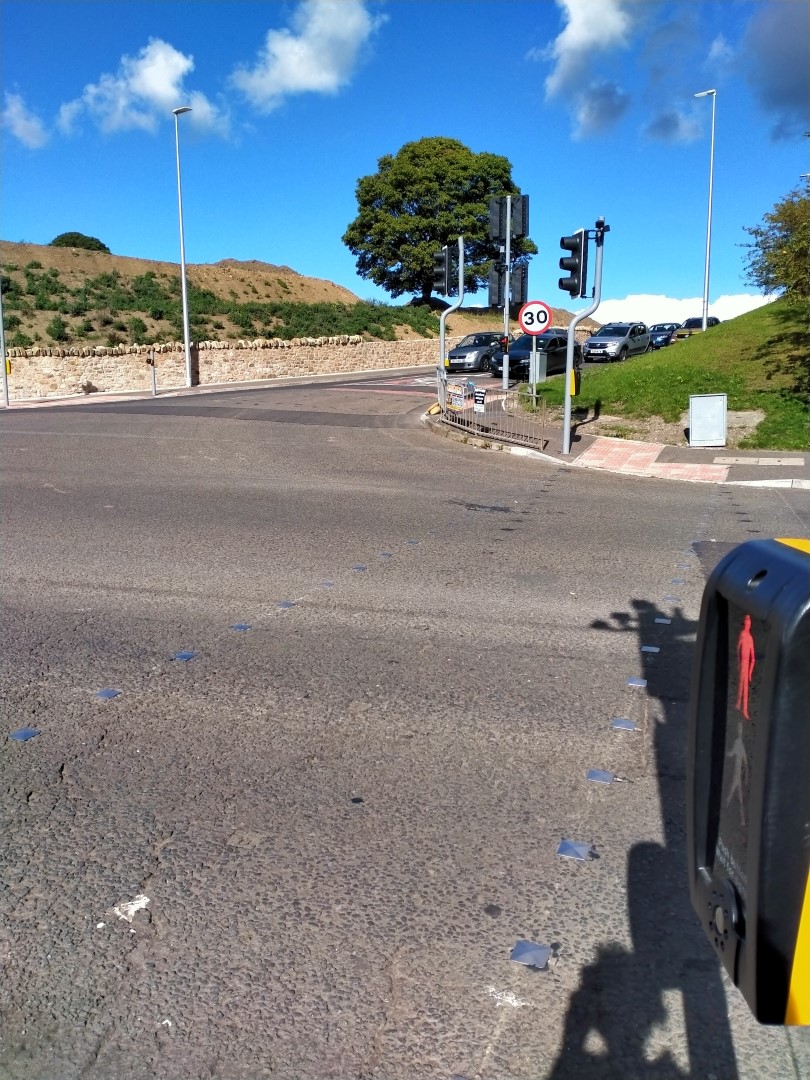
A Living Streets Edinburgh volunteer paid a detailed visit to this junction following social media reports. She described it as “one of the worse junctions I’ve seen. Truly shocking, and feels unsafe to walk across.
Pedestrian is vulnerable crossing three lanes of traffic with vehicles passing close by at up to 40mph. I would avoid using this crossing, and it would be especially risky for slower walkers, eg. with children, wheelchairs, sight impairment, or elderly, etc.”

Summary:
• Inadequate green man illumination (7 seconds).
• Wide splay, no islands, cyclists swirling along pavement.
• Small crossing signals, poorly positioned and difficult to see.
• Absence or invisibility of road sign for change of speed limit.
• Two cars observed speeding through crossing while woman was walking on Green Man phase.

Details:

Old Dalkeith Road (A7) / The Wisp
Traffic signals
Not automated
No audio (beeps)
Tactile cones – present and workoing
Max waiting time for GM: 59 seconds
Length of GM phase: 7 seconds
Date Fri 23/9/22
Time 12.30

Description:

This is a busy junction designed to ease vehicle flow, not protect pedestrians. The Wisp runs north-south onto Old Dalkeith Road which is in west – east direction (before bending south). There are two lanes of traffic both ways on Old Dalkeith Road travelling at 40mph. It is a complex traffic light system with filters for different traffic lanes going straight ahead or turning.

The speed limit changes at the junction, from 40mph on Old Dalkeith Road, to 30mph on The Wisp. There is a 30mph sign visible to vehicles turning right into The Wisp from east side of junction, but no sign is visible to vehicles turning in from the west. Without visible signage, vehicles turning left into The Wisp may continue to drive at 40mph in the 30mph zone past Danderhall village.

I’ve reported this speed signage problem to CEC and to Midlothian Council (as the junction is on the border).

Junction is splayed wide and traffic turns corner at 40mph.

There are two pedestrian crossings, operating separately from each other – south end of The Wisp, and Old Dalkeith Road at east side of junction. Both crossings span three traffic lanes with no islands offering protection. Pedestrian road markings are not easily visible, camouflaged by colour of road.

People must ‘cross with traffic’ which feels dangerous while vehicles alongside are moving through filter lights.

The new pavement on the west side of The Wisp is extra wide -maybe it is for shared use with bicycles? There are no signs on the pavement, but the pedestrian crossing includes cycle lights. Cyclists were observed using the pavement. (Not surprised – cycling on the road here would be hazardous or frightening, given the multiple traffic lanes and high speeds.)

There is a new housing estate under construction to the north-west of the junction.
The bus stop on the south side of Old Dalkeith Road is accessible only via the pedestrian crossing.

The crossing light for pedestrians is mounted at waist height and faces in the direction of the road, not the pedestrian’s crossing route, so the GM on the far side is not visible when walking across.
The GM is illuminated for only 7 seconds and changes to red before people have crossed the road, even when walking quickly.

By the time the pedestrian light on the far side becomes visible, it has changed to red, which is alarming since you have no way of knowing how long before traffic starts to move again.

Together with vehicles moving through the junction alongside while GM is illuminated, the pedestrian feels feels vulnerable and insecure.

Total cycle time varied from 1 minute to 1 min 45 sec, so the GM appearance was unpredictable. There are no beeps, and the pedestrian crossing light is small and poorly positioned, so it is easy to miss the change from red to green, and then have to wait another minute or more. It is also possible to miss the GM phase because it is so short, especially if watching the traffic to gauge when the lights will change.

I saw a person crossing without waiting for GM light, which is very risky because of unpredictable traffic flow from traffic filter lanes.

In one phase I saw two cars drive fast through the green man while a woman was crossing The Wisp. She was visibly shaken. She was on The Wisp crossing and the cars were turning left into The Wisp from Old Dalkeith Road (west) where traffic was moving at 40mph.

Either the drivers deliberately drove through their light on red, or they were confused by the filter lights (which were red for left but green for ahead). The cars went through the crossing a long time after the GM appeared, as the woman was already half way across.

Spoke to two women with pushchairs who were obviously frustrated with this crossing. They said it had been installed quite recently. The previous system had both pedestrian crossings green at the same time, and all traffic stopped at once, which felt safer as pedestrians could cross without vehicle movement. They miss the audio beeps that have disappeared.

The women were very glad to speak as they feel ignored by council and road planners.

Photos attempt to show poor visibility of pedestrian lights, and wide splay of roads at junction.

Smokey Brae Consultation – LSE Response

LSEG supports the proposals for Smokey Brae in the consultation advertised in April 2022: https://consultationhub.edinburgh.gov.uk/sfc/smokey-brae-improvements-developed-designs/

Smokey Brae is currently at total odds with the transport hierarchy. It feels like a hostile environment for anyone not moving in a car. The current layout puts pedestrians in as an afterthought and is particularly unsuitable for anyone pushing a pram or using a wheelchair. The pavement is too narrow, and traffic moves incredibly quickly and close to those using it. The pavement creates a pinch point that when two adults walk through in opposite directions on foot, they struggle to pass. If a pram or wheelchair is involved, one party must give way. Currently, walkers and wheelers who choose to avoid this junction due to its inadequacies must make a 15-minute detour.

LSEG greatly welcomes the proposals to redesign Smokey Brae and create a space that respects the transport hierarchy more.

We strongly support the introduction of continuous pavement with raised table junctions. We would like you to implement these using pavement materials rather than road material as this will emphasise pedestrian priority.

The designs appear to reduce the overall footway space available for pedestrians by removing the pavement on the eastern side of the road. However, this seems to be a reasonable compromise as there is currently no safe crossing near the railway underpass, and the existing footway is too narrow.

If it’s possible to make the proposed new pavement even wider, LSEG will welcome this. However, we appreciate this may not be easy to do given the overall width available and the welcome introduction of safe infrastructure for cyclists. Perhaps you could achieve this by closing the road from the T-junction to the Meadowbank House entrance to both northbound and southbound traffic, except for emergency vehicles only. This change would allow the fire service quick access to the south and create ample room for walkers, wheelers and cyclists alike.

LSEG members have noted that the Jock’s Lodge crossroads have abysmal pedestrian crossing times. Those who need to cross the road must wait for 2-minutes between signals and only have 7 seconds to cross. People who want to go down Smokey Brae will need to use these crossings. Pedestrians coming from Portobello Road will now have to as the pavement has switched sides. Therefore we think it should be a requirement to adjust the timings of these crossings to give more priority to pedestrians; 7 seconds isn’t enough!

Lastly, we’ve mentioned in our other answers to the survey that we would like the introduction of seating and wildflowers. Due care should be given to the seating positioning so as not to obstruct the natural movement of people through the area.