Tag Archives: Pedestrian Crossings

Response to consultation on Meadows to Castle Terrace cycle route proposal

You can read the full report here – LSE Response to Meadows to Castle Terrace cycle route

We welcome the measures included in this proposal to improve walking, although these are often fragmented and largely incidental to the continuous corridor-based approach to the cycling design – a particular example being the lack of continuous footways (avoiding changes of level for pedestrians) across side streets where they join the cycle corridor, despite this being a requirement of the Edinburgh Street Design Guidance (ESDG).

Worryingly, we have identified a number of other instances of the route design failing to comply with the ESDG. A fundamental principle of all such schemes is that designs should explicitly conform to the ESDG for the category/categories of street affected. Until the adoption of finalised Detailed Design Sheets for the ESDG, the latter’s Design Principles (as already adopted by the Council) should be adhered to, for example with regard to frequency of pedestrian crossing points, footway width, decluttering, crossfalls, improvements of currently sub-standard pedestrian crossing facilities and junction corner radii (amongst many other issues). These Principles are Council policy, and should also be adhered to in order to avoid the Council being subject to legal challenge under the Equality Act duty to make reasonable adjustments to assist protected groups.

We suggest that a workshop or seminar should be held in order to get the design right for both cyclists and pedestrians.

Key points of principle

Space:

  1. An increase (or no net loss) of pedestrian space.
  2. Footways meet recommended widths.
  3. Conflicts with cyclists are avoided, with dedicated and well-defined space provided for pedestrians (including separated ‘tiger’ crossings).

Crossings:

  1. Junctions make foot crossing easier by being raised, with radii of corners and widths minimised
  2. In busier areas, controlled crossings are provided in convenient places, with acceptable waiting and crossing times.
  3. Pedestrian priority is made clear at all the key crossing points of the cycle routes, eg with continuous footways across side streets at junctions.

Equalities:

  1. The design incorporates features to assist people with disabilities, including dropped kerbs (where continuous footways are not feasible), seating and tactile paving.

Public realm:

  1. The footway is made free from clutter.
  2. Guardrails are avoided / removed.

Impact of traffic:

  1. If the area is a residential or shopping street or busy pedestrian route the speed is 20mph and the design helps to achieve this speed.
  2. The level of parking and access to motor vehicles is appropriate and does not dominate the space.

You can read the full report here – LSE Response to Meadows to Castle Terrace cycle route

overall-plan

LSE press statement on east – west cycle route through Roseburn

This is a lot more than a cycle route – it brings plenty of benefits for pedestrians too, in terms of safer junctions, wider pavements and more road crossings.

At an early stage of the consultation we were concerned with aspects of the design which would have caused conflict between cyclists and pedestrians, but we’ve been impressed by the way the Council took on board our constructive suggestions.

A key point is that the pavements will now be widened on both the north and south sides of the busy stretch of Roseburn Terrace, and they will both meet the minimum width standards stipulated in the Council’s own Street Design Guidance.

That will help to make Roseburn Terrace a more people-friendly place, less dominated by road vehicles.

roseburn-plan-a

Walking Campaigners Welcome Change To Roseburn Cycle Plan Design

A proposed change to the design of the planned Roseburn-Leith Walk segregated cycling route has been welcomed by the local walking campaign, Living Streets Edinburgh [1]. The City Council’s amended plan published on 21st June suggested two options to change the route design at Roseburn Terrace, both of which removed the controversial ‘floating bus stop’ on the north side of Roseburn Terrace. The Convenor of Living Streets Edinburgh, David Spaven, said:

“We’re pleased that the Council have taken note of our biggest concern about the Roseburn design – a floating bus stop at this busy location would have created unwelcome conflicts between pedestrians and cyclists at a busy location.”

However, the group are continuing to strongly oppose the Council’s plan to drive the cycle route along the centre of the busy east end of Princes Street pavement, arguing that “this would take space from pedestrians and would create unmanageable conflicts between cyclists and pedestrians, in which the most vulnerable street users would inevitably come off worst.”

Living Streets says it is “surprised and disappointed” that the Council has not specifically addressed 16 other detailed concerns [2] it raised in the consultation, including the narrow footway on Roseburn Terrace towards the junction with Roseburn Street, and the proposed elimination of the eastbound bus lane from Roseburn to Coates Gardens.

In its submission  the group indicates that it will continue to work with the Council on the details of this scheme, and to scrutinise the emerging design iterations to ensure that they (i) prioritise the needs of pedestrians, (ii) are in line with Council’s own Street Design Guidance, and (iii) comply with Equality Impacts Assessment requirements.

The full response can be found here

Response to Roseburn-Leith Walk cycle route project amendments 21/06/16

Princes Street – lengthy pedestrian crossing wait times

Princes Street is the heart of Edinburgh and its busiest street for people on foot. But pedestrians get a very raw deal as they proceed along the street.  We have recorded video footage of this junction in September 2015 and found that it can take to FOUR MINUTES 22 SECONDS for people to wait for the green man phase to cross just the Frederick Street junction. This is an unacceptable wait time for people on foot and not only leads to delays for the great number of people on foot but is dangerous as some people will inevitably seek to cross before the ‘green man’ phase comes on, resulting in frequent ‘near misses’.

The problem lies with the timing of the traffic signals. According to council policy, “absolute priority” is given to trams; this has had a knock-on effect of increasing the time that pedestrians have to wait to cross the roads which join Princes Street. However, the Council has responded to our concerns by tweaking the signal timings and we understand that pedestrian wait times have reduced recently. We will make more video recordings in the future, so that the pedestrian experience and actual wait times can be accurately documented and monitored. We also want to ensure that, should trams be extended to Leith or Newhaven in the future, there is no detriment to the pedestrian experience on any other part of the tram route.


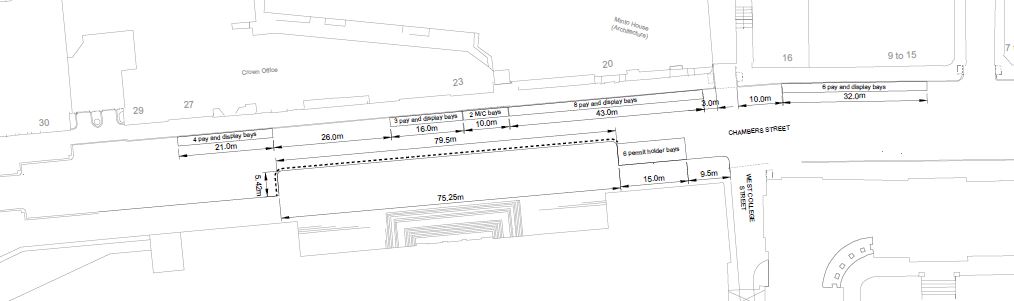
Response to Chambers Street TRO

Living Streets Edinburgh is pleased to support the initiatives to make better use of Chambers St.  We support the principles proposed in the TRO.

Chambers-Street-TRO

(The original Traffic Regulation Oder can be found here)

However, in the interests of taking placemaking seriously, we would like to see the proposal go further than simply creating a performance/gathering space in front of the NMS.  Any placemaking project  should surely consider the street as a whole, and not simply one short stretch.

Chambers-Street-Widen-Full-Length-2We would like to see the widened pavement stretching at least the full block from West College St to George IVth bridge, and preferably the full length of the street.

This would provide a more balanced effect, rather than creating an uneven patchwork. It would also respond to the congestion that regularly occurs on the pavement around the new, tower entrance to the NMS building.

This buildout would provide a much enhanced pedestrian experience both for those travelling along the street, and for those visiting the museum.  Similar consideration should also be given to the junction with South Bridge, which records very high footfall, but which is often an unpleasant experience for those on foot.

Chambers-street-Crossing-2Finally, to enable pedestrians safer access to the Cowgate, we propose a zebra crossing  across Chambers Street at West College St. This would link up NMS to the steps down to Guthrie Street, as well as making it easier for staff and students moving between George Square and University buildings on the far side of Chambers st.