Tag Archives: Pavement Widths

Smokey Brae Consultation – LSE Response

LSEG supports the proposals for Smokey Brae in the consultation advertised in April 2022: https://consultationhub.edinburgh.gov.uk/sfc/smokey-brae-improvements-developed-designs/

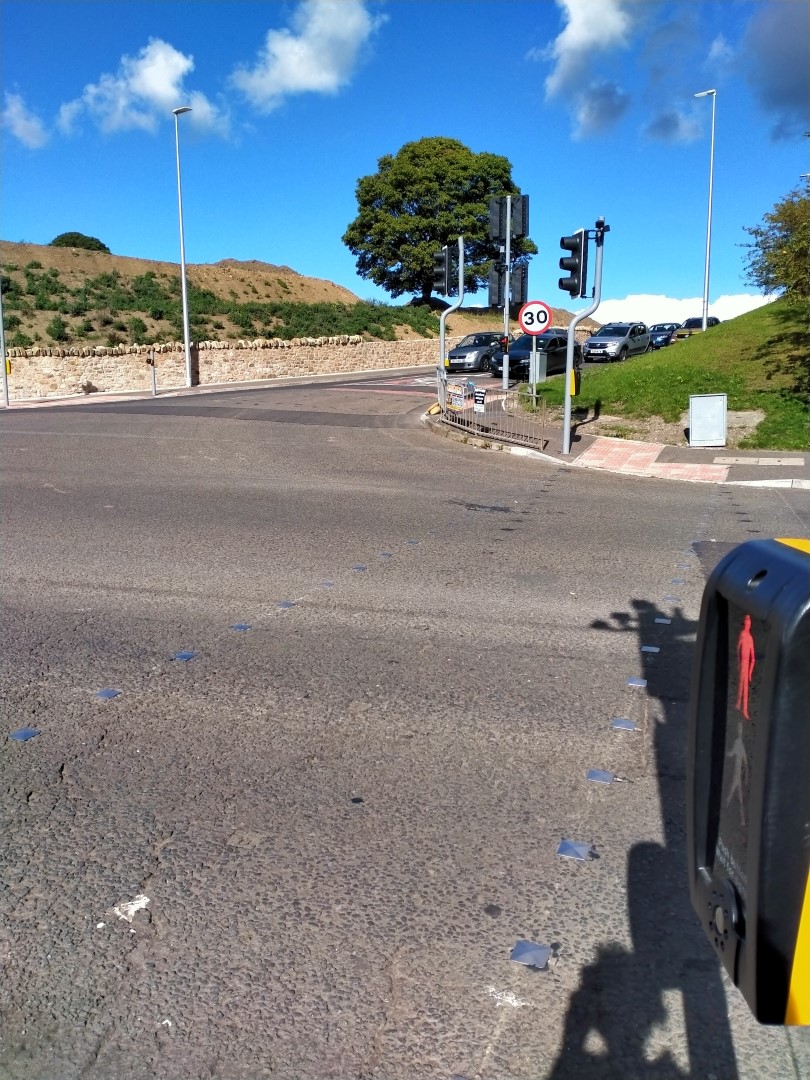
Smokey Brae is currently at total odds with the transport hierarchy. It feels like a hostile environment for anyone not moving in a car. The current layout puts pedestrians in as an afterthought and is particularly unsuitable for anyone pushing a pram or using a wheelchair. The pavement is too narrow, and traffic moves incredibly quickly and close to those using it. The pavement creates a pinch point that when two adults walk through in opposite directions on foot, they struggle to pass. If a pram or wheelchair is involved, one party must give way. Currently, walkers and wheelers who choose to avoid this junction due to its inadequacies must make a 15-minute detour.

LSEG greatly welcomes the proposals to redesign Smokey Brae and create a space that respects the transport hierarchy more.

We strongly support the introduction of continuous pavement with raised table junctions. We would like you to implement these using pavement materials rather than road material as this will emphasise pedestrian priority.

The designs appear to reduce the overall footway space available for pedestrians by removing the pavement on the eastern side of the road. However, this seems to be a reasonable compromise as there is currently no safe crossing near the railway underpass, and the existing footway is too narrow.

If it’s possible to make the proposed new pavement even wider, LSEG will welcome this. However, we appreciate this may not be easy to do given the overall width available and the welcome introduction of safe infrastructure for cyclists. Perhaps you could achieve this by closing the road from the T-junction to the Meadowbank House entrance to both northbound and southbound traffic, except for emergency vehicles only. This change would allow the fire service quick access to the south and create ample room for walkers, wheelers and cyclists alike.

LSEG members have noted that the Jock’s Lodge crossroads have abysmal pedestrian crossing times. Those who need to cross the road must wait for 2-minutes between signals and only have 7 seconds to cross. People who want to go down Smokey Brae will need to use these crossings. Pedestrians coming from Portobello Road will now have to as the pavement has switched sides. Therefore we think it should be a requirement to adjust the timings of these crossings to give more priority to pedestrians; 7 seconds isn’t enough!

Lastly, we’ve mentioned in our other answers to the survey that we would like the introduction of seating and wildflowers. Due care should be given to the seating positioning so as not to obstruct the natural movement of people through the area.

Strategic Transport Projects Review/ STPR2 – Comments by LSE

Living Streets Edinburgh Group is the local voluntary branch of the national campaign for everyday walking and wheeling. We welcome the opportunity to comment on the Scottish Government’s draft proposals for capital investment in transport over the next 20 years (STPR2).  https://www.transport.gov.scot/our-approach/strategy/strategic-transport-projects-review-2/

Walking and Wheeling

The draft STPR2 proposals completely fail to recognise the importance, or scale of the task, of improving pedestrian spaces in Scotland. With ‘walking and wheeling’ top of the Scottish Government’s own sustainable travel hierarchy, the lack of any coherent programme to improve the everyday pedestrian experience is a serious omission which, unless rectified, would greatly undermine the opportunity to achieve the Government’s social, economic and environmental objectives.

There is a wealth of evidence on the negative effects of, and inequalities caused by, poor walking environments. Given the emphasis in STPR2 on ‘evidence-based’ decision-making, it is essential that an ambitious programme to improve the legacy of inaccessible, inadequate and poor quality infrastructure is adopted as a strategic priority.

In particular, we call for:

  • the inclusion of local roads in the scope of the STPR2. This is vital for the achievement of many of the recommendations, including ‘Connected Neighbourhoods’ (#1) and ‘Increasing Active Travel to Schools’ (#8).
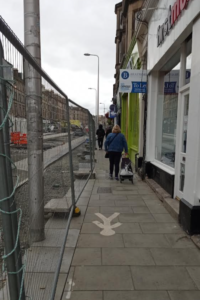
  • a specific theme on improving pavements – both widening them and improving the surface quality. The wider pavements introduced by the City of Edinburgh Council in local town centres as part of ‘Spaces for People’ have almost all been removed. We wrote to Ministers in 2021 (jointly with Spokes Lothian) asking that capital funding is made available to councils to ensure that infrastructure is introduced to replace temporary schemes which is fit for purpose in the long term: The STPR2 is the opportunity to address this.
  • investment in walk-friendly junctions. Scotland (like the rest of the UK) has a massive legacy of street design which favours vehicles, not people. Junction splays in many residential areas are wide, favouring 30+ mph speeds even where those limits have been reduced to 20 mph. There is a huge job to redesign junctions with a tighter radius and shorter crossing route for pedestrians.
  • investment in traffic signals and pedestrian crossings. Much signalling infrastructure is out of date and cannot easily be adapted to give priority to travel modes which we need to put first – public transport, cycling and especially of course, walking.  We have documented pedestrian wait times at dozens of signalled crossings in Edinburgh and found many to be quite unacceptable: . On a positive note, there is a massive opportunity to improve them at relatively modest investment.
  • a national programme of investment in dropped kerbs and continuous footways. In Edinburgh, we have been told that 17,000 out of 22,000 junctions have no, or substandard, kerb arrangements. These make pavements dangerous – or simply unusable – for many pedestrians, especially disabled people.
  • a national effort to reduce pavement clutter (and to stop adding to it). This includes management of temporary obstructions such as hedges and bins, and removal of unnecessary fixed structures such as signage poles and guard rails, many of which persist despite changes in legislation (TSRGD 2016) and recognised best practice. New threats to pavements such as telecoms cabinets and EV chargers must be avoided. See our reports and video resources for further information here: .
  • an initiative to encourage the provision of seats and toilets, especially in high footfall areas. Both of these simple, modest measures are important to many pedestrians – and especially for older people, children, disabled people and women. A national programme which increased such provision would make many areas more attractive and inclusive at modest cost.

Cycling

We support investment in cycling infrastructure, especially in routes which will encourage more people to commute into Edinburgh by bike, rather than by car. However, the recommendations under the ‘Active Travel’ theme do not have the right balance between walking/wheeling on the one hand, and cycling on the other, and this section does not properly reflect the agreed ‘sustainable travel hierarchy’.

Influencing Travel Choices

We strongly support the wider rollout of 20 mph speed limits in residential and shopping areas. However, they need to be accompanied by both engineering and enforcement measures. Many streets are designed for 30mph+ travel and driver compliance is known to be lower in such circumstances. There is enormous scope for imaginative use of new technology to assist with compliance, education and enforcement.

Measures to encourage active travel to school are very important. Our comments under the first active travel theme are relevant here. Official data (TaTiS 2019) shows that 52% of children currently walk to school in Scotland, which is an encouraging basis to build on. Only 2% of children cycle and while there is certainly scope to increase this figure, this data underlines again the need for active travel efforts to focus much more on safe walking environments.

Public transport

We support investment in the public transport measures with two qualifications. It is vital that good quality public transport is available if car reduction targets are to be achieved. However, we don’t support the recommendations on ‘DRT and MaaS’ (#20) or ‘mobility hubs’ (#22) as they stand.  We consider these initiatives to be over-hyped and lacking an evidence base that they will make a significant contribution to improved public mobility. We suggest instead that investment in DRT focuses on exploring opportunities there may be to develop existing DRT services such as community transport (which is under-funded), taxis and private hire cars. ‘Mobility hubs’ should be seen simply as one aspect of better transport interchanges (#21) rather than as a separate recommendation in its own right.

Increasing …resilience

The STPR2 has far too many ‘get out clauses’ which could be used to justify further significant investment in trunk roads and motorways, especially under the ‘Increasing safety and resilience’ theme.  For example, “Junction improvements, carriageway widening, route realignment and provision of overtaking opportunities” (#30) are not the priorities Scotland needs. These recommendations are not consistent with the ambitious national targets to reduce motor traffic, and would have an enormous opportunity cost in reducing the scope for investment in everyday walking and wheeling.

Planning policy

Investment in infrastructure needs to be accompanied by complementary planning policy. The ‘Infrastructure First’ principle, advocated in the draft NPF4, is essential so that new developments do not proceed until suitable sustainable transport options are in place. This is especially important around Edinburgh; for example the housing developments around West Craigs and Winchburgh where it appears that the essential new railway station may be in doubt despite massive housing expansion.

This document can be downloaded as a pdf here

LivingStreets Edinburgh Group: our manifesto for Council elections May 2022

Please see our manifesto for the 2022 council elections. We hope that all parties and all candidates will adopt these policies, to make Edinburgh the wonderfully walkable city it should be. Please help get walking and wheeling given the priority it needs by asking your councillor and candidates for their support!

Living Streets Edinburgh is the local group of the national charity that campaigns for everyday walking and wheeling. Edinburgh is essentially a wonderful city for walking, thanks to its size, history and geography. However, the pedestrian environment is often substandard and overlooked by policy makers. We want everyday walking to be accessible, attractive, convenient and quick.

All parties in the current council agreed in August 2020 that walking is “top of the sustainable movement hierarchy”. But in practice walking is often given inadequate priority and funding, despite it being the greenest and most universal way that people travel.  We ask all candidates and political parties standing for election in May 2022 to support the following actions for the next council term:

Reduce motor traffic

  • Reduce road space for motor vehicles, including supporting low traffic zones and reducing on-street parking spaces;
  • provide better alternatives for people to travel by walking, cycling and public transport;
  • adopt a tougher approach to enforcement of antisocial parking – including at bus stops, schools and in bus and cycle lanes;
  • early and ‘zero tolerance’ enforcement of the pavement parking ban when it is introduced.

Improve pavements

  • Introduce proper wider pavements in all ‘town centre’ locations, replacing the temporary ‘spaces for people’ measures;
  • make pavements smooth and trip-free with a 20% increase in footway maintenance budgets;
  • set a new budget to remove pavement clutter, and stop adding to it (for example through EV chargers);
  • introduce at least 100 dropped kerbs (or continuous pavements) a year where they are missing.

Improve pedestrian crossings

  • Review every signalled pedestrian crossing to reduce the time people have to wait to cross;
  • increase the ‘green man time’ for pedestrians to a minimum of 10 seconds;
  • increase the pedestrian crossing budget by 20% and support the widespread introduction of low cost crossings such as ‘informal zebras’.

Make roads safer

  • Renew the council’s road safety plan with a vision zero approach – there should be no deaths or serious injuries from traffic collisions by 2030;
  • increase enforcement of road traffic offences such as speeding and red light jumping, with a big increase in the use of speed cameras;
  • introduce a safe travel plan for every school in the city which either removes traffic from the school gates or (where not possible) makes the pavement wider.

Use planning controls effectively

  • Encourage car-free housing on brownfield sites;
  • reject car-dependent applications including commercial ventures such as ‘drive through’s;
  • ensure developers pay a fair contribution to improving pedestrian spaces through voluntary or ‘Section 75’ payments.

https://www.livingstreetsedinburgh.org.uk

November 2021

CAMPAIGNERS SLAM ‘HOPELESS’ LEITH WALK PAVEMENTS

Campaigners for better walking in Edinburgh have slammed the plan for pavements alongside the tram on Leith Walk as ‘hopeless’. It has emerged that the pavements, which are being rebuilt as part of the tram works, will be so narrow that in many places they don’t even meet the council’s own standards for minimum width. The campaigners have been told that over 250 metres of footway,  in 11 different sections, will be below this minimum – in one place (just north of the Pilrig Street junction) as little as 1.8 metres wide.

David Hunter, Convenor of Living Streets Edinburgh Group said: “We’re incredibly disappointed to learn of the hopeless final design for many sections of Leith Walk’s pavements.  These pavements should be at least 3 metres wide, with a stipulated minimum of 2.5 metres.  As the main link between Edinburgh and Leith, and an important local street in its own right, Leith Walk needs quality pedestrian space. We are big supporters of the tram project, and welcome the benefits it will bring to people walking in other places. But having engaged with the tram team regularly over the past two years, it’s a bombshell to hear – right at the point of construction – just how poor the the street will be for pedestrians.

This is frankly unacceptable and at odds with the repeated claims that “walking and wheeling” are top of the ‘Sustainable Travel Hierarchy’, both in Edinburgh and in Scotland as a whole. Even at this, the eleventh hour, we’re calling on the council to revisit the plans to give pedestrians the space they need.”

Position Paper On Picardy Place Detailed Design

Following the regrettable decision of the City Council’s Transport & Environment Committee on 25th January 2018 to back the traffic-generating gyratory roundabout design, Living Streets Edinburgh is now focusing on the need for significant improvements in the detailed design of the Picardy Place scheme. Incredibly, the latest Council design actually represents a net deterioration in the pedestrian environment compared to the current (pre-Leith Street closure) situation on the ground – as a result of, in particular, more circuitous road crossings, narrower pavement sections, and cycling /walking conflicts where new cycleways bisect footways. This is not acceptable.

Continue reading Position Paper On Picardy Place Detailed Design