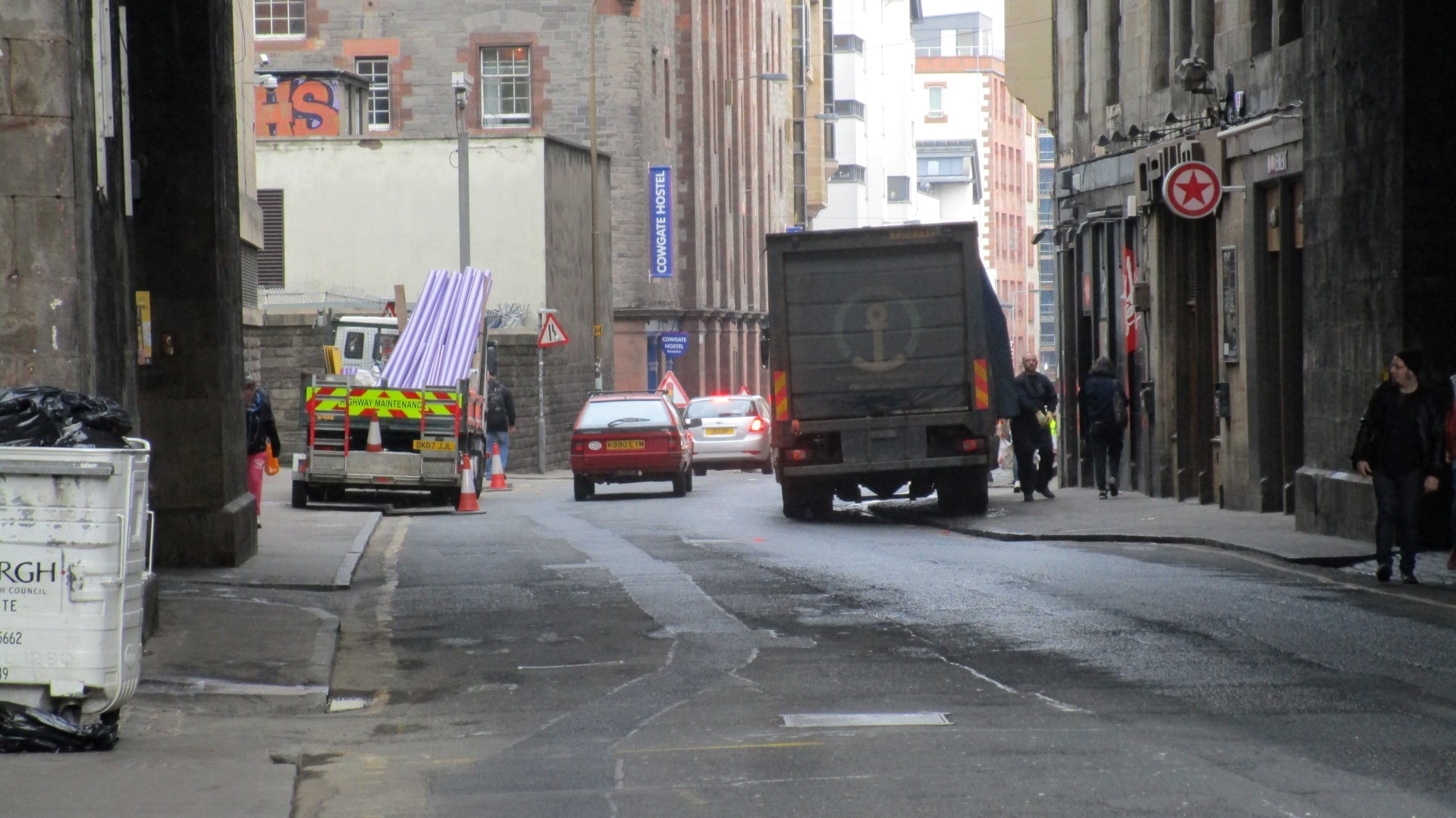
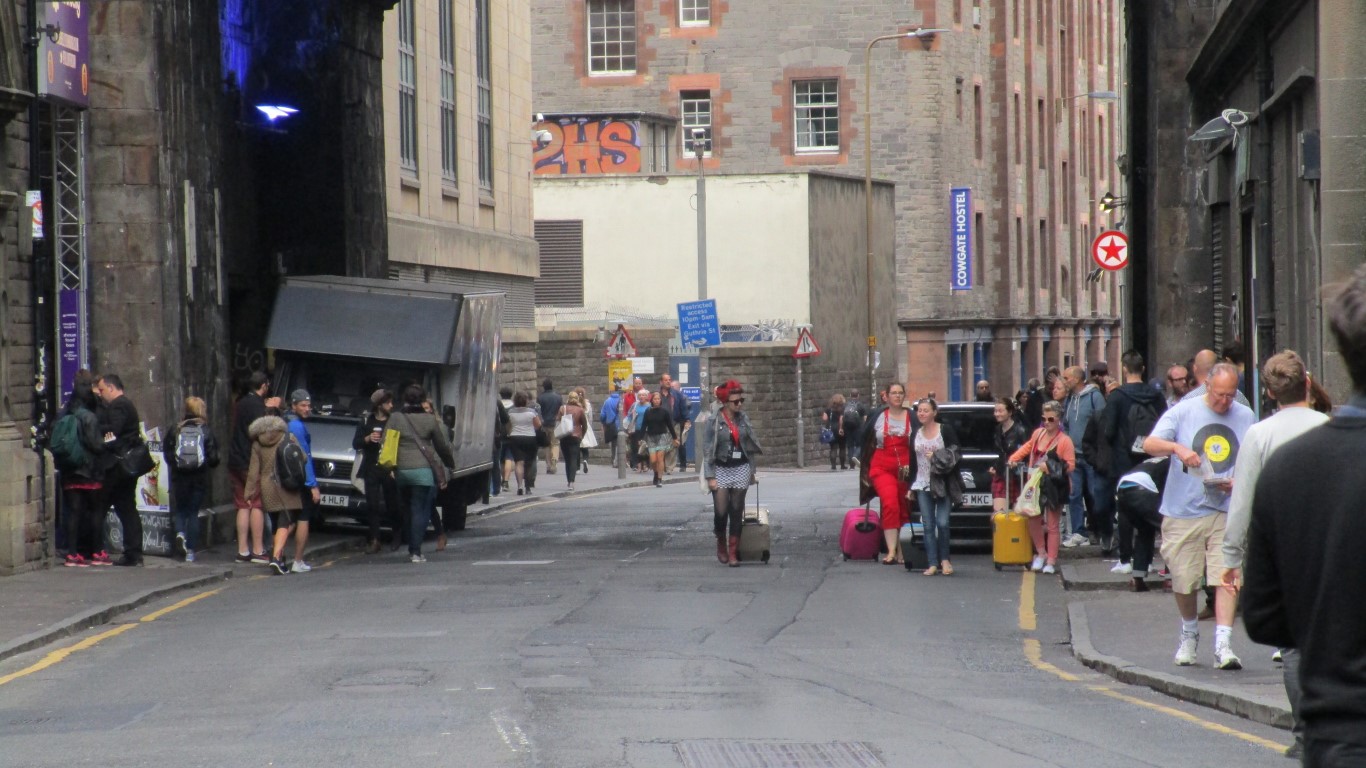
Living Streets Edinburgh would like to ask that the Council formally considers the widespread closure of streets during next summer’s festival season. This year, many of our members noted how many city centre pavements were so crowded (especially in the Old Town) that they were not only uncomfortable, but also felt unsafe. In addition, bus timetables became highly unreliable. Narrow pavements were occupied by hundreds of people, while wide roads were occupied by a handful of vehicles. The situation was exacerbated in streets like the Cowgate, where pavements were also frequently blocked by vehicles servicing venues. Unlike Glasgow during the Commonwealth Games (with similar attendances), there are no special provisions such as Park and Ride.
As a result, the way that Edinburgh’s streets are used at this time of year has become completely out of balance. We believe that the festival has grown to such an extent that a wholesale review is required to make much of central Edinburgh car-free during the peak festival season. This will make the Edinburgh festivals more enjoyable and successful, with a positive effect on travel, safety, tourism and the economy.
We therefore ask that a report is brought to appropriate Council Committee(s) to recommend measures which will redress this imbalance and make much of the city centre car-free for 2016. This report should consider the extent of street closures to general traffic (apart from buses) and recommend what exemptions might be made (considering issues such as emergency vehicles, taxis, deliveries and disabled parking).
We hope that you will agree to this request and look forward to your reply.
Living Streets Edinburgh objection to planning reference 15/04445/FUL- Mixed use development comprising hotel, bar, restaurant, cafe, retail and commercial uses and alterations to India Buildings, 11-15 Victoria Street and Cowgatehead Church. | 1 -15 Victoria Street 18-20 Cowgate Edinburgh EH1 2EX
Living Streets Edinburgh has a number of concerns about this application, which lead us to object to it. Our reading of the application leads us to believe that the developer has not fully considered the implications of their proposal for pedestrians, and where they have considered them, they have ignored key issues.
Our main objection relates to the issue of loading/unloading in the Cowgate and Victoria Street, but we highlight below further concerns about access to bus stops, and general pedestrian accessibility.
Loading & Unloading
The planning application proposes that coaches and goods vehicles will use the Cowgate for loading/unloading of goods and people. They’ve included a very narrow loading bay to facilitate this. However, the Cowgate is simply not wide enough at this point to accomodate vehicle loading.
The proposed loading bay will take away valuable pavement space. The pavements in this area are already very narrow – and are on a busy road. They’re currently 1.8m (at the back of this site ), and yet the developers want to NARROW them further, which seems likely to take them to the very minimum advised in the council’s own street guidance, given that the Cowgate is demarcated as a secondary retail/high st.
At present, deliveries to the site use the lane at the back of the Central Library up to the back of ‘Espionage’. They do not use the street as in the current proposal. The Cowgate is one of the only east / west roads left in the city center open to general traffic. Any blockage would have major knock on effects through the Cowgate and Grassmarket. Any vehicle loading or unloading would cause severe congestion within minutes. The proposed narrow loading bay would not facilitate 2 way traffic.
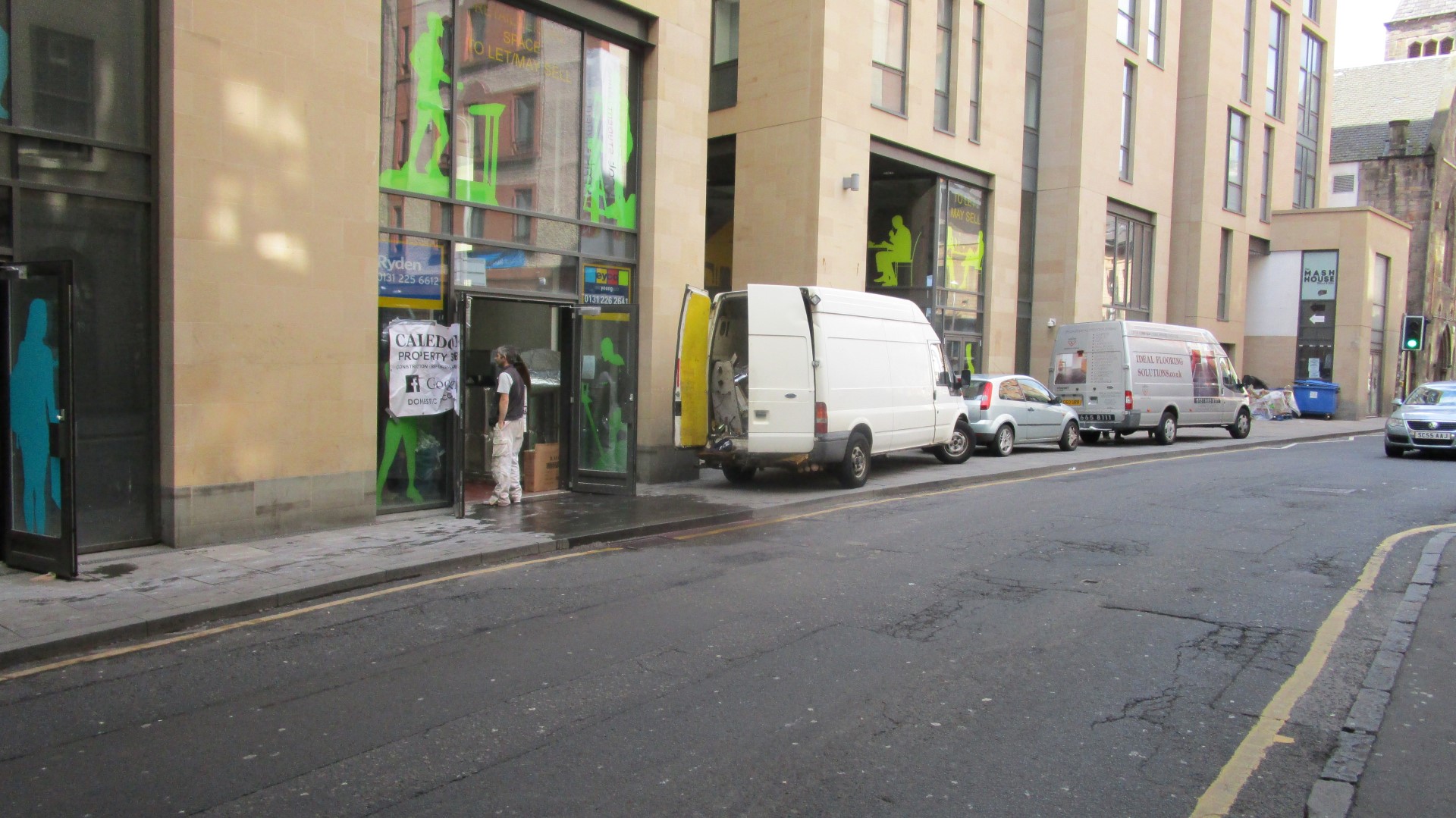
As can be seen elsewhere in the Cowgate, delivery vehicles frequently park on the pavement, forcing pavement users into the road. The damage caused by delivery vehicles can be seen throughout the Cowgate. It would be extremely deleterious to the pedestrian experience of Edinburgh, as well as costly to the council, if this practice were to be expanded any further.
For example, at the back of the recently opened Soco development an attempt was made by developers to build a loading bay on the pavement. This has not worked as vehicles often take up the entire loading bay AND pavement, again blocking the pavement for legitimate users.
Night-time closures
We also note that the site is within the night time road closures of Cowgate. There is no mention of this in the planning application. If a delivery vehicle or bus requires access 10pm till 6 am where do they park? If a vehicle does go through the no entry signs, parks on the Cowgate, how would it leave the site? Reverse out or drive through the closed road? Any of these options would again be disadvantageous to vulnerable road users such as pedestrians.
Narrow pavements and expanded footfall
Pavement narrows to just 85cm meters from the proposed development
This proposal will inevitably increase the number of pavement users on the Cowgate. No mention of this has been made in the application. To the east of this development the pavement narrows to just 85cm under George the 4th Bridge on both sides of the road. To the west pedestrians have to negotiate the very wide junction at the bottom of Victoria street.
With regards to Victoria Street the road narrows at the front of the development / behind the G&V Hotel. As can be seen in some of the photos in the application the pavements in this area have been badly damaged by delivery vehicles parking on them.
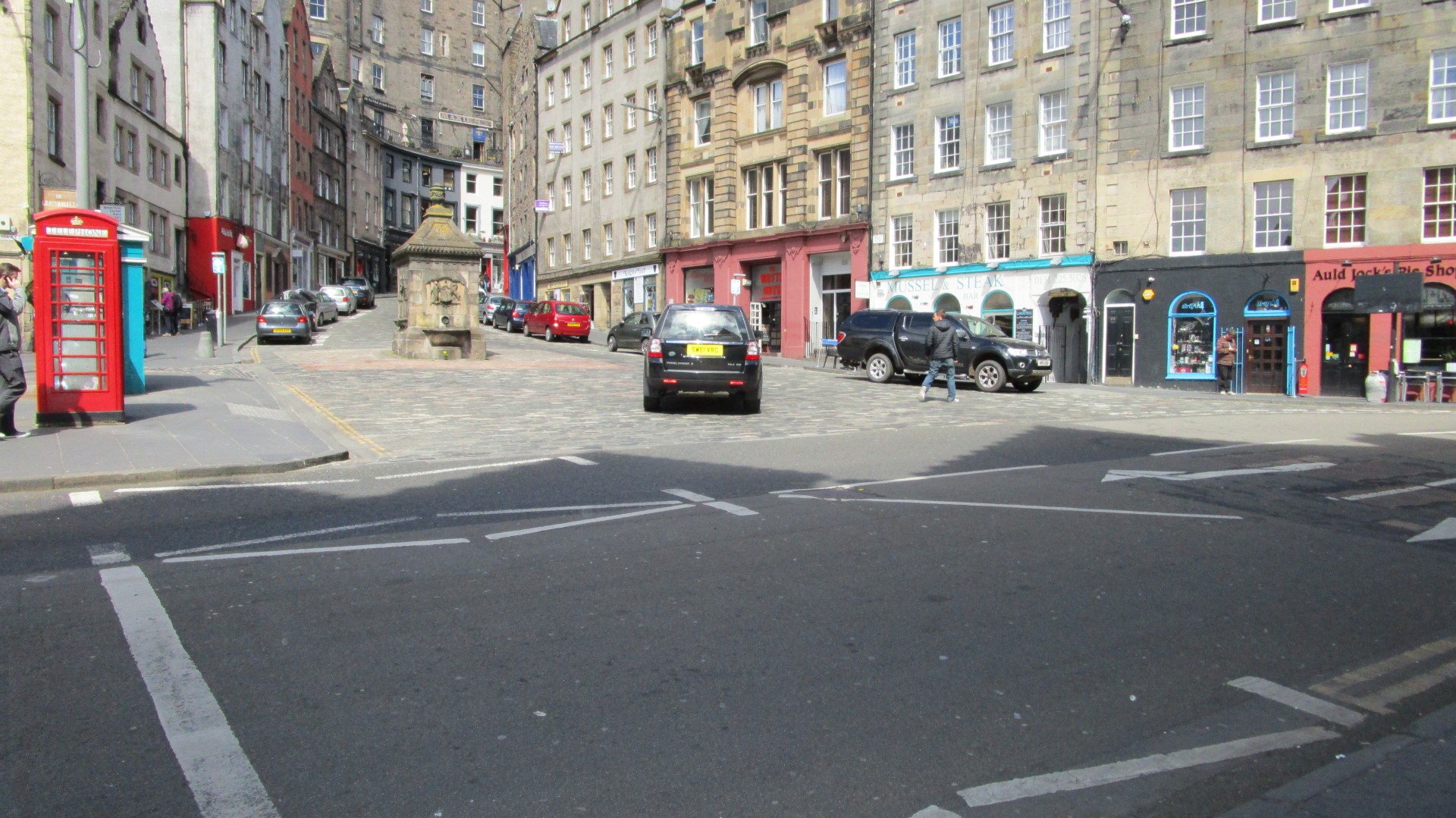
Cowgate / Victoria Street junction – very wide for pedestrians to cross
Victoria st junction
Any hotel guest trying to travel north will have to cross the 2 lanes of traffic at the top of Victoria Street. During the rush hour it can be difficult to cross this junction on foot. The increased number of vehicle movements on this street as a result of this development will only make the issue worse.
We are also concerned about the knock-on effects on Victoria St, which is likely to be used by coach or other delivery vehicles, especially those relying on SatNav. The street runs the risk of being overwhelmed if large vehicles attempt to negotiate this narrow street and become blocked.
Bus facilities- George IV bridge
The planning application makes note of the bus facilities nearby for use by its customers. It does not mention that you have to cross 4 lanes of heavy traffic on George IV bridge to get to them.
Our advice would be that if the development is approved, it should be on the condition that
An off-street loading / unloading / drop off point should be created off the Cowgate. The site is big enough for this. There’s an example of an off road delivery bay at the Smart City Hostel further along the Cowgate.
The pavements should be widened along this part of the site to at least the far side of the George the 4th Bridge.
A pelican crossing should be installed on George the 4th Bridge at the top of Victoria St to allow people to cross the road without having to walk up to the junction with the Royal Mile to be able to cross the road safely.
All pavements surrounding the site should be protected by bollards to prevent vehicles parking on the pavement. The upkeep and maintenance of these bollards and the paving stones should be met by the development.
During construction pedestrian traffic should be maintained on both sides of the road.
The bottom of Victoria Street at the junction with the Cowgate should be narrowed to allow pedestrians to cross the junction safely.
Along Victoria Street and the Cowgate more crossing points should be provided to allow pedestrians safer access to the development.
The Living Streets Edinburgh group organised a ‘street audit’ in Tollcross on 25 and 26 September. The aim of the initiative was to help the local community identify improvements to local streets in a systematic way and campaign for improvements. Thirteen people took part, with Living Streets supporters and members of the public joined by people from the Tollcross Community Council and the Edinburgh Access Panel.
The focus was on Home Street and Lochrin Place – streets which will be improved shortly during works to link the cycle network from the Union Canal to the Meadows. The chief recommendations were to:
better manage movable clutter (A boards, bins etc);
introduce a proper cycle parking plan to meet demand (on street where possible);
make enforcement effective – for example, cushioning of scaffolding, management of waste bins and parking controls;
install dropped kerbs and tactile paving consistently and properly;
ensure that pedestrians can cross the street easily at signalled crossings (especially at Tollcross itself).
A meeting with council officials to discuss the findings will be organised soon and we hope to see improvements introduced this financial year. Living Streets Edinburgh hopes that this audit will encourage other local communities to organise audits of their streets throughout the city, to identify improvements to the design, maintenance and management of the walking environment.
CAMPAIGNING GROUP CALLS FOR DELAY IN ‘FLAWED’ NEW BUS SHELTER PROGRAMME
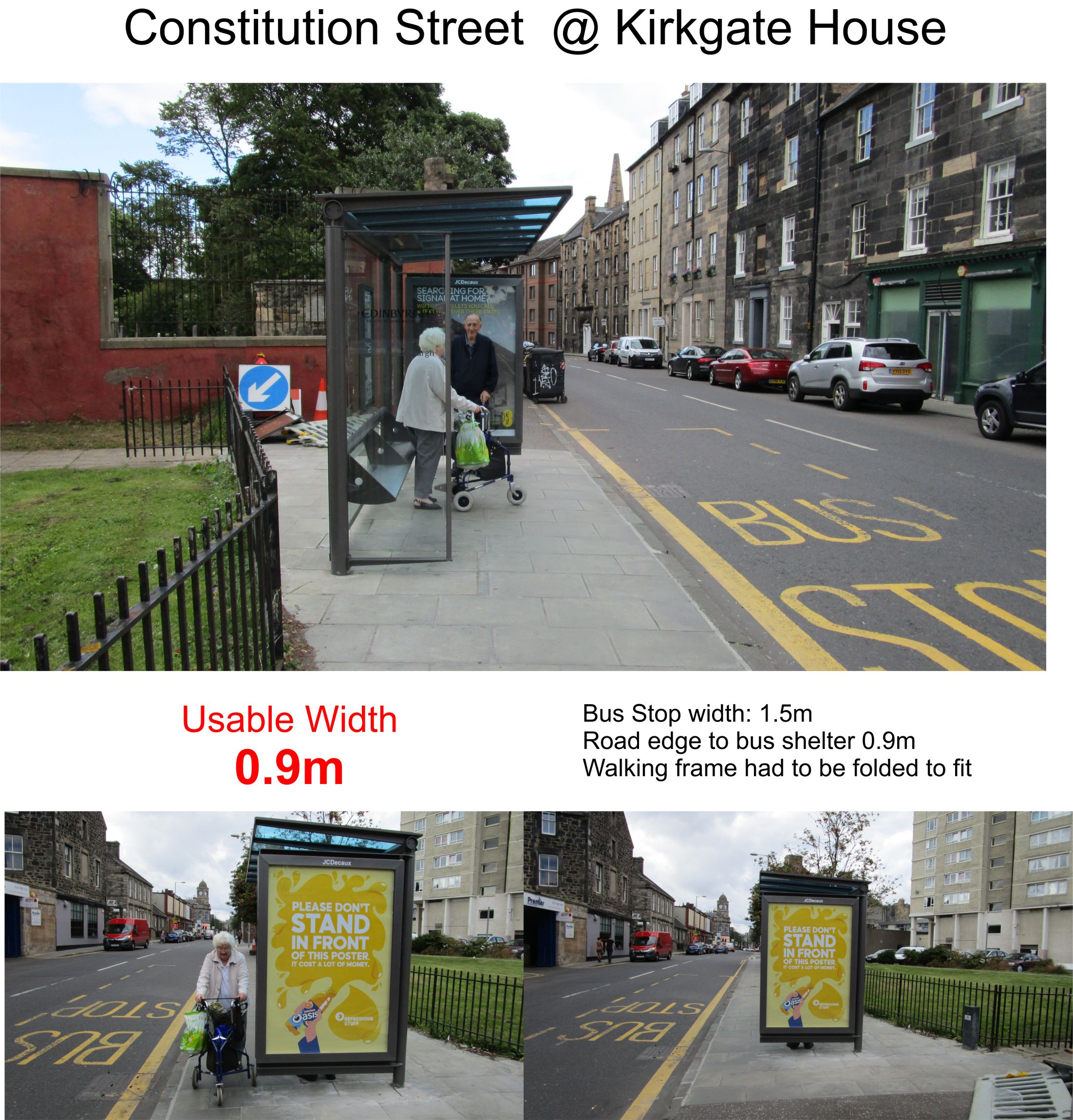
The City of Edinburgh Council (CEC) should call a halt to its new bus shelter programme [1] while numerous breaches of Council space standards for pedestrians by contractors are investigated, says the walking campaign group, Living Streets Edinburgh [2]. In a letter to CEC Transport Convenor, Cllr Lesley Hinds [3], Living Streets say that “in random sampling in a few areas of the city we have identified a range of locations [4] where the pavement space left for pedestrians does not met the minimum standard in CEC’s Bus-Friendly Design Guide. which states that ‘an unobstructed width of at least 1400mm must be provided along any length of footway adjacent to a shelter’”. The group’s Convenor, David Spaven commented:
“We’ve found some shocking examples where contractors installing new shelters have seriously failed to meet the Council’s own standard that ‘an unobstructed width of at least 1400mm must be provided along any length of footway adjacent to a shelter’. This is highly inconvenient for people on foot and in wheelchairs, and flies in the face of the Council’s claim to be prioritizing the needs of pedestrians. The bus shelter programme is clearly flawed and we’ve called on Cllr Hinds to delay the implementation programme until CEC can be assured that implementation will be such as to (a) meet CEC’s minimum standards and (b) at the very least not make conditions worse for pedestrians at the bus stops.”
MORE INFO: David Spaven on 0131-447-7764 or 07917-877399
NOTES FOR EDITORS:
[1] Over 350 ‘advertising bus shelters’ are being provided across the city as part of a 10-year CEC contract with JC Decaux, a major advertising company, see: http://www.jcdecaux.co.uk/edinburgh-live
[2] Living Streets Edinburgh is the local volunteer group of Living Streets the national charity for ‘everyday walking’, see: http://www.livingstreetsedinburgh.org.uk
[3] Letter from Living Streets Edinburgh Group to Cllr Hinds sent 11 October 2015:
‘Cllr Hinds
‘Living Streets Edinburgh is concerned that a number of the new bus shelters now being installed by JC Decaux are failing to meet even the absolute minimum space standards specified for pedestrians in CEC’s Bus-Friendly Design Guide, let alone providing much needed improvements to allow reasonable space for pedestrians. In random sampling in a few areas of the city we have identified a range of locations (see foot of letter) where the pavement space left for pedestrians does not met the minimum standard in the Guide, which states that ‘an unobstructed width of at least 1400mm must be provided along any length of footway adjacent to a shelter’.
‘We are aware of two instances, at Constitution Street and at Buccleuch Street, where the shelters have apparently been installed in the wrong positions, and where remedial action is being taken, or is planned, after this has come to the attention of CEC staff.
‘But there are other locations where the minimum standards have clearly also been breached, such as Crewe Road North (at Selex) and Lindsay Road (at Annfield), and a number of others where the absolute minimum width requirements are barely met, but where the shelters could readily have been positioned to give more space. Examples of the latter are on Ferry Road (at Wash & Valet, Morrisons and Pilton Drive). In these instances the shelters could have been positioned at the rear of the pavement where an unnecessary c. 0.5m gap has been left (supposedly for cleaning purposes, despite there being no need for such a gap and none usually being left when installing CEC funded shelters).
‘It would seem that JC Decaux and their contractors cannot be relied upon to have any regard for the needs of pedestrians, or for the Council’s standards, even at the most basic level. In the circumstances we are seeking your intervention to delay the implementation programme for the new shelters until CEC can be assured that implementation will be such as to (a) meet CEC’s minimum standards and (b) at the very least not make conditions worse for pedestrians at the stops.
‘In view of the importance of this issue, we will issuing a media statement, embargoed until 10.00 Tuesday 13th.

 As a result, the way that Edinburgh’s streets are used at this time of year has become completely out of balance. We believe that the festival has grown to such an extent that a wholesale review is required to make much of central Edinburgh car-free during the peak festival season. This will make the Edinburgh festivals more enjoyable and successful, with a positive effect on travel, safety, tourism and the economy.