Category Archives: Road Safety

Tram safety review – what about pedestrians?

16th August letter to Councillor Lesley Macinnes

Dear Councillor Macinnes

We are very pleased to see some real debates starting in earnest about a vision for Edinburgh where people (pedestrians!) take precedence over traffic and look forward to participating in these discussions over the coming months.

Meanwhile, there is one important matter to which we wanted to draw your attention, concerning the motion on tram safety which you put to full Council of 29 June last year. This essentially called for a “thorough infrastructure review…to improve pedestrian and cycling safety”. A consultation was carried out by the Council in response to your motion, but this dealt with cycling safety alone.  Our response focussed on the need to respond to your motion by also considering pedestrian safety:  http://www.livingstreetsedinburgh.org.uk/2018/04/10/edinburgh-tram-route-cycle-safety-consultation-comments-by-lse

We were then further disappointed to see walking safety considerations and improvements once more entirely ignored in the Council’s summary of the consultation responses, which again dealt solely with cycling safety:   https://consultationhub.edinburgh.gov.uk/sfc/tram-route-cycle-safety-improvements/

We subsequently raised these concerns directly with the Active Travel Team; however, we were unable to convince them that a wider remit for the project to include the safety and convenience of pedestrians was as necessary as that of cyclists. Discussion on the walking aspects of the project seem purely incidental.  So far the sole focus has been on managing the potentially negative impacts for pedestrian movement as a result of cycling improvements, eg loss of footway space.

While we recognise how important it was to respond to the tragic death of the cyclist Zhi Min Soh, we don’t regard the overall Council response to your motion as acceptable. There are considerably more pedestrians injured on Princes Street and other roads than cyclists. We would therefore like to request two actions:

  • Could you ask officials to revisit the review to highlight measures which address pedestrian safety and convenience along the tram route, as required by your motion to Council?
  • Would you consider appointing a councillor as a ‘walking champion’ for the Council, in a similar role to the cycling champion? We feel that this might be a useful measure to ensure that pedestrian interests are given more attention than is often the case currently, where ‘active travel’ effort focuses principally on cycling, and does not give sufficient weight to walking.

Kind regards

David Spaven

Convenor, Living Streets Edinburgh Group

Edinburgh Tram Route Cycle Safety Consultation: Comments by LSE

Introduction

Living Streets Edinburgh Group (LSEG) is the local voluntary arm of the national charity, Living Streets, which campaigns for better conditions for ‘everyday walking’. In LSEG our key aim is to promote walking as a safe, enjoyable and easy way of getting around the city.

The main general point that we would want to make in relation to this consultation is that, while we understand the urgent need to review the tram routes in the light of the legitimate concerns for the safety of cyclists, the main victims of road vehicle collisions are pedestrians. Their needs should be at the forefront of thinking on improvements to the tram route, bearing in mind also that 99% of tram users access the tram on foot (or wheelchair). The motion to Council by Cllr Macinnes in June explicitly aimed to enhance pedestrian and cyclist safety and convenience (our emphasis); this initiative should therefore be named as ‘Tram Route Pedestrian and Cycle Safety Consultation’.

However there is little in this proposal to address the specific needs of pedestrians and we want to see much more vigorous action to address a number of long-standing problems which pedestrians face on the tram route in the city centre. In particular, we have frequently drawn attention to the unacceptably long wait times that people walking along Princes Street face when trying to cross adjoining streets such as Frederick Street, Hanover Street and South St David Street. We strongly recommend that the pedestrian phases are reviewed at all signalled junctions along Princes Street (and indeed along the entire route, for example at Haymarket). The aim would be to reduce the wait times for pedestrians to cross and if necessary increase ‘green man’ times and the frequency of crossing opportunities. Making these improvements will in turn increase pedestrian safety, as it will reduce the incidence of ‘red man’ crossing, which is encouraged by the unacceptably long times that people have to wait for the pedestrian phase.

Continue reading Edinburgh Tram Route Cycle Safety Consultation: Comments by LSE

Picardy Place Scheme Must Be Safe For People On Foot, Says Walking Group

The detailed design of the controversial Picardy Place traffic scheme must ensure that it is safe and convenient for people to get around the area on foot, says the local walking campaign group. Living Streets Edinburgh [1] has responded to the City Council’s decision to back the controversial gyratory roundabout design by setting out a detailed list of measures [2] which they say are essential to avoid conditions getting worse for pedestrians. David Spaven, Convenor of Living Streets Edinburgh, which campaigns for ‘everyday’ walking, commented:

‘It’s unacceptable that the Council should be proposing a design which would actually make life worse for pedestrians, through more circuitous road crossings, narrower footway sections, and cycling /walking conflicts where new cycleways bisect footways. So we’ve put together a two-page list of key design principles which would ensure that it will be easier for people to cross roads using direct routes and following desire lines.

‘A fundamental principle is that the design details must comply with the Council’s own Street Design Guidance, so, for example, footways should be at least 4 metres wide, providing plenty of space for pedestrians, pushchairs and people with disabilities.

‘Another big concern is the planned ‘Floating Bus Stops’ on Leith Street, which will bisect the east side footway and make life more difficult for bus passengers, unless the Council applies the highest possible design standards to avoid conflicts between pedestrians and cyclists.’

[1] Living Streets Edinburgh Group is the local volunteer arm of the national charity campaigning for ‘everyday’ walking.

[2] Living Streets Edinburgh 2-page position statement on the detailed design of Picardy Place can be found here – Living-Streets-position-statement-Picardy-Place-detailed-design

Ten charities back 20mph for safer Holyrood Park

Ten charities back 20mph for safer Holyrood Park

150414160858IMG_0973
Park dominated by cars

Ten leading disability and environmental Scottish charities (1), brought together by Living Streets’ Edinburgh Group (2), have written to the Scottish Government urging action to be taken to turn Holyrood Park into a safe and attractive space for all.

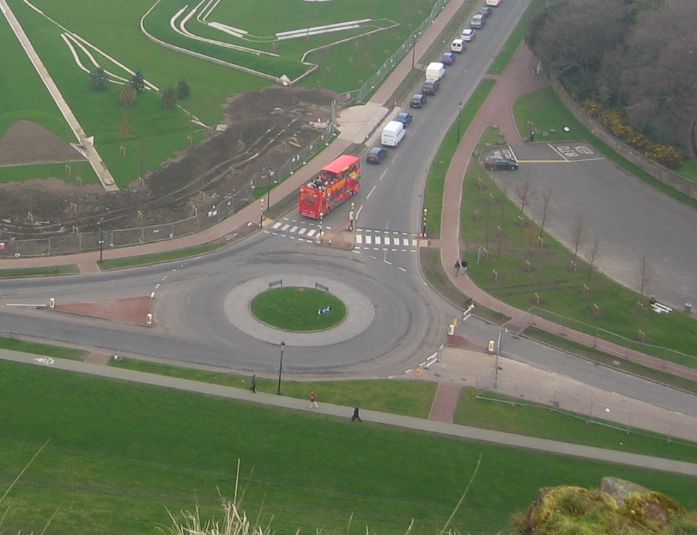
While the city of Edinburgh gears up to reduce speeds to 20 mph, most of the sprawling park, meant to provide leisure opportunities for residents and visitors alike, remains a 30 mph limit with only one pedestrian crossing. The call follows concerns about the growing number of traffic accidents in the park (3).

The ten co-signing charities are calling for Historic Environment Scotland to review visitor access and safety arrangements in the park more generally at a time when Historic Environment Scotland is consulting on its corporate plan (4).

David Spaven, Convener, Living Streets Edinburgh, said:

IMG_7052
Park should be a green space

“Holyrood Park is a unique green space, close to the heart of Edinburgh, but it’s become far too dominated by the speed and noise of vehicle traffic.

“People who want to enjoy this special park quietly and safely face far too many obstacles – speeding traffic, hardly any safe road crossings, and pedestrians and cyclists forced to use narrow ‘shared space’ paths.

“The time is right for Historic Environment Scotland and the Scottish Government to consider transport priorities for the park, with the needs of people on foot put right at the top of the list.”

Ross Macfadyen, Interim Director, RNIB Scotland, said:

“We want Holyrood Park to be a safe place that can be accessed and enjoyed by everybody. At the moment, the high volumes of traffic not only affect the air quality and noise but also people’s perception of how safe the park is.

“This can be very off-putting for many people with sight loss and can result in them not using the park, therefore denying themselves the pleasures of the great outdoors and being fit and healthy.”

John Lauder, National Director, Sustrans Scotland, said:

”While City of Edinburgh Council is rolling out 20mph zones across the city, the iconic Holyrood Park is being left behind. Right now it’s just not living up to its potential as a safe, attractive space for people on foot and bike to enjoy.

“In Scotland we have strong, cross-party support for walking and cycling and a government that has invested record levels in active travel over the past couple of years. Yet, on the door-step of the Parliament, one of Scotland’s most iconic parks is being used a rat-run – to the detriment of its users and those who live in the neighbouring communities.

“We want Holyrood Park to reflect Scotland’s ambition on active travel, by making it a safe attractive space for people making journeys on foot and by bike.”

Brian Sloan, Age Scotland Chief Executive, added his support to the campaign:

“Traditionally urban parks have been viewed as the ‘lungs of the city’ and we fear that given the current situation Edinburgh’s ‘lungs’ are being unnecessarily harmed.

“Holyrood Park could be a wonderful space for people of all ages to engage in an activity, such as walking or cycling, to enhance wellbeing and quality of life.

“Yet, given the current infrastructural prevalence for vehicular traffic this means that many people are put off from venturing into Holyrood Park. We urge the authorities to re-consider this so that Holyrood Park can rightfully be restored as a beneficial place for citizens and visitors alike to enjoy to its full potential.”

Contact

For more information or to arrange interviews, please contact Kathryn Shaw, Media and PR Coordinator: Kathryn.Shaw@livingstreets.org.uk / 020 7377 4914.

Zebra-Crossing
Zebra crossing installed in 2005 removed by end of 2008
This crossing point was removed


Notes to editors:

  1. RNIB Scotland, Guide Dogs Scotland, Age Scotland, Spokes (Lothian Cycle Campaign), Sustrans Scotland, Paths for All, Living Streets Scotland, Transform Scotland and Ramblers Scotland
  2. Living Streets Edinburgh is a local campaign group of Living Streets, the UK charity for everyday walking. We want to create a walking nation, free from congested roads and pollution, reducing the risk of preventable illness and social isolation and making walking the natural choice. We believe that a walking nation means progress for everyone.Our ambition is to get people of all generations to enjoy the benefits that this simple act brings and to ensure all our streets are fit for walking. For more than 85 years we’ve been a beacon for walking. In our early days our campaigning led to the UK’s first zebra crossings and speed limits. Now, our campaigns and local projects deliver real change to overcome barriers to walking and our ground breaking initiatives such as the world’s biggest Walk to School campaign encourage millions of people to walk.
  3. http://www.crashmap.co.uk/Search shows over 50 fatal (1) serious and minor accidents
  4. Historic Scotland Consultation http://www.historic-scotland.gov.uk/index/about/consultations/hesconsult.htm. Historic Environment Scotland’s new Chief Executive David Middleton was in charge of Transport Scotland when it brought out guidance on 20mph limits in urban areas
Holyrood park only has one zebra crossing