Category Archives: Council Policy

Council Transport Delivery ‘Seriously Imbalanced’ Against Pedestrians

The City of Edinburgh Council is paying ‘lip service’ to the importance of walking in its transport policies, while doing  very little in practice to make Edinburgh more walking friendly, says the city’s pedestrian campaign group, Living Streets Edinburgh [1]. The group says it is ‘shocked’ that out of 44 Active Travel projects being developed by the Council in 2017-18, only seven are for walking, compared to 37 for cycling [2]. In a letter to the Transport spokespersons for each political group on the Council, Living Streets says:

‘We have also seen over recent months other evidence of the low priority given to walking in practice, despite the lip service often given to it by the Council. During the recent icy weather, a common sight all across the city was pedestrians walking in the road because un-gritted pavements were too dangerous to walk on. We also see dozens of cycle parking racks being installed on city pavements despite the Council’s commitment in its own business plan to reduce pavement clutter’

 The Group’s Convenor, David Spaven, commented: Continue reading Council Transport Delivery ‘Seriously Imbalanced’ Against Pedestrians →

Picardy Place Decision ‘Embarrassing For Councillors’

The City Council decision to back the controversial Picardy Place gyratory roundabout will be a ‘continuing embarrassment’ to those Councillors who approved the plan, say local walking campaigners. Living Streets Edinburgh [1] criticised the decision of Transport & Environment Councillors from the Conservative, Labour and SNP groups for giving the green light to what the walking campaigners describe as ‘a 1960s’ solution to a 21st century problem’ Living Streets Edinburgh Convenor, David Spaven, commented:

‘Councillors – other than the visionary Greens – have backed a fundamentally flawed plan, which runs completely counter to the Council’s own transport policies. We now face the deplorable prospect that the Council’s design will make the Picardy Place and Leith Street even worse for pedestrians than it is at present. This will surely be a continuing embarrassment to these councillors, unless big changes are made to the detail of the design in the months ahead.

‘We will be pressing strongly for design improvements by Council officers to reduce the negative impact of more circuitous road crossings, narrower pavements and cycling /walking conflicts where new cycleways bisect pavements.’


NOTES FOR EDITORS

[1]  Living Streets Edinburgh Group is the local volunteer arm of the national charity campaigning for ‘everyday’ walking. See: http://www.livingstreetsedinburgh.org.uk/END OF RELEASE

Edinburgh’s Street Design Guidance – key standards for clear pavements

In 2015, the City of Edinburgh Council adopted new Street Design Guidance. This sets out the standards and requirements for how the city’s streets are to be designed, maintained and managed. Fundamental to the Guidance is ‘walkability’ – wider pavements, less street clutter, less dominant traffic. “Everyone who manages, maintains, alters or reconstructs streets, including urban paths, will be expected to comply with the Guidance” (p8).

The Living Streets Edinburgh Group has prepared this briefing paper to help anyone wanting to campaign for a more walkable Edinburgh, by setting out some key requirements contained in the Guidance. For full details, see http://www.edinburgh.gov.uk/info/20089/roads_and_pavements/906/edinburgh_street_design


Pavement widths

The Council classifies all Edinburgh streets: for example as “Retail/High Street”, “High Density Residential”, “Low Density Residential“ etc. It further classifies streets as ‘Strategic’, ‘Secondary’ or ‘Local’.

A minimum, and desirable, width applies for each different type of street. However, no pavement on any street should be less than 2 metres wide. Some key standards are:

Retail/High streets:
“absolute minimum 2.5m (only allowed in short sections), general min 3m, desirable min 4m or wider”

High density residential (Strategic and secondary):
“absolute min. 2m (only allowed in short sections), general minimum 2.5m, desirable min 3m or wider”

All streets:
“absolute minimum of 2m (only allowed in short sections), general min of at least 2.5 m or wider.”


“Clear Walking Zone”

 This is the space on a pavement that must be kept clear of *any* obstructions (lamp posts, A-boards, bins, bus shelters, signage poles, etc):

All streets: 1.5 metres minimum Clear Walking Zone


This document is available as a downloadable PDF here – Living-Streets-Edinburgh-Street-Design-Clear-Pavements


Pedestrian Campaign Gives Cautious Welcome To Council Street Shake-Up Plan

City of Edinburgh Council plans to re-organise street management have been given a cautious welcome by the pedestrian campaigning group, Living Streets Edinburgh [1]. The Council’s Transport & Environment Committee meets on 10 August to consider a report which brands current street management arrangements as ‘unfit for purpose’ and proposes a new streamlined arrangement to look after roads and pavements. David Spaven, the Convenor of Living Streets Edinburgh, commented:


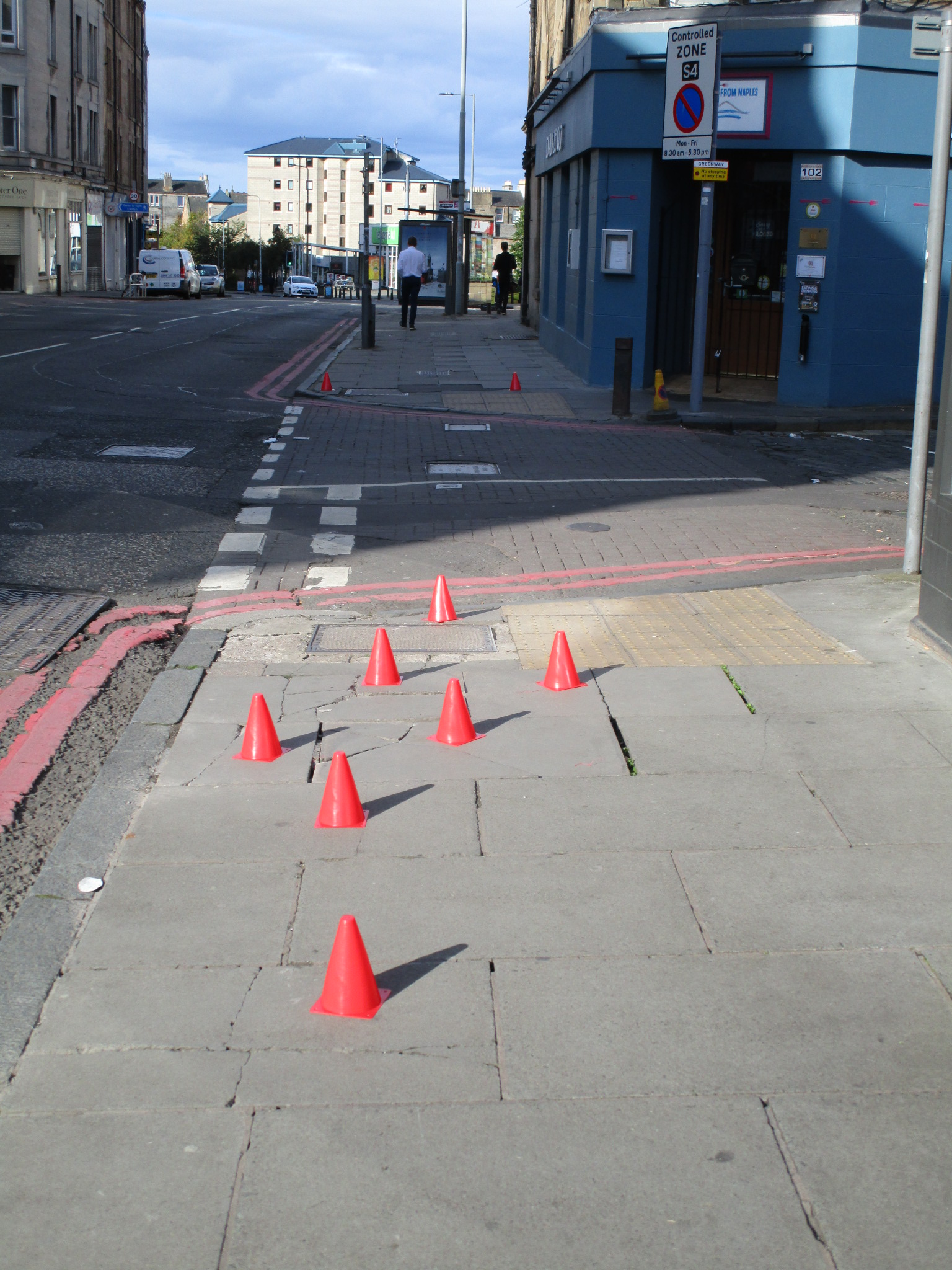
‘We’ve been monitoring the state of Edinburgh’s streets for years, and it’s fair to say that many are currently a shambles, with broken pavements [3] full of all kinds of clutter. In the run-up to the Council elections earlier this year, we called on all the parties to back a big shake-up in street management [2] with joined-up and accountable responsibility for looking after our streets, spotting faults and ensuring that they are fixed quickly. Much better conditions for walking – including wide, well-maintained and clutter-free pavements – are the key to making the city’s public realm much more civilised, and safer.


‘We welcome the Council’s recognition that the inspection and fixing of street faults is currently not working properly and that plans to improve efficiency and co-ordination are being brought forward. However, it’s not yet clear how far this new set-up will help to transform conditions for pedestrians – the new Roads Services Improvement Plan mentions ‘roads’ over 50 times, but ‘pavements’ on just five occasions.’

Photos below by Living Streets Edinburgh illustrate pavement problems across the city:


Party Manifestos Edinburgh: 2017 Council Elections

Our analysis of all the parties’ manifestos for the recent elections (see below) shows that there is much common ground on the need to improve conditions for walking in Edinburgh, as a key means of improving the health, environment, economy of the city.

Edinburgh has inherited – from the vision of politicians and planners hundreds of years ago – a compact pattern of development which still lends itself to walking, but that is not enough for the 21st century. We urge Councillors of all parties to work pro-actively together to deliver the transformation of the car-dominated public realm which Edinburgh residents and visitors deserve.

Labour:

Poor air quality presents a significant challenge to young and old, and broken surfaces on pavements and roads affect us all, whether walking, driving or cycling.

Create a dedicated ‘Budget for Walking’ to be used, for example to install more pedestrian crossings, more drop kerbs and increase the number of paths and pedestrian zones.

Make significant progress towards making our city ‘barrier free’ by improving accessibility to buildings, and making streets and pavements suitable for people with disabilities.


SNP:

 …ensuring Edinburgh remains a walkable city where the needs of pedestrians are central to how our streets are designed.

We will invest £100m over the next five years to fix our roads and pavements.

We will tackle pavement obstructions and further reduce street clutter. We will tackle parking at drop kerbs and parking on pavements as soon as we have the powers to do so and conduct a wide-ranging review on access issues for people with disabilities.

Utility companies continually digging up our roads and pavements can inflict damage to our infrastructure, increase traffic pressure and cause chaos in our communities. We will explore the introduction of a rent charge for utility companies to prevent such disruption.


Green:

 …create safe and attractive routes for cyclists and walkers

Review and set a target to significantly increase the current 58% share of people walking, cycling or using public transport to commute;

Introduce a number of days where public transport, cycling and walking are given priority

Make it easier and more attractive for people to choose walking and cycling

We back more money for well-managed services which improve day to day life: streets free of litter and dog-fouling; bin collections which are on time; and well-maintained pavements, cycle-paths and roads.

Tackle the state of roads and pavements by putting in place a Roads Inquiry and Action Plan with three priorities:

  1. Prevent (reducing large trucks and pavement mounting);
            1. Manage (better co-ordination of utilities’ road works and improving roads team customer service);
  2. Invest (push for the Scottish Government to switch money from high-profile “prestige” projects and towards maintenance and repair).


Conservative:

 Improve the condition of Edinburgh’s roads, paths and pavements for all.

Create an Edinburgh Index, published annually or more frequently, showing an assessment of road, path and pavement conditions…

Increase targeted provision for pedestrians such as safe school zones, pedestrian zones and addressing casualty blackspots.


Liberal Democrat:

 Pavements are in an equally dangerous state [to roads]

We want to make it easier for people to get around our great city, whether by walking, cycling, getting around by public transport and using the car where appropriate. It means ensuring the city is accessible for all, regardless of physical or sensory ability. Liberal Democrats will work with others to ensure the city improves the experience of people who walk in the city.

…will maintain the walking and cycling element of our transport budget at 10% {I pointed out to their transport spokesperson months ago that the 10% is all for cycling!]

…encourage more people to cycle and to do so considerately, especially where space is shared with pedestrians.

…we will focus on repairing potholes in the city and deteriorating pavements.