All posts by Living Streets Edinburgh

Campaigning Group Calls For Delay In ‘Flawed’ New Bus Shelter Programme

CAMPAIGNING GROUP CALLS FOR DELAY IN ‘FLAWED’ NEW BUS SHELTER PROGRAMME 

The City of Edinburgh Council (CEC) should call a halt to its new bus shelter programme [1] while numerous breaches of Council space standards for pedestrians by contractors are investigated, says the walking campaign group, Living Streets Edinburgh [2]. In a letter to CEC Transport Convenor, Cllr Lesley Hinds [3], Living Streets say that “in random sampling in a few areas of the city we have identified a range of locations [4] where the pavement space left for pedestrians does not met the minimum standard in CEC’s Bus-Friendly Design Guide. which states that ‘an unobstructed width of at least 1400mm must be provided along any length of footway adjacent to a shelter’”. The group’s Convenor, David Spaven commented:

“We’ve found some shocking examples where contractors installing new shelters have seriously failed to meet the Council’s own standard that ‘an unobstructed width of at least 1400mm must be provided along any length of footway adjacent to a shelter’. This is highly inconvenient for people on foot and in wheelchairs, and flies in the face of the Council’s claim to be prioritizing the needs of pedestrians. The bus shelter programme is clearly flawed and we’ve called on Cllr Hinds to delay the implementation programme until CEC can be assured that implementation will be such as to (a) meet CEC’s minimum standards and (b) at the very least not make conditions worse for pedestrians at the bus stops.”

MORE INFO:    David Spaven on 0131-447-7764 or 07917-877399

NOTES FOR EDITORS:

 [1] Over 350 ‘advertising bus shelters’ are being provided across the city as part of a 10-year CEC contract with JC Decaux, a major advertising company, see: http://www.jcdecaux.co.uk/edinburgh-live

[2] Living Streets Edinburgh is the local volunteer group of Living Streets the national charity for ‘everyday walking’, see: http://www.livingstreetsedinburgh.org.uk

[3] Letter from Living Streets Edinburgh Group to Cllr Hinds sent 11 October 2015:

‘Cllr Hinds

‘Living Streets Edinburgh is concerned that a number of the new bus shelters now being installed by JC Decaux are failing to meet even the absolute minimum space standards specified for pedestrians in CEC’s Bus-Friendly Design Guide, let alone providing much needed improvements to allow reasonable space for pedestrians. In random sampling in a few areas of the city we have identified a range of locations (see foot of letter) where the pavement space left for pedestrians does not met the minimum standard in the Guide, which states that ‘an unobstructed width of at least 1400mm must be provided along any length of footway adjacent to a shelter’.

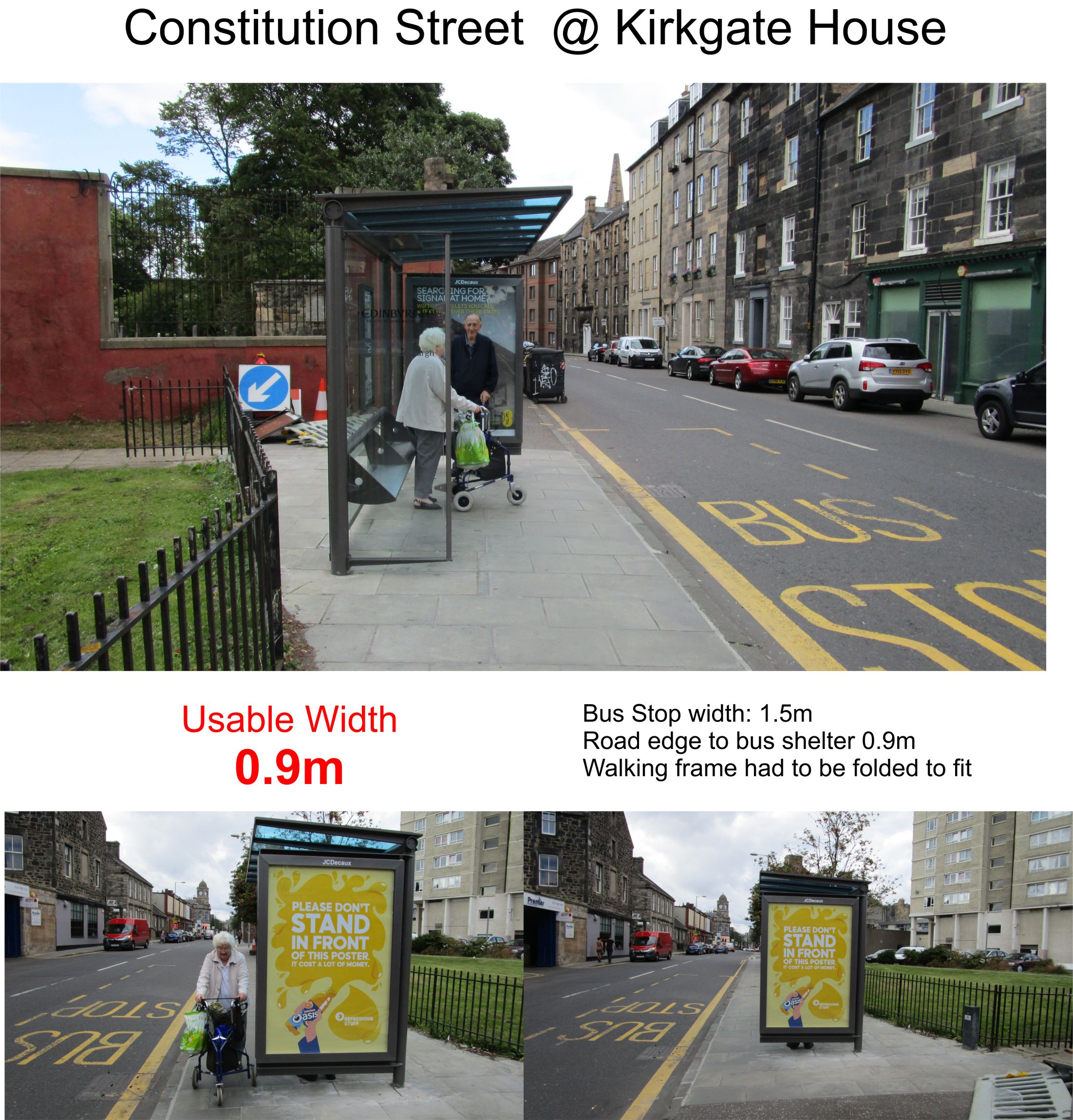
‘We are aware of two instances, at Constitution Street and at Buccleuch Street, where the shelters have apparently been installed in the wrong positions, and where remedial action is being taken, or is planned, after this has come to the attention of CEC staff.

‘But there are other locations where the minimum standards have clearly also been breached, such as Crewe Road North (at Selex) and Lindsay Road (at Annfield), and a number of others where the absolute minimum width requirements are barely met, but where the shelters could readily have been positioned to give more space. Examples of the latter are on Ferry Road (at Wash & Valet,  Morrisons and Pilton Drive). In these instances the shelters could have been positioned at the rear of the pavement where an unnecessary c. 0.5m gap has been left (supposedly for cleaning purposes, despite there being no need for such a gap and none usually being left when installing CEC funded shelters).

‘It would seem that JC Decaux and their contractors cannot be relied upon to have any regard for the needs of pedestrians, or for the Council’s standards, even at the most basic level. In the circumstances we are seeking your intervention to delay the implementation programme for the new shelters until CEC can be assured that implementation will be such as to (a) meet CEC’s minimum standards and (b) at the very least not make conditions worse for pedestrians at the stops.

‘In view of the importance of this issue, we will issuing a media statement, embargoed until 10.00 Tuesday 13th.

‘Kind regards


‘David Spaven

Convenor, Living Streets Edinburgh Group’


[4]

‘Photos of issues noted above:

Still being installed but looks like they will breach standards:

Previous issues that we’ve been informed are being fixed:

END OF NEWS RELEASE


Buccleuch-Street-South-BoundConstitution-Street-Kirkgate-House-Measured  Ferry-Road-at-MorrisonsReoseburn-Terrace-Water-Of-Leith  Ferry-Road-At-Wash-n-valetLyndsay-Road-at-Citadel-Tisos

Living Streets Edinburgh response on Draft Parking Action Plan

The Living Streets Edinburgh response on Draft Parking Action Plan can be found here – Response on Draft Parking Action Plan

The main points include

  • Generally this plan is very welcome – an excellent initiative
  • Take space from on-street parking and give it to people on foot
  • Ensure that Council’s Equality Act duties are included in plan’s actions
  • Proposed actions on footway parking are insufficient
  • Don’t let more parking controls mean more street clutter
  • Increase the public acceptability of the plan
  • Evidence on use and demand should support the Action Plan

Welcome to Living Streets Edinburgh

Edinburgh, with its generally dense population and walkable distances, could be a European exemplar of a pedestrian-friendly city. But the many sensible walking-related policies of the City of Edinburgh Council too often don’t translate in practice into a safe and attractive walking environment on the streets. Motor traffic continues to dominate the vast majority of the city’s streets – yet there are clear economic, environmental and social benefits in prioritising pedestrian movement within a high-quality public realm.

Our overall aim is to:

Promote walking (including ‘wheeling’) as a safe, enjoyable, accessible and healthy way of getting around Edinburgh.

To this end, we want to see:

  • walking given the top priority over other forms of travel in all council transport and planning policies;
  • a reduction in the volume of motorised traffic and its impact on people using the street;
  • better designed and maintained pavements, road crossings and other pedestrian facilities;
  • more effective and joined-up monitoring and inspection of the walking environment by CEC;
  • planning policy which encourages dense, sustainable housing over car-dominated, dispersed development;
  • more effective implementation of pro-walking policies ‘on the ground’.

Our priorities for action in 2026 are to:

  • Campaign for increased budgets (capital and staffing) for the
    pedestrian environment by the City of Edinburgh Council, especially
    to:
    • widen footways;
    • tackle pavement clutter;
    • improve priority for pedestrians at signalled crossings;
    • improve accessibility by installing dropped kerbs and continuous
      footways.
  • Secure better enforcement of controls on parking (including new
    ‘pavement parking’ provisions) and speeding.
  • Support specific local campaigns for place-making and traffic
    reduction.
  • Develop our work on walk-friendly environments at and around
    schools.
  • Influence planning policy and practice to aid walking and wheeling
    and reduce motor traffic.
  • Influence Holyrood 2026 to support our four election asks (engine idling, zebra crossings, roadworks and speed cameras: https://bit.ly/4o5nTVd )
  • Grow the number of our supporters and range of our campaigns.

If you would like to get involved in our work in any way, please email us at:
 edinburghgroup@livingstreets.org.uk


Edinburgh Tram Inquiry Call for Evidence – Response of Living Streets Scotland

The Living Streets Scotland official response to the Edinburgh tram enquiry can be found here – Edinburgh Tram Inquiry Call for Evidence – Response of Living Streets Scotland

The main points of the response:-

  •  Poor crossing facilities, using out-dated concepts such as barrier islands with inadequate space for volume of pedestrians (example York Place)
  • Unnecessary controlled crossings, not justified by the volume of traffic – which needlessly hinder pedestrian movement (example St Andrews Square)
  • Significant impacts on existing signalised crossings, causing extensive delays for pedestrians and dangerous crowding at junctions. This has led to risky crossing behaviour due to frustration (example Princes Street)
  • Conflicts with cyclists through poorly designed shared space (St. Andrews Square, / North St. Andrews Street)
  • Poor routes and integration between the tram route stops and major destinations and interchanges, creating indirect and diversionary routes to major facilities (Examples include: Gyle Shopping Centre / Edinburgh College / Bankhead Stop and Waverley railway station / St. Andrews Square)
  • Generally, worse conditions for walkers and cyclists in terms of safety, convenience and comfort (example Haymarket)


Local Pedestrian Campaign Group to Launch in Edinburgh

Living Streets’ Edinburgh supporters group is being relaunched at a joint event with the Cockburn Association “Edinburgh – fit for walking?” on 1 June 2015 at the Friends Meeting House, Victoria Street, Edinburgh. Doors open 17.45 for 18.00pm start

Edinburgh is great city to walk in but motor traffic continues to dominate the vast majority of the capital’s streets. Sadly pedestrians have languished at the bottom of transport priorities for far too long.

Attitudes in the council are changing and Living Streets’ Edinburgh local group is being formally launched to make the case for the enormous economic, environmental and social benefits of prioritising walking within a high-quality public realm.

The public are being encouraged to come along to hear about what Living Streets stands for, how walking fits into a civilised public realm, and the group’s plans for an exciting late summer campaign of street audits.

The event will be an opportunity walkers to get involved with efforts aimed at getting the City of Edinburgh Council to transform its many sensible walking-related policies into practical improvements on our streets. Confirmed speakers:
1.Standing Up for Walkers, David Spaven, Convener of the Living Streets Edinburgh Group
2.A Better Public Realm, Marion Williams, Director of the Cockburn Association (Edinburgh’s Civic Trust)
3.Auditing Edinburgh’s Streets, Stuart Hay, Director of Living Streets Scotland

The event will conclude with questions and answers and a chance to decide on which city centres streets are most in need of a make over.
– See more at: http://www.livingstreets.org.uk/edinburgh-fit-for-walking#sthash.dxlB5F4N.dpuf