All posts by Living Streets Edinburgh

Slower Speeds, Safer Streets for Edinburgh: An Action Plan

Action Points for the City of Edinburgh Council

1  CEC  should set a ‘Vision Zero’ target of no deaths or serious injuries on its roads, within its new Road Safety Plan, with a target of 2030 for realising that vision.  (A more ambitious target than the national one is realistic in Edinburgh, where speeds are lower and road  safety problems are less diverse.)  

2   Excessive speeding is the principal source of the collisions that result in casualties. Realising this vision will require stronger and more comprehensive actions to reduce speeds on the city’s roads. Stronger measures both to enforce speed limits, and to redesign streets are essential. 

3   Maximum use should be made of both fixed and mobile speed cameras, and red light cameras for enforcement.  Suitable technology should be employed to ensure that the breaking of all speed limits (from 20 to 70 mph) can be enforced. Successful schemes on main roads using average speed cameras, such as that on Dalkeith Rd, should be rolled out across the city. But camera deployments must also be targeted by evidence of highly excessive speeds, not just by whether these have yet resulted in collisions.

4  Enforcement of 20mph limits across the city is never likely to be a priority for the police however, and CEC initiative and support will be essential. Involvement of the public and community groups, through initiatives such as ‘Speedwatch’, is vital for the identification of speeding problems and targeting of enforcement efforts on residential streets. 

5  With the necessary legal powers, the council could readily undertake enforcement actions, alongside and co-ordinated with the police, under a system analogous to that for parking offences. Lesser speeding offences should be subject to fines issued by council wardens, with evidence of more serious abuses passed on for action by the police. CEC should seek the necessary devolved powers for such an enforcement system, with the fines set to fully fund the costs of enforcement. 

6   A renewed emphasis on street redesign is needed, with the full range of traffic calming measures flexibly used wherever required. More use of soft measures such as speed indicator signs can be helpful, but they are no substitute for the hard engineering measures such as humps, cushions, and speed tables that effectively curb speeds. A single road hump on the approach to a sharp bend for example can eliminate a serious risk. Perceptions of safety are also very important for pedestrians and are an additional benefit on traffic calmed streets.

7   Raised crossings should become the norm on residential streets with 20mph limits. There should be a presumption that all new crossings, whether formal or informal, should be raised, with appropriate tactile paving, making them safer and easier to use for pedestrians.  Especially where located at the approaches to junctions the slower speeds would have additional traffic calming benefits. 

8   The current CEC safety review of major junctions is very welcome and needs to be made comprehensive. There are also still a multitude of more minor junctions with dangerous wide splay entrances that need to be redesigned. A new targeted review and investment programme is needed to systematically improve them, with tighter radii, build outs and raised entrances, as appropriate.

9   School safety plans are needed that provide for safer routes and for the safer school entrance areas that are needed at many of the city’s schools. Wider pavements should be provided that allow for the concentration of pedestrian activity these areas inevitably attract, with reduced parking and less use of guardrail.  

10   Many pavements in the city are sub-standard, and often far too narrow.  A comprehensive review and investment programme is needed to widen pavements and meet minimum design standards wherever possible. Where narrower carriageway widths result this will often also help to slow traffic speeds.

Action Points for the Scottish Government

1   ‘Vision Zero’ has strong public support, but to be realistic it requires more resources to support camera enforcement of speed limits at national and local level. Fines should be set at increased levels to ensure that finance will be available to support sufficiently comprehensive enforcement efforts, independent of the more general state of public finances.

2    Fines and license penalties should be graduated by the degree of excessive speeding involved and should be applicable to employers as well as individual drivers, where there is evidence of repeat offending.

3   Powers should be devolved to local authorities to allow them to undertake proportionate enforcement actions through wardens and levy fines for offences including speeding, red light jumping, pavement cycling and illegal use of e-scooters in co-ordination with the police. This will be vital for effective enforcement efforts where 20 mph limits apply across residential areas, with police resources and priorities necessarily being stretched.  

4   National driver and employer education campaigns should be undertaken on the consequences of speeding, aimed at making speeding as socially unacceptable as driving with excess alcohol has become.

5   More advice and resources should be made available to local authorities to support the creation of safer streets through redesign and traffic calming. There is still a massive design deficit in terms of safety, but local authority road safety budgets and teams have been severely cut over recent years. Without strong and prioritised central government support, ‘vision zero’ will remain a mirage on many local authority streets. 

Living Streets Edinburgh Group

November 2021

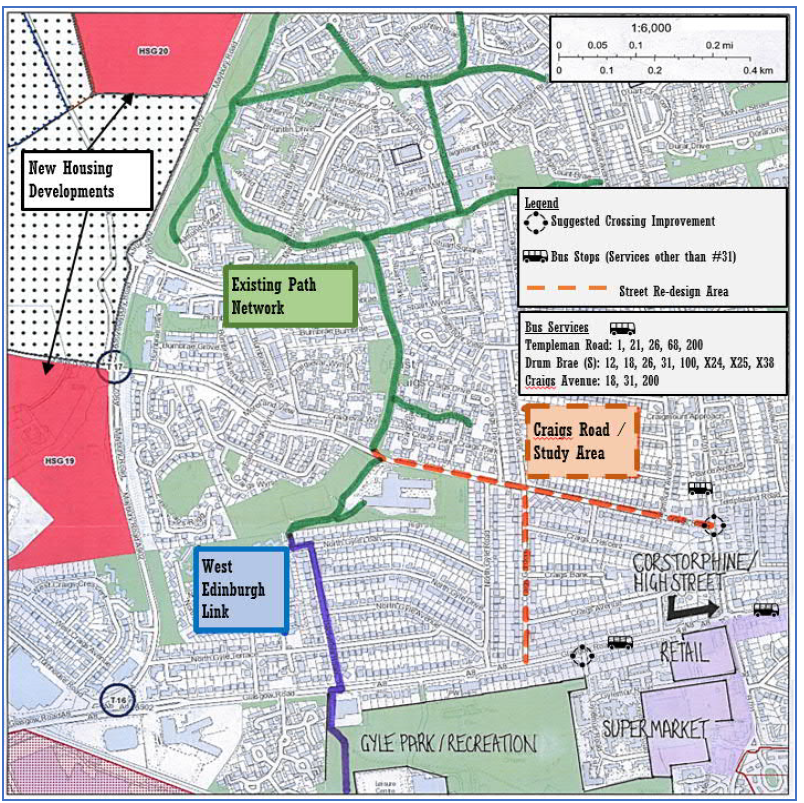
East Craigs Better Choices

East Craigs Better Choices” is our new report, prepared by LSEG supporter, transportation professional and local resident John Kennedy.

It presents a vision of how East Craigs can be made a better place to live, building on community views expressed over the past two years.

If you would like to get involved in the East Craigs project, please email us!

Slower Speeds, Safer Streets summit, October 2021

Living Streets Edinburgh Group held an online summit on ‘Slower Speeds, Safer Streets’ on 23 October 2021. Chaired by, and the brainchild of Mark Lazarowicz, former MP and Edinburgh Transport Convener, the event aimed to put the spotlight on how we can make traffic slower and streets safer, especially for pedestrians and cyclists. Some 60 people participated in lively discussion, hearing from Cllr Lesley Macinnes (Transport and Environment Convener of City of Edinburgh Council), Steven Feeney, (Head of the Scottish Safety Camera Programme, Transport Scotland), traffic expert Professor John Whitelegg and Action Zero campaigner Jeremy Leach.

Among highlights of these talks were Cllr Macinnes describing the administration’s ambitious £118 million Active Travel Programme over the next five years, while Steven Feeney described how the Safety Camera partnership works. Professor Whitelegg pointed to much more radical approaches in Sweden and Germany, which reduced road casualties and appeared to have high levels of community support and involvement.  Jeremy Leach described a lot of the detailed work to reduce traffic and traffic speeds in London, much led by Living Streets activity there.

The event also allowed representatives of political parties to comment on their approach to making streets safer. In addition to Cllr Macinnes (representing the SNP) the panel was joined by Cllr Scott Arthur (Labour), Cllr Chas Booth (Scottish Green Party) and Christine Jardine, MP for West Edinburgh (Scottish Liberal Democrats). The Scottish Conservative and Unionist Party weren’t able to be represented.

Several themes attracted widespread support among participants including:

Street Design: It is not enough to set speed limits, the engineering of the road (for example, to introduce narrow traffic lanes and ‘tight’ corners at side roads) needs to be changed to ensure driver compliance.

Enforcement: there is a widespread perception that 20 mph limits, while welcome, are widely broken; the traffic camera regime especially faced criticism for the number of ‘bagged’ cameras and inability of fixed cameras to be used in 20mph zones.  There was a lot of scepticism that the national Scottish approach to deciding when and where to locate cameras (based on average speeds) was appropriate as this can mean tolerating significant levels of speeding traffic.

Budgets: The meeting was told that across Scotland, the Safety Camera Partnership had an annual budget across Scotland of £5 million; a proportion which was widely felt to be out of kilter with Transport Scotland’s overall £2.5 billion budget. Locally, residents report being told that road changes can’t be made because of council budget constraints.

Community Speedwatch: there was significant interest in – and support for – communities being involved in measuring and enforcing speed limits; in promoting awareness (eg through stickers on wheely bins) and in being involved in decisions on where to deploy speed cameras.

Cycle infrastructure: there was significant support for providing segregated cycle infrastructure as part of safer street environments.

Technology: there were a number of interesting ideas about the use of new technology to achieve safer streets, for example, the potential for more use of Intelligent Speed Assistance (ISA) to control and limit the speed of council vehicles, buses and taxis; or to deter ‘rat running’ behaviour (eg to avoid speed camera or through satnavs).

The meeting concluded with lots of positive feedback from participants and speakers alike, and thanks were expressed to Living Streets Edinburgh Group for organising the event. LSEG is preparing an ‘Action Plan’ to reduce speeding and traffic danger and this event will help to inform it. Hopefully, it will also influence the City of Edinburgh Council’s next statutory Road Safety Plan, the last one (2010-20) having expired. Of course,  time will tell how these aspirations, ideas and plans will translate into action to make streets safe from traffic danger.

You can view the presentations here

Deterring speeding – enforcement and compliance; Empowering individuals and community groups with data

Slower speeds…safer streets

Safety Camera Presentation – Current programme and future plans in Scotland

Message to City of Edinburgh Council Planning Convener and Chief Officer on planning policy

As you know Living Streets Edinburgh Group has longstanding concerns regarding the priority given to walking in the planning process and the provision that is made for walking both in planning policy and in consideration of individual development proposals.

Walking is at the top of the movement hierarchy in Scottish Planning Policy and the National Transport Strategy; in 2020 the Council stated that ‘pedestrians are at the top of the urban transport hierarchy.’  Indeed, the Highway Code has also recently been revised to reflect this position.

CityPlan2030 offers an opportunity to review the position in terms of policy and allocations, but this will mean little in practice without a change in mindset across the authority and amongst developers.  COVID-19, COP 26 and the ongoing energy crisis add weight to the case for providing for walking at a level commensurate with its place at the top of the hierarchy.

We will obviously be reflecting this when we respond to the forthcoming consultation on the draft CityPlan2030.  In the meantime, we consider that there are steps the Council can take immediately to demonstrate its commitment to its own stated policy position.

When assessing planning applications under current policy there is already considerable scope with reference to documents such as Designing Streets and the Council’s own parking standards to secure, for example, car free developments and layouts focused on pedestrians. Whilst the situation is slowly improving, there is much more that can be done, particularly if it is made clear in pre-application discussions and is then in turn reflected in decisions on applications.

On a more practical note, we are all aware of the limitations of existing pedestrian infrastructure and the pressures put on it, directly and cumulatively, as a result of new development.  This can be directly by generating increased pedestrian movements or indirectly from additional vehicle movements which in turn require safer footways, crossings etc for walkers.  The Council has limited resources and maintenance/upgrading of pedestrian infrastructure is not a priority, even in the active travel budget.

The Council has Supplementary Guidance on Developer Contributions which currently provides for contributions for road improvements, but hardly at all for pedestrians other than as part of active travel projects.  This does not reflect the hierarchy in Scottish Planning Policy or the Council’s own position, so it will need to be updated in tandem with CityPlan2030.  

Circular 3/2012 (as amended) gives guidance on developer contributions for, inter alia, community benefits/infrastructure which can presumably include improvements to pedestrian infrastructure so long as the relevant tests are met.  This can provide a basis for the Council to develop a structured approach to assessing the requirement for contributions towards pedestrian infrastructure from development proposals. Depending on the type and scale of development this can be a specific contribution for an identified project directly related to the development.  In other cases it could be a proportionate financial contribution towards an area based programme justified by cumulative impact of developments.

Contributions for off site pedestrian infrastructure could form part of a Section 75 Planning Obligation along with any other contributions; or an upfront contribution (agreed with the developer) following determination, but before the issue of a decision; or perhaps under other legislation such as the Roads (Scotland) Act 1984.  It should be possible for the Council to put together area based programmes setting out actions required by different levels of additional development, identify the costs and set out thresholds for contributions.  Once collected they could be ring fenced until sufficient funding is available and then spent within an agreed timescale or else returned.

Living Streets Edinburgh Group is happy to discuss any or all of this further and work with the Council on detailed area programmes as well as advise on improvements that would benefit everyday walking. In the meantime we look forward to your thoughts on our suggestions.

Low Emissions Zone – LSE Response

Living Streets Edinburgh Group (LSEG) welcomes the Council’s plans to move forward with introducing a Low Emissions Zone (LEZ) in Edinburgh but we are concerned that the current proposals are not sufficiently ambitious and will have a serious detrimental impact for some residents, particularly those that live outside the boundaries of the currently proposed City Centre LEZ. We strongly believe that the boundaries of the LEZ should be increased in order to benefit a larger proportion of the residents of Edinburgh.

The area of the proposed LEZ currently covers only 2.5% of the City and excludes many areas of the City with the greatest density of residents. It will also not include the designated Town Centres, which form such an important element in the development of 20-minute neighbourhoods outlined in the recently approved City Mobility Plan. In setting the boundaries of the LEZ, more consideration has been given to providing convenient diversionary routes for non-compliant vehicles than maximising the health benefits for people living in Edinburgh. Pollution levels have been considered on an absolute basis without any consideration of the number of people that will be exposed to that pollution. LSEG is particularly concerned that there is no recognition of the risks to pedestrians from vehicular emissions in areas outside of the proposed LEZ; some of which have very high levels of walking including children walking to school.

The Council report that was considered by the Transport and Environment Committee at their June 2021 meeting states non-compliant vehicles will increasingly use the roads immediately outside the LEZ resulting in increased pollution on these routes. The SEPA forecast attached to the report shows an increase in atmospheric pollution on Queen Street, London Street and Abbeyhill; all areas on the edge of the currently proposed LEZ. We note that the Council has included an objective to “minimise the impact from traffic displacement across network, related to LEZ scheme”. No detail is provided on the mitigating actions that will be taken or how achievement of this objective will be measured. Before any final decision is taken on introducing a LEZ it is critical that there are clear plans in place to limit the negative impact of displaced traffic to reassure residents living near the LEZ.

The current plans are focussed on reducing levels NOx pollution from vehicles within a small part of the City to meet current legislative limits. In our view, this goal does not go far enough. Other forms and sources of pollution need to be both more closely monitored and reduced, in particular the levels of particulate pollution and continued use of temporary diesel generators within the LEZ. We would like to see the Council setting more ambitious and wide ranging targets for reducing pollution given the accepted health benefits of such a reduction. This is the time for bold action that supports the Councils plans to encourage walking, wheeling and cycling across the City.

Despite the title of a ‘low emission zone’, the proposals do not address the need to reduce carbon dioxide emissions. Plans that only address pollution are essentially backward looking, whereas we should be looking forward to a future where fossil-fuel vehicles are completely eliminated and levels of all motor traffic are reduced.

Finally, while we recognise that the plan includes proposals to encourage compliance with the new restrictions for vehicles entering the LEZ, it is critical that enforcement is rigorously applied. There have been too many Council transport-related initiatives (e.g. 20mph speed limits, parking and loading restrictions, prohibition of idling stationary vehicles) that have foundered due to lack of effective enforcement. In the case of idling vehicles, it would be clearly wrong to turn a blind eye to such behaviour while at the same time introducing the significant controls required by the LEZ.

Finally, we note that the enforcement regime will be based on the use of automatic number plate recognition (ANPR) cameras. From our review of Appendix 7 of the report presented to the 17 June 2021 Transport and Environment Committee meeting, we note that the recommended approach is to install these cameras on only 16 routes of the identified 48 entry points to the City centre LEZ. One mobile unit will cover the other 32 entry routes. Given that the LEZ is intended to operate 24/7, we are concerned that this approach will affect the levels of compliance required for the LEZ to achieve the intended reduction in atmospheric pollution and health benefits for those living and working within the City centre. We are further concerned that this approach will encourage the drivers of non-compliant vehicles to use the non-arterial routes to avoid detection thus increasing traffic further in the many residential streets bounding the proposed LEZ. We believe that to achieve the required compliance for the success of the LEZ, it is critical that enforcement is rigorously applied. There have been too many Council transport-related initiatives (e.g. 20mph speed limits, parking and loading restrictions, prohibition of idling stationary vehicles) that have foundered due to lack of effective enforcement. We do not believe that the currently proposed arrangements are adequate.