Introduction
Living Streets Edinburgh Group would like to supplement our objection to the TRO with
the following brief comments. The key issue is the failure of the Council to give adequate
priority to the needs of pedestrians, in conflict with both national and local (Council)
policy.
These comments assume that the strategic case for the scheme is essentially sound, with
regard to, for example the viability of bus routes, traffic management etc. given that we
do not have information which either confirms or counters the assumptions.
We are particularly concerned at the failure to improve pavements on the Mound and
Hanover Street. In addition we understand that a significant section of high-footfall
pavement would be removed on the south of George IV Bridge adjacent to the National
Museums of Scotland. Finally, we object to the inappropriate use of ‘floating’ bus stops.
Policy
The Council’s Statement of Case is extremely selective and biased with regard to citing
both national and local policy. While the National Transport Strategy, NPF4 etc. are cited
widely in support of cycling provision, there is (astonishingly) no mention of the universally
agreed ‘sustainable travel hierarchy’ which places walking and wheeling at the top. There
are 36 references to “walking” in the Statement, with 68 for “cycling”.
In contrast, little policy is quoted in support of walking and especially the need for
accessible pedestrian environments such as for example, the introduction to the Council’s
Active Travel Implementation Plan: “We want to work towards a transformational change
in walking and wheeling in Edinburgh. Our vision is a fully accessible city, where people of
all ages and abilities can get around safely, conveniently and comfortably.”
The numerous references to policy highlighting the importance of “active travel” or
“cycling, walking and wheeling” do not adequately recognise the different and at times
conflicting, infrastructure requirement of cycling on the one hand, and walking the other.
While there are a number of references to the ‘desirable’ widths (according to guidance)
of cycleways – 2.5-3.00 metres) there are none to the desirable width of footways (3.00m).
The Mound
The inadequate consideration of walking is clearest with regard to the Mound, where the
Council proposes no general footway widening despite acknowledging that it forms part
of the “primary network for place…and for walking” (2.16). Pavements are so crowded at
times that pedestrians are frequently found to be walking in the road.
Meadows to George St.
Despite claiming that the footways meet an opaque ‘pedestrian comfort’ test, the current
Chief Executive of the Council reported in 2020 “pavements being often over-capacity
and people having to stray onto the road”.1 Under the present plans this will continue,
both in the road on the western pavement, and in the cycleway to the east –
disadvantaging all road users.
As noted above, the desirable minimum width for the Mound footways is 3.00 metres
according to the ESDG, but in places they would remain less than 2 metres wide (a
minimum standard not only for Edinburgh but also national Inclusive Mobility guidance.
The Council’s statement in paragraph 8.5 that “it has not been possible to provide
additional footway widening on the eastern footway alongside the proposed cycleway” is
patently untrue: footways could be widened if the Council was willing to compromise on its
preferred design for the cycleway. One obvious example would be to limit the cycleway to
2.5m (still meeting “desired” standards for high volume cycleways) instead of 3.00m.
Similar concerns apply to Hanover Street, where some of the city’s busiest pavements will
be criss-crossed by cycleways with floating bus stops. While we consider George IV
Bridge to be less problematic, we strongly object to the removal of a section of very busy
pavement adjacent to the National Museums of Scotland.
Floating Bus Stops
We strongly object to the inclusion of bus stop bypasses on the hilly Mound and Hanover
Street. They would build in conflict between pedestrians and cyclists and will deter
disabled people from using some of the busiest city centre bus stops. They are unlikely to
work well for cyclists either.
The Statement of Case is especially selective in citing standards and guidance in support
of the bus stop bypasses, such as ‘Cycling by Design’. However, it omits crucial
qualifications such as: “Bus stop bypasses on steep downhill gradients should be avoided,
as cycle users are likely to approach these at higher speeds, creating interactions that are
more difficult to manage.” (CbD p97).
The Statement refers extensively but again selectively to a report by Living Streets UK in
support of cycle bypasses, but omits this important section: “we recommend that those
promoting or providing bus stop bypasses should more clearly acknowledge that
continuing a cycle track at a bus stop is likely to introduce some disadvantage to blind and
partially sighted pedestrians, even if well-designed, and even if the design enhancements
described in this report are proven effective. The risks of disadvantage to a wider group of
pedestrians and other disabled people should also be acknowledged for complex
environments where cycle tracks are busy, if cycling speeds in the location are higher, and
in any case where cycling levels are very high.” (P126) 2
Meadows to George St.
The Statement ignores much other authoritative guidance such as “Creating a public realm
for all’ (CIHT 2024) and ‘Designing for Inclusion’ (UCL, 2024) which 3 4 all emphasise the
problems caused by floating bus stops for pedestrians, especially blind and disabled.
We therefore do not consider that the Statement is balanced or objective with regard to
bus stop infrastructure, or indeed consistent with the Council’s commitment to accessible
public spaces as noted at the start of this document.
Alternative options
We recognise that the connection of cycle facilities from Middle Meadow Walk to the city
centre is a legitimate and important objective; however, it must be balanced against other
priorities.
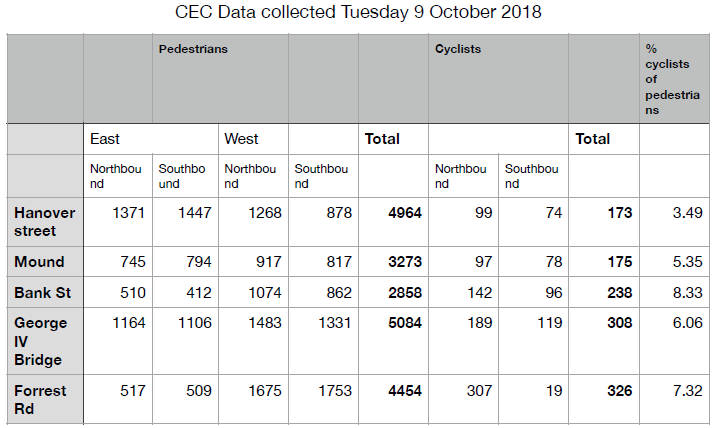
Monitoring of movement carried out by the Council 8 years ago showed starkly how many
more pedestrians used the streets compared to cyclists (see appended table). This
fundamental fact is given insufficient weight in the plans.
The data also appears to show that fewer than half the northbound cyclists using Forrest
Road went on to continue along the route though Bank Street, the Mound etc. Many
presumably dispersed along Chambers Street, Candlemaker Row, the High Street etc, or
their destination was on George IV Bridge itself. This suggests that the rationale of
assuming that Meadows to George Street is a primary route may not be justified.
We therefore suggest some alternative options to meet the need for improved cycling
facilities which would not result in unacceptable compromises to walking and wheeling:
1) no cycleway on the Mound, recognising that the cycling environment will be much
enhanced compared to the present owing to the greatly reduced volume of traffic
resulting from the bus gate, along with the 20mph speed limit. We are sceptical that
many northbound (downhill) cyclists would in any case use the segregated cycleway in
preference to the carriageway.
2) a narrower cycleway on the Mound; a 2.5 metre wide cycleway still meets minimum
standards, but would allow footways to be widened by 0.5m.
3) a one-way cycleway on the Mound (southbound) – consistent with cycle design
standards which emphasise the greater importance of segregation on uphill routes.
4) end the George IV Bridge cycleway at the Royal Mile and provide alternative signed
low-traffic routes to the east (via the High Street, Cockburn St, Bridges etc) and west
(via Victoria Street, Lawnmarket/Johnston Terrace, etc).
We are not advocating any of these alternatives, but they illustrate the need for fresh
thinking rather than pursuing a design which was conceived a decade ago, which predates
much current policy and standards and which fails to meet the needs of pedestrians.
Living Streets Edinburgh Group
May 2026
1 Report by Paul Lawrence to CEC Leadership Advisory panel, 31 March 2020, para 3.5 (available
on request)
2 https://www.livingstreets.org.uk/press-media/research-into-bus-stop-bypasses-released/
4 https://www.guidedogs.org.uk/how-you-can-help/campaigning/our-current-campaigns/streetsahead/